
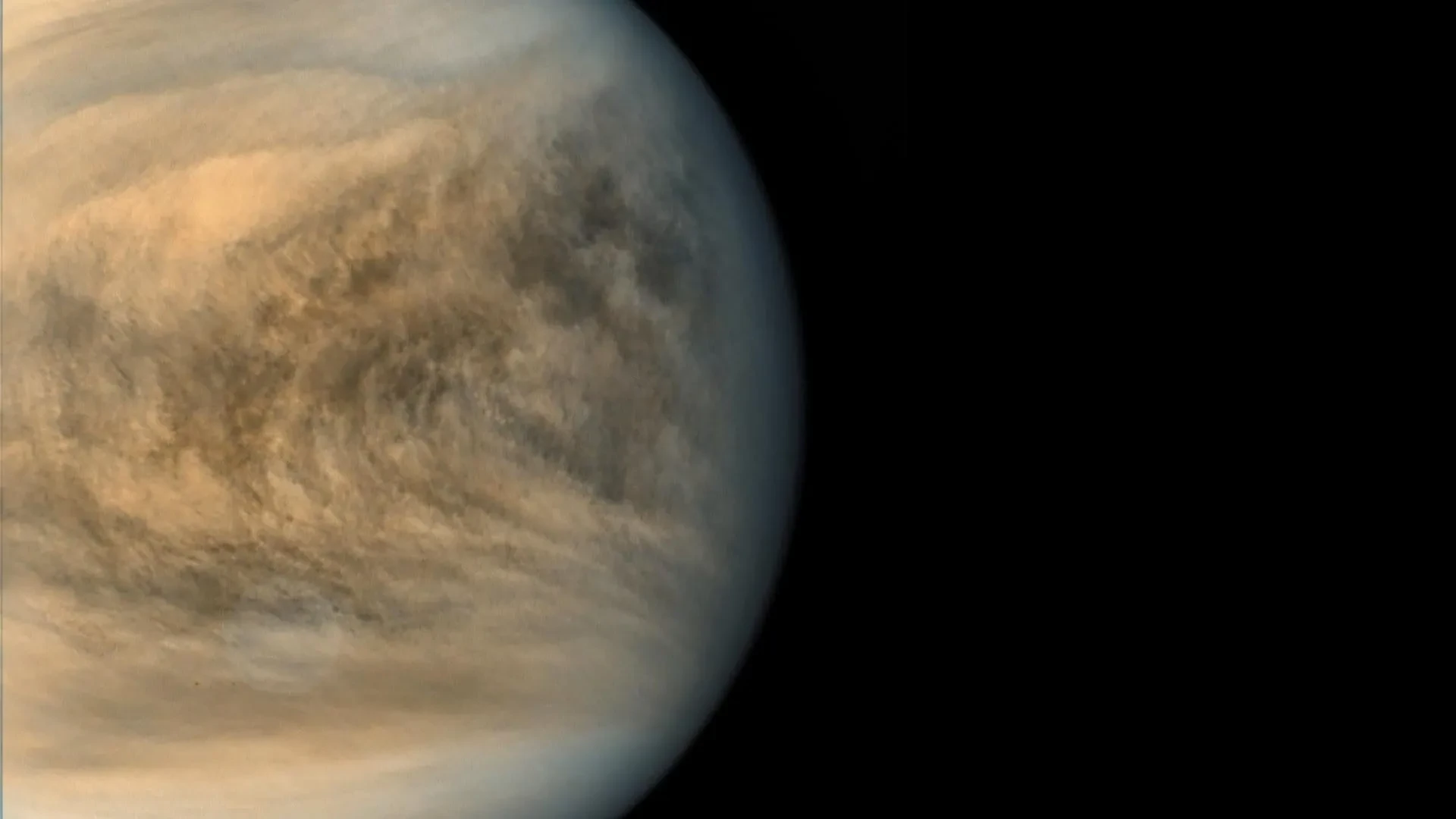
To the naked human eye or through standard visible-light imaging, Venus appears as a remarkably pale, smooth, and largely uniform yellow world, shrouded entirely in a thick, impenetrable veil of clouds. Yet, the moment scientists shift their perspective to ultraviolet wavelengths, that tranquil pale facade vanishes completely. In ultraviolet light, the planet transforms into a dynamic, highly textured canvas where dramatic dark and bright features, streaks, and swirls sweep relentlessly across its upper sulfuric acid cloud deck.
For approximately a century, astronomers and planetary scientists have tracked these complex patterns, attempting to decode the underlying mechanisms driving them. Despite decades of observation, however, the specific substance responsible for producing these distinct absorption features—widely referred to in the planetary science community as the "unknown absorber"—has resolutely eluded positive identification.
Now, an international team of researchers has broken new ground by establishing rigorous numerical limits on what this mysterious material must actually look like and how it must behave physically. By combining high-resolution observations of Venus with sophisticated radiative-transfer modeling, the scientific team successfully estimated the exact degree to which the liquid inside the planet’s cloud droplets would need to absorb ultraviolet and blue light in order to replicate the exact phenomena routinely captured by passing spacecraft and Earth-based telescopes.
Reimagining Venus’s Clouds in the Lab
The groundbreaking study, which was recently published in the scientific journal Astrobiology, approached this enduring planetary mystery from an unconventional and highly creative angle. The lead author of the study, Dr. Jan Spacek, posed a fundamental question regarding how Venus’s cloud material would appear if the microscopic droplets could somehow be physically gathered together into a spectrometric cuvette and analyzed collectively as a bulk liquid.
This conceptual distinction is far from trivial, as a dispersed planetary cloud can exhibit optical properties that differ drastically from the concentrated material that physically constitutes its individual particles. A familiar, terrestrial analog to this optical phenomenon is ordinary cigarette smoke. Smoke typically appears white or gray to an observer because its sub-micrometer particles scatter incoming light with extreme efficiency. However, if those exact same microscopic smoke particles are captured and consolidated inside a closed flask, they do not remain a white haze; instead, they condense into a dense, viscous suspension of burned tobacco—a dark, tar-like sludge.
The upper clouds of Venus may operate under a remarkably similar optical principle, largely because their internal particle size distribution bears a striking resemblance to that of cigarette smoke. Consequently, an atmospheric cloud layer that appears a subtle pale yellow when viewed from millions of miles away could very well contain liquid droplets that look surprisingly dark, dense, and concentrated when examined in bulk.
"Our model effectively asks what would happen if we could collect that cloud material into a cuvette and put it into a laboratory spectrometer," explained lead author Jan Spacek, representing the Foundation for Applied Molecular Evolution in the United States. "This is important, as light absorption in a bulk liquid may be correlated with the concentration of light-absorbing material in the solution."
Measuring How Strongly the Mystery Material Absorbs Light
To bridge the vast gap between distant astronomical observations and tangible laboratory chemistry, the research team synthesized empirical data of Venus with a complex radiative-transfer model. This computational model meticulously tracks the intricate ways in which sunlight is repeatedly scattered, reflected, and absorbed by both suspended cloud droplets and background atmospheric molecules.
By running these simulations, the researchers successfully converted abstract astronomical measurements into a concrete metric regularly utilized in standard laboratory ultraviolet-visible spectroscopy: the absorption coefficient of the liquid comprising Venus’s cloud droplets.
"The key is that Venus’s cloud particles scatter sunlight very efficiently, so the brightness observed from space cannot be directly compared with the absorption of a bulk liquid measured in the laboratory," noted Dr. Yeon Joo Lee of the Planetary Atmospheres Group within the Institute for Basic Science in South Korea, who performed the intensive radiative-transfer model calculations for the study. "By accounting for the scattering and absorption by the cloud particles and atmosphere, the model allows us to estimate how strongly the liquid of cloud droplets itself must absorb light."
Across the specific modeled wavelength range spanning from 365 to 455 nanometers, the required decadic absorption coefficient reaches an impressive threshold of approximately 1,278 inverse centimeters at the 375-nanometer mark.
This numerical requirement places a demanding burden on any prospective candidate for the unknown absorber. It explicitly means that whatever substance is creating the dark ultraviolet features must either possess an extraordinary innate efficiency for absorbing light, exist at a remarkably high concentration suspended within the droplets, or satisfy a demanding combination of both physical conditions.
Could Carbon-Based Molecules Explain It?
When evaluating which substances might be capable of such intense and specific absorption, scientists naturally look toward complex carbon-based chemistry. One prominent class of substances capable of matching such strong absorption profiles is highly absorbing conjugated organic molecules. In this specific scientific context, the term "organic" merely denotes that the chemical structures are carbon-based, carrying no implication whatsoever that the material originated from biological life or living organisms.
For hypothetical molecules possessing light-absorption strengths comparable to highly efficient terrestrial porphyrinoid pigments, the required atmospheric concentration would sit at roughly 10 grams per liter.
The researchers are careful to emphasize that they are not proposing chlorophyll, heme, or any other specific biological pigment as the direct culprit behind Venus’s dark ultraviolet features. Instead, these biological compounds serve merely as useful, well-documented reference points because they represent familiar examples of molecular structures capable of absorbing light with exceptional efficiency.
The precise shape of Venus’s absorption spectrum provides yet another crucial piece of the puzzle. When simple organic compounds are introduced into concentrated sulfuric acid environments, they frequently react to form dark, chemically complex, tar-like mixtures. However, those resulting mixtures typically display a broad, indiscriminate absorption profile across the entire visible spectrum, rendering them visually brown or black.
Crucially, that broad-spectrum behavior does not align with the specific pattern inferred for Venus, where light absorption drops off sharply between 365 and 455 nanometers.
"Pokud the observed light absorption is due to conjugated organic matter, the relatively sharp absorption profile is consistent with a chemically defined absorber that resists conversion into the tar-like mixture we typically observe with organics dissolved in concentrated sulfuric acid," Spacek pointed out.
New Constraints Make the Venus Mystery Harder
Rather than providing an instant, definitive identification of the unknown absorber, the new findings have a paradoxical effect: they make the roster of plausible chemical candidates significantly more restrictive, thereby sharpening the scientific mystery.
"Paradoxically, by placing additional constraints on the unknown absorber, we might have made the mystery even more intriguing," remarked Janusz J. Petkowski of the Wroclaw University of Science and Technology in Poland.
At the same time, traditional inorganic explanations continue to face severe hurdles when evaluated against these new quantitative boundaries.
"The model places a demanding constraint on any proposed absorber," added Paul B. Rimmer of the University of Cambridge in the United Kingdom. "Many of the proposed inorganic candidates would need to be present at very high concentrations to match the required absorption."
Most importantly, the findings do not establish that microbial or any other form of life exists within the hostile, acidic clouds of Venus, nor do they definitively prove that the mysterious absorber is strictly organic in nature.
Instead, the research successfully establishes a rigid framework of specific quantitative requirements that any prospective material—whether organic or inorganic—must satisfy. These parameters dictate how efficiently the substance must absorb light, what its minimum concentration must be, how it is distributed throughout the planet’s atmospheric layers, and whether it can realistically remain stable within the observed physical range of Venus’s cloud-particle sizes.
Future Missions Could Test the Mystery Directly
With these newly established numerical constraints in hand, planetary scientists finally have a concrete set of criteria that can be directly tested through targeted laboratory experiments. Ultimately, these models will be validated against empirical measurements gathered inside the atmosphere of Venus itself.
The international initiative known as the Morning Star Missions to Venus is currently developing innovative in situ techniques designed to probe the complex chemistry of the planet’s upper cloud decks. These forward-looking efforts encompass dedicated searches for complex organic molecules alongside high-precision measurements that could finally pinpoint the identity of the elusive unknown absorber.
Among the planned instruments is the Autofluorescence Nephelometer, a specialized device engineered to examine Venus’s cloud particles specifically for the fluorescence signatures typically associated with complex organic molecules. This instrument is slated for inclusion on an upcoming Rocket Lab mission to Venus.
By seamlessly bridging the gap between distant astronomical observations, rigorous laboratory chemistry, and the next generation of dedicated spacecraft measurements, this research charts a promising new course toward solving one of planetary science’s most enduring and perplexing mysteries.