
Canada needs roughly twice as much housing construction as currently projected to restore affordability to pre-pandemic levels by 2036, as a growing shift toward rental development leaves ownership housing facing a significant supply crunch, according to the Canada Mortgage and Housing Corp.
The national housing agency’s Fall 2026 Housing Supply Report paints a sobering picture of the country’s long-term real estate landscape, estimating that Canada requires between 417,000 and 469,000 housing starts annually over the next decade to fix the affordability crisis. This is a dramatic escalation from the roughly 231,000 housing starts anticipated under current baseline projections. That massive discrepancy leaves an annual supply gap of between 187,000 and 238,000 homes.
The agency warns that failing to build enough housing during the current market downturn could leave the country severely short of homes when market demand strengthens again, setting the stage for a renewed price surge.
Construction Increasingly Shifts to Rentals
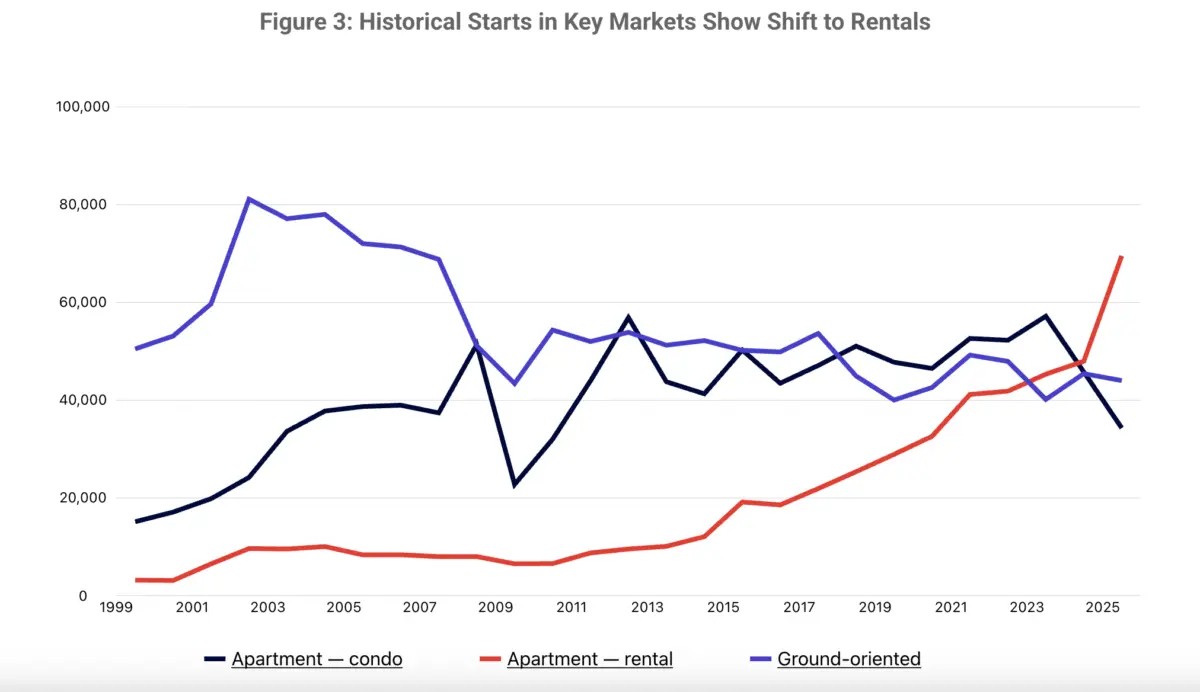
The composition of Canadian housing construction is undergoing a historic transformation. Purpose-built rentals now account for two-thirds of all apartment starts across the key metropolitan markets examined by CMHC. Meanwhile, condominium and ground-oriented construction has weakened sharply in major urban centers, including Toronto, Vancouver, Ottawa, and Montreal.
Historically, these ownership-oriented homes have also provided a vital secondary source of rental supply through individual investors who buy units to rent out.
CMHC notes that rental markets are moving toward better balance as new purpose-built supply finally comes online and rent growth begins to slow down. However, the agency warns that the greater long-term risk may not be an overabundance of rental construction, but rather a profound insufficiency of ownership construction.
Housing demand is expected to remain relatively subdued over the next two years as slower population growth weighs on both rental and ownership demand. Over the longer term, however, CMHC expects population growth to recover robustly in most major cities while rising incomes continue to support underlying housing demand.
"As a result, the greater long-term risk may not be excessive rental construction," reads the report. "Instead, it may be insufficient condominium and ground-oriented housing supply that leaves too few ownership options when demand strengthens again."
Toronto Condo Construction Collapses
This demographic and structural shift is particularly pronounced in Toronto, where CMHC says annual housing starts need to increase by at least 50 per cent over the next decade to return housing affordability to 2019 levels.
Population-adjusted housing starts in the Toronto area during the first half of 2026 dropped to their lowest levels since 1996, excluding the anomalous year of 2025. The inventory of permitted units awaiting construction has plummeted 50 per cent from its 2023 peak, while condominium project launches have largely stalled across the Greater Toronto Area.
CMHC estimates that Toronto alone needs between 21,000 and 26,000 additional starts each year to bridge the gap.
The weakness in the market is concentrated heavily in the ownership sector. Ground-oriented freehold starts are sitting at record lows after more than two decades of steady decline, while condominium construction has cratered amid weak presales, poor investor demand, and high levels of unsold inventory in the resale market.
The magnitude of the condo slowdown is stark at the municipal level. Within the City of Toronto proper, just 156 condominium units started construction during the first half of 2026. This represents a staggering drop compared to the annual average of about 7,000 condo starts over the previous decade.
Rental Starts Move in Opposite Direction
While the ownership market struggles, purpose-built rental construction is moving sharply in the opposite direction, buoyed by government interventions and changing developer strategies.
Toronto-area rental apartment starts surged 82 per cent in the first half of 2026 compared to the same period in 2025, making rentals the only major housing category to record growth in the region. For the first time since 1994, rental apartment starts surpassed condominium apartment starts in the market.
A combination of federal and provincial government financing programs, municipal incentives, and the strategic conversion of some proposed condo projects into dedicated rental apartments has helped support this upward trajectory.
CMHC says the growing rental pipeline has helped bring much-needed balance to Toronto’s rental market, offering relief to tenants after years of aggressive rent hikes. However, the agency cautions that fewer condo completions in the years ahead will also remove an important source of secondary rental units that historically helped absorb tenant demand.
Supply Gaps Vary Across Canada
The scale and nature of the housing challenge differ significantly across the country, with distinct regional pressures shaping local markets.
Montreal currently faces the largest estimated annual supply gap among the major markets examined by the agency, requiring between 42,000 and 469,000—or rather, 42,000 to 56,000 additional starts annually. Ottawa follows closely, needing another 22,000 to 27,000 starts per year. Vancouver requires between 5,000 and 7,000 additional annual starts, while Calgary faces a gap of 4,000 to 5,000 homes per year.
Edmonton stands apart as an exception among Canada’s major urban centers, with no measurable housing supply gap identified because construction has generally kept pace with population growth over the evaluation period.
CMHC concludes that recent improvements in affordability across certain markets could prove difficult to sustain if overall housing construction fails to keep pace when economic and population demand eventually strengthens.