
Yet, the final score only tells part of the story. For a few frantic moments, the Chiefs believed they had effectively sealed the game and secured a dramatic defensive victory earlier in the extra period. Instead, a controversial and game-altering replay review by the officiating crew granted the Colts a crucial reprieve, breathing new life into Indianapolis and setting the stage for a frantic finale that kept millions of viewers on the edge of their seats.
The dramatic conclusion served as a fitting capstone to a tightly contested game that had already gone down to the wire. Regulation time ended with the two formidable AFC squads deadlocked at 27-27, forcing the game into the extra period. Having won the coin toss, the Chiefs elected to receive, marching methodically down the field on the opening possession of overtime. However, the Indianapolis defense stiffened when it mattered most inside the red zone, holding firm and forcing Kansas City to settle for a short field goal. That cautious three-pointer gave the Chiefs a 30-27 advantage, leaving the door wide open for the Colts. With the game on the line, Indianapolis took over with one final opportunity to either tie the contest with a field goal or march into the end zone for a walk-off victory. What followed next was pure, unadulterated football madness.
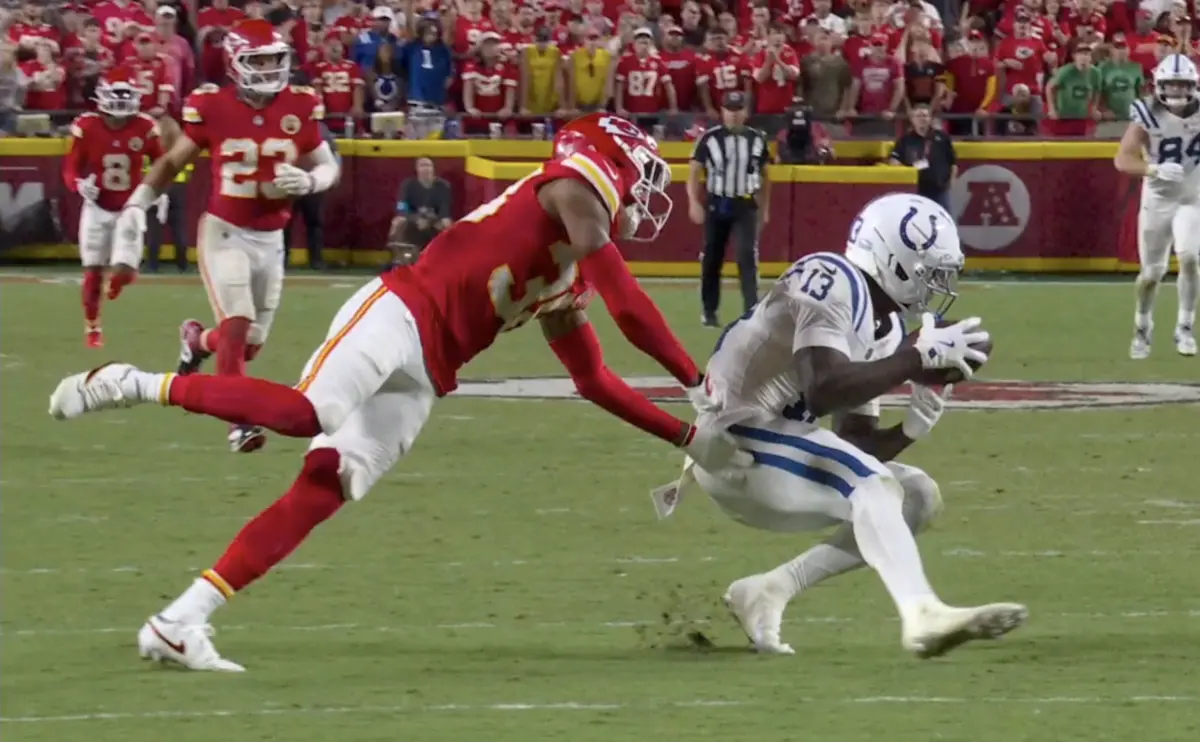
On the very first play of the Colts’ overtime possession, newly minted Indianapolis quarterback Daniel Jones dropped back and uncorked a deep, high-arching pass downfield. The ball sailed through the autumn air and fell directly into the open arms of wide receiver Laquon Treadwell, who had managed to find a seam in the Kansas City secondary. As Treadwell hauled in the reception, he bobbled the ball slightly on his way tumbling to the turf, fought through the contact, ultimately secured the catch, and then made the fateful decision to get back up to his feet. It was a sequence that unfolded in a matter of seconds, but it completely altered the trajectory of the game.
The moment Treadwell stood back up and attempted to advance the ball, Kansas City cornerback Nohl Williams diagnosed the play instantly, surged forward, and delivered a sharp punch to the football, dislodging it in a textbook strip. The fumble squirted loose into the open field, where a Chiefs defender pounced on it. On the field, the officials immediately blew the whistle and signaled a fumble recovery for Kansas City. Pandemonium erupted on the field and in the stands as the Chiefs defense celebrated what they believed was a game-ending turnover, seemingly locking up a dramatic Week 2 victory in front of their home crowd.
However, with the game hanging in the balance, the play was subjected to a rigorous video review. As the officiating crew huddled under the hood to examine the replay angles, tension mounted across the stadium. The replay showed the intricate details of Treadwell’s catch, his tumble to the ground, and the subsequent strip by Williams. After a lengthy and agonizing deliberation, the referee crew announced that the ruling on the field had been overturned.
The rationale behind the reversal centered on the precise moment Treadwell went to the ground. Upon closer inspection, the officials ruled that a Kansas City defender had a hand firmly placed on Treadwell’s hip the exact moment he made contact with the turf. Under NFL rules, that fleeting contact constituted being down by contact, meaning Treadwell was already legally down before he rose to his feet and had the ball punched out. Because the runner was down by contact, the subsequent fumble never legally happened.
The reversal stunned the Arrowhead Stadium crowd and the Chiefs defense, completely erasing what they thought was the game-winning play. Given the razor-thin margins of the rule, analysts and fans immediately began debating whether the play truly warranted a game-ending fumble or if the officiating crew got the call right. Upon reviewing the broadcast angles, the contact from the defender’s hand on Treadwell’s hip as he hit the turf appears remarkably close. While it remains one of those bang-bang plays that could easily have gone either way depending on the interpretation of the crew, the contact was arguably just sufficient enough to establish that the runner was down. Even so, seeing a call of that magnitude go against the home team in such a high-stakes environment in Kansas City remains a jarring rarity.
Rescued by the replay review, the Colts seized their second chance. Indianapolis drove deep into Kansas City territory, threatening to score the game-winning touchdown. Facing a critical 4th-and-8 situation deep inside the red zone, the Colts coaching staff weighed their options heavily, contemplating whether to go for the win with a high-stakes touchdown conversion or play it safe. Ultimately, Indianapolis elected to take the points, kicking a clutch field goal to knot the score back up at 30-30 and force the Chiefs back onto the field.
Unfortunately for Indianapolis, the reprieve granted by the replay review only delayed the inevitable. The Colts defense, exhausted after a grueling night of defending the Kansas City aerial attack, could not hold off Patrick Mahomes and the high-powered Chiefs offense on the ensuing drive. Mahomes engineered a rapid, precise response, moving Kansas City into scoring range and setting up Butker for another high-pressure field goal opportunity.
Butker, renowned for his poise and reliability in clutch moments, calmly drilled the game-winning kick, officially sealing the 33-30 victory and sparing the Chiefs from what would have been a devastating collapse after their initial celebration was overturned. While the dramatic ending will undoubtedly be analyzed and debated across the league for days to come, the final ledger shows the Chiefs standing victorious at the end of a wild, unforgettable Sunday night in Kansas City.