
Every month, the culinary staff behind Bon Appétit’s "Well Stocked" series tackles an age-old dilemma familiar to anyone who loves to cook yet frequently finds themselves pressed for time: how to get a delicious dinner on the table with virtually no notice. While the publication’s editors are passionate about scratch cooking, weeknight realities often demand a pivot toward reliable pantry and fridge staples that can quickly morph into satisfying meals. This month, the spotlight falls on an item usually relegated to late-November festivities: boxed stuffing.
Few dishes in the American culinary canon inspire as many fiercely debated opinions as holiday stuffing, or dressing, depending on regional preferences. Culinary traditionalists and holiday enthusiasts have long been divided across several lines: Is it better baked in a casserole dish or stuffed directly into the bird? Does the recipe call for sourdough, classic white bread, or cornbread? Should the flavor profile lean on fresh herbs or dried ones, and is sausage a mandatory addition or a sacrilegious intrusion?
On one side of the cultural divide stand the purists. These dedicated home cooks insist on the laborious process of drying their own artisan loaves, meticulously chopping aromatic vegetables like onions, celery, and garlic, and seasoning every element entirely from scratch. On the other side are the steadfast loyalists of the iconic red box of Stove Top. Raised on its unmistakable savory profile, these consumers remain permanently dedicated to the convenience and nostalgia of instant stuffing.
Rachel Tepper Paley, the site director for the publication, firmly identifies with the latter group. Her culinary background is deeply intertwined with the boxed variety, largely because of familial tradition. Her late father considered the boxed version to be the absolute platonic ideal of stuffing, meaning she grew up with the ultra-savory side dish gracing her family’s table every single Thanksgiving. To this day, she continues to serve it annually in his honor, proving that sentimental attachment to convenience foods can run just as deep as any heirloom recipe.

Beyond the holiday loyalists, however, lies a particularly resourceful subset of home cooks and food professionals: the culinary maximalists who view the cardboard box not merely as a seasonal shortcut, but as a versatile, highly seasoned pantry staple. The editors themselves belong to this resourceful group, constantly finding inventive ways to think far outside the box long after the holiday season has passed. Their collective experiments reveal that the pre-seasoned breadcrumbs packed into these boxes can serve as the foundational building block for an array of weeknight dishes, breakfast items, and comforting dinners.
One-Pan Schmaltzy Chicken
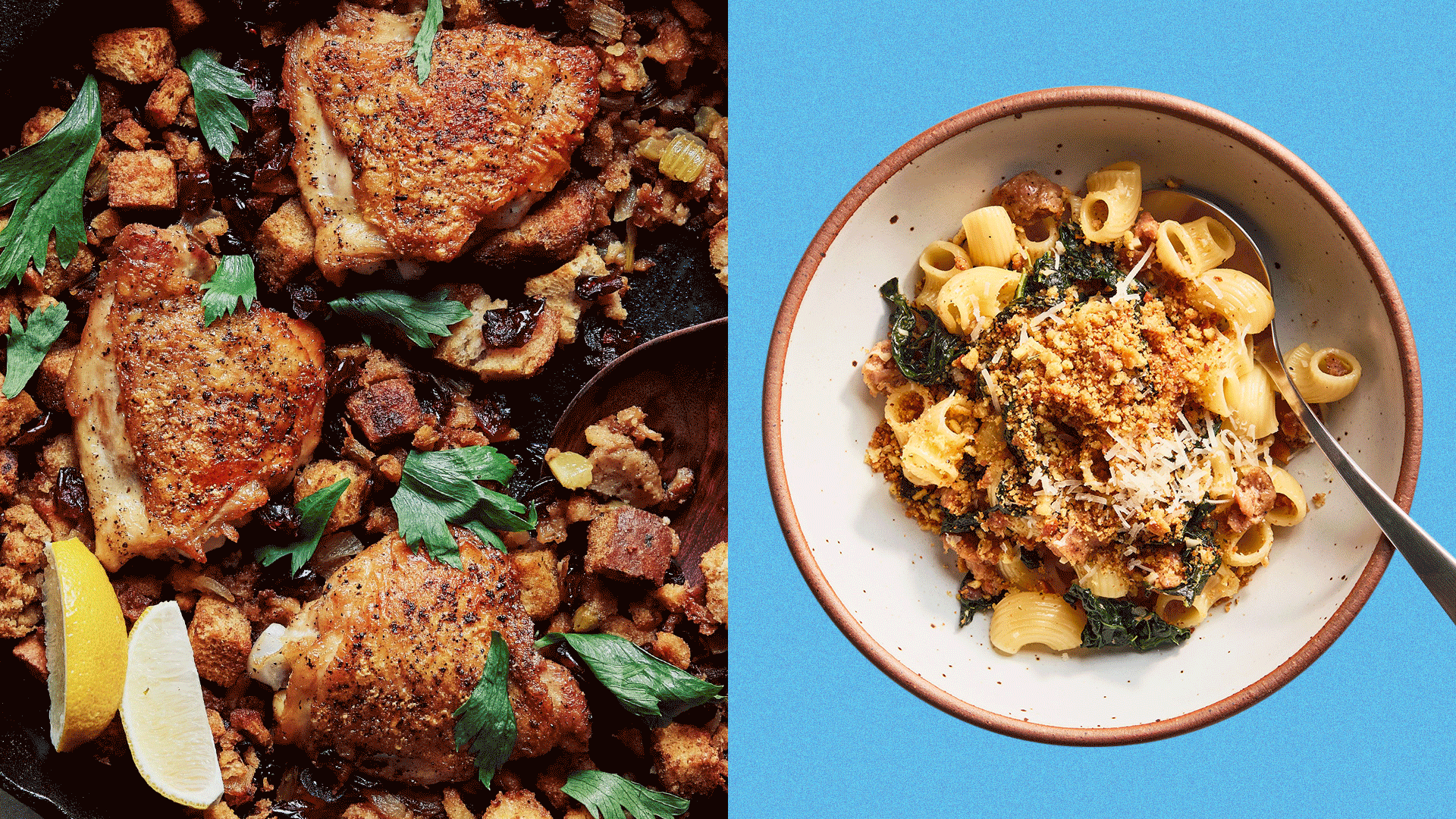
One of the most compelling transformations of the ingredient comes from senior Test Kitchen editor Jesse Szewczyk, whose Schmaltzy Chicken and Stuffing Skillet has left a lasting impression on his colleagues. When Nina Moskowitz, associate editor for cooking, first encountered the dish in the Test Kitchen, its unexpected brilliance immediately sparked ideas for future meals ranging from casual Friendsgiving gatherings and football Sundays to random weeknight dinners and date nights.
The brilliance of the dish lies in its efficient use of flavor and pan drippings. The process begins by searing chicken thighs in a skillet until the skin becomes deeply golden and crisp. Instead of discarding the rendered fat—often referred to affectionately by cooks as liquid gold—the recipe utilizes these rich chicken drippings to season and hydrate the boxed stuffing mix. The savory mixture is then dotted with sweet-tart cranberry gems, and the crispy chicken thighs are nestled back into the skillet before finishing in the oven. The result is essentially a complete Thanksgiving-style meal executed in a single pan, proving that the flavor profile of the holiday is far too good to be restricted to the month of November.
Breakfast Baked Eggs
For another approach to the pantry staple, Rebecca Firkser, a Test Kitchen editor, looks toward the morning meal. When faced with leftover or impromptu instant stuffing, she frequently transforms it into a savory baked egg dish. The preparation starts on the stovetop by cooking the stuffing according to the standard box directions directly within a shallow, oven-proof skillet, allowing the bottom layer to develop a pleasant crispness as the heat continues.

Once the base is ready, Firkser tosses in handfuls of hearty greens such as kale or spinach, letting them wilt just slightly into the warm mixture. Using a spatula, she then carves out small divots across the surface of the stuffing and cracks fresh eggs directly into each indentation. The entire skillet is transferred to an oven heated to 375 degrees Fahrenheit, where it bakes until the egg whites are fully set, a process that takes roughly 15 minutes. To finish the dish, she adds a bright drizzle of green hot sauce alongside either a crumbling of salty feta cheese or slices of fresh avocado, creating a complete and satisfying breakfast built on an unexpected foundation.
Magic Materials and Sheet-Pan Suppers
The adaptability of boxed stuffing stems largely from its core composition: pre-dried breadcrumbs heavily infused with herbs, dehydrated vegetables, and savory broths. Recognizing this, Kelsey Jane Youngman, senior cooking editor, points out that a box of stuffing is functionally identical to a box of highly seasoned breadcrumbs. This realization opens the door to using it as a savory panade—a traditional culinary technique used to bind and moisten meat—which can successfully transform lean ground turkey into exceptionally tender meatballs.
Youngman highlights a sheet-pan dinner developed by Jesse Szewczyk that pairs these turkey and stuffing meatballs with creamy baby Yukon gold potatoes and snappy green beans. The meal cleverly leans into holiday associations while remaining approachable for any night of the week, complete with an accompanying dipping sauce made by combining canned cranberry sauce—another autumn pantry staple—with fresh lemon juice and honey. The approach successfully delivers all the comforting flavor notes of a holiday feast on a single baking sheet with minimal cleanup required.
Stuffing-Crusted Fish
In busy food media test kitchens, professionals frequently encounter the classic cooking challenge of inventing meals out of miscellaneous ingredients left over from recipe testing. Joe Sevier, senior editor for SEO and cooking, notes that while his personal preference for holiday dressing remains a classic, homemade cornbread and biscuit version, he is no stranger to repurposing boxed stuffing when convenience calls.

One of his favorite weeknight applications is using the seasoned crumbs as an instant crust for baked fish. Borrowing from a popular no-recipe-required crispy fish method developed by Anna Stockwell, Sevier has relied on the technique dozens of times. The method offers a reliable, relatively hands-off approach to dinner that easily accommodates whatever vegetables or pantry items happen to be on hand, ensuring a successful weeknight meal with virtually zero friction.
Weeknight Sausage and Kale Pasta
As colder weather sets in, the culinary desire for comforting, carbohydrate-heavy meals naturally rises. Emma Laperruque, cooking director, has long appreciated the textural contrast of pasta topped with seasoned breadcrumbs, a traditional technique found in various Mediterranean pasta preparations. However, she praises another creative twist developed by Jesse Szewczyk that elevates the concept even further.
Rather than reaching for plain or Italian-seasoned breadcrumbs, Szewczyk’s recipe calls for running boxed stuffing mix through a food processor to create coarse, highly flavorful crumbs. This mixture is then used to generously top a cozy bowl of pasta tossed with savory sausage and kale. For Laperruque and her colleagues, the crunchy, herbaceous topping transforms a simple weeknight pasta dish into a standout culinary experience, demonstrating that the humble red box of stuffing possesses a versatility that extends far beyond the traditional holiday dinner table.