
The Atlanta Falcons arrived at Lambeau Field for their Week 3 Thursday night matchup against the Green Bay Packers carrying the heavy weight of an organization in deep turmoil. Through the first two weeks of the regular season, the Falcons had looked entirely lost on both sides of the football, stumbling out to an abysmal 0-2 start. They had been outscored by a combined 54-16 margin in their opening contests, culminating in an embarrassing, disjointed home loss to the division-rival Carolina Panthers that prompted brutal assessments across the national sports media landscape, with analysts questioning whether the franchise had plumbed entirely new depths of professional football futility.
Yet, professional sports are notoriously unpredictable, and the script flipped dramatically under the Thursday night lights in Wisconsin. The Falcons secured a resounding 35-14 victory over the Packers, a result that sent shockwaves through the NFC and left Green Bay’s faithful reeling while breathing new life into an Atlanta squad whose season appeared to be slipping away before autumn had even truly begun.
For the Falcons, the primary catalyst for change was the long-awaited return of their young quarterback. Michael Penix Jr. made his official season debut, stepping in to mercifully steer the offense after a pair of disastrous performances from Cooper Rush to open the campaign. While Penix delivered a series of precise, composed throws and managed the game with veteran poise, the offensive explosion was largely fueled by two of the team’s undisputed superstars. Running back Bijan Robinson put on an absolute clinic, carving up the Green Bay defense for 194 yards and two touchdowns on the ground. Wide receiver Drake London matched that production through the air, hauling in catches to rack up 194 receiving yards of his own and consistently exploiting holes in a helpless Packers secondary.
Despite the comprehensive nature of the victory, the broader narrative of the game quickly shifted from Atlanta’s impressive resurgence to the alarming state of the Green Bay Packers. The home team’s performance was so thoroughly lifeless and uninspired that the notoriously loyal and passionate Lambeau Field crowd turned on their own players. Disappointed fans began raining boos down upon the Packers during the fourth quarter, and as the magnitude of the blowout set in, faint yet distinct chants of "ATL" echoed through the historic stands.
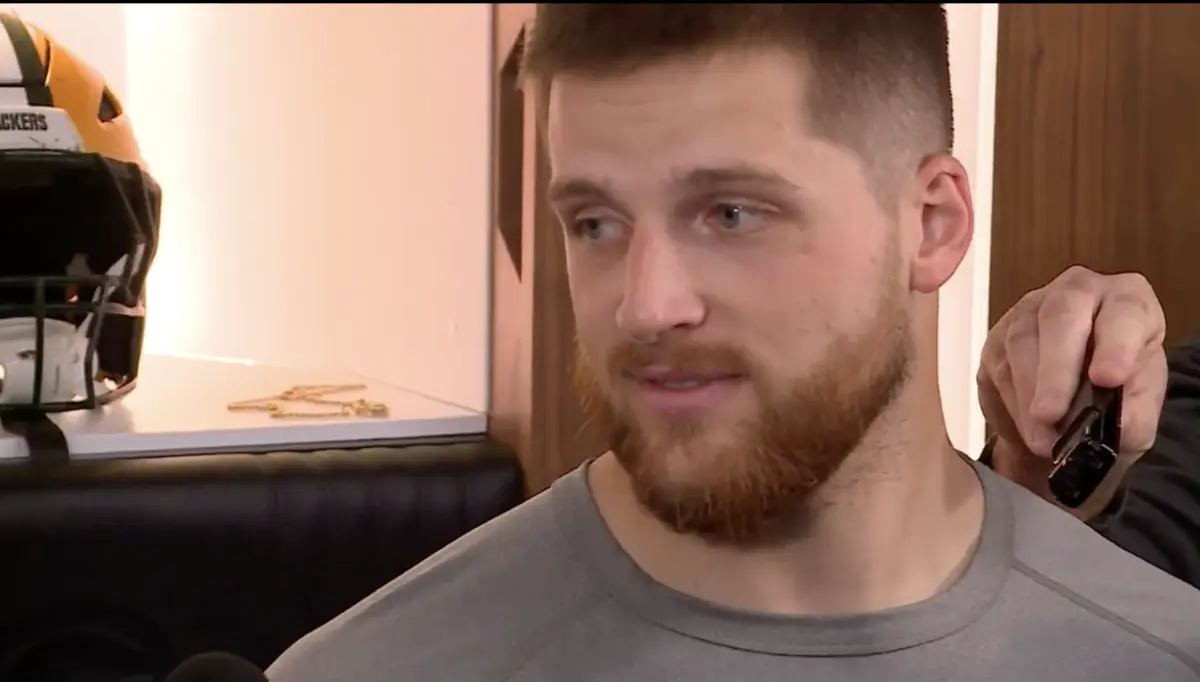
The frustration in the stadium spilled over into the post-game locker room, where second-year tight end Tucker Kraft addressed the negative reaction from the home crowd with remarks that quickly drew widespread scrutiny. Kraft did not shy away from expressing his displeasure regarding the fans’ decision to boo the team during their home opener.
"That’s pretty tough. Like everyone pictures Lambeau Field and not boos. I don’t picture boos. I picture my home stadium. That’s tough. It’s pretty disappointing, especially for a home opener. It’s pretty disappointing. It’s not going to help us win. Like I don’t know what people think that’s going to rally us or something like that. But that’s — we’re grown men. We’re mentally strong enough, capable enough to get back on the field and play ball. But it’d probably much easier with the 70,000 people behind us rather than opposing us," Kraft said.
While the young tight end voiced his disappointment, it was difficult for objective observers to blame the Green Bay faithful for voicing their profound frustration after witnessing such a dismal product on the field. The Packers’ defense was completely dismantled from the opening whistle to the final gun, failing to force the Atlanta offense into a single 3-and-out the entire evening. Quarterback Jordan Love found himself under relentless, suffocating duress throughout the game, constantly running for his life behind a porous offensive line, even though he was officially credited with taking only one sack.
Compounding Green Bay’s offensive woes was a completely nonexistent running game. With veteran running back Josh Jacobs held out of the lineup due to ongoing domestic abuse charges that placed him on the commissioner’s exempt list, the Packers had virtually no ground game to rely on. When the final statistics were tallied, Green Bay’s entire rushing attack had produced a meager 17 yards, standing in stark, humiliating contrast to Atlanta’s dominant 249 rushing yards.
The special teams unit fared no better, delivering a sequence so calamitous that they managed to give up a blocked field goal to an Atlanta defense that had only 10 men on the field at the time. Across all three phases of the game—offense, defense, and special teams—the Packers displayed systemic flaws that suggested a roster construction built on fragile foundations.
Through the first three weeks of the season, Green Bay could very easily find themselves sitting at an unblemished 0-3 record. In their season opener, they dropped a 39-22 decision to the Minnesota Vikings and Carson Wentz, and in Week 2, they required nothing short of a miraculous effort just to squeak past the New York Jets in an exhausting overtime affair.
The cracks in the Green Bay franchise appear to run much deeper than a single bad night. The roster feels concerningly thin across critical positional groups, particularly in the trenches on both sides of the line, within the defensive backfield, and among the playmaking skill positions at running back and wide receiver. Furthermore, the decision by the front office to hand head coach Matt LaFleur a controversial contract extension during the offseason is already beginning to look like an unmitigated catastrophe. LaFleur has developed a persistent reputation for coaching with an overly conservative, fearful approach, and critics argue that this cautious philosophy has systematically stripped the team of its competitive confidence and identity.
Compounding the team’s long-term outlook is a notable lack of future draft capital. The Packers do not own their 2027 first-round draft pick, having surrendered it as part of the blockbuster trade to acquire star pass rusher Micah Parsons. That high-value pick is now controlled by the New York Jets. Parsons himself remains sidelined as he continues his recovery from a torn ACL, though team officials expect him to work his way back onto the field by the midpoint of the season.
Longtime observers of the franchise noted that the mood surrounding the team has reached a grim nadir. Local fans and analysts discussing the state of the franchise on social media have pointed out that this current stretch feels like the lowest point the team has experienced in the last thirty years, spanning the eras of sustained stability and elite quarterback play. It is difficult to mount a counterargument against that sentiment, as any team demonstrating the vulnerability required to make an struggling Falcons squad look like a powerhouse clearly possesses deep-seated structural issues.
As the dust settles on a sobering Thursday night at Lambeau Field, the reality of the situation is setting in for the Green Bay organization. With a thin roster, mounting injuries, a demoralized fan base, and mounting questions surrounding the coaching staff’s ability to right the ship, it is shaping up to be a very long and arduous season in Wisconsin.