
The stock market has once again found a way to leave investors marveling, worrying, and second-guessing their financial futures. As major indices scale record valuations, a familiar sense of anxiety is gripping Wall Street and Main Street alike. This time, the driving force behind the market euphoria and subsequent jitters is the frenzied global boom in Artificial Intelligence. For retirees and long-term investors, the narrative feels terrifyingly familiar: a massive technological revolution is driving asset prices to historic highs, and the inevitable fallout threatens to trigger a devastating market crash.
Yet, stepping back from the daily barrage of financial news reveals a broader historical perspective. Market booms and busts are not unprecedented anomalies; they are recurring chapters in a much longer economic story. To understand the current climate, it helps to examine how investor anxieties have evolved over the decades, and why the fundamental drivers of human prosperity remain largely immune to cyclical market panics.

Will the AI Bubble Ruin Our Retirement?
Financial anxiety is a persistent companion for anyone watching retirement accounts fluctuate. Reflecting on decades of early retirement, long-time financial commentators often field variations of the same anxious question from friends and followers: how can anyone remain comfortable and sleep at night given the state of the world?
The list of global anxieties in any given year typically reads like a catalog of impending doom. Today’s headlines feature volatile geopolitical figures, persistent inflation eroding purchasing power, towering national debt levels, and the looming threat of global conflicts alongside the burgeoning AI bubble.

However, a look back two decades to 2006 reveals a strikingly similar landscape of worry. Back then, investors fixated on different leaders, conflicts in the Middle East, surging national debt, and rising inflation. Instead of an AI bubble, the market anxiety centered on a massive housing bubble. Instead of artificial intelligence threatening white-collar employment, the prevailing fear was that outsourcing jobs to India and China would devastate the domestic labor market. There was even widespread panic over "Peak Oil"—the persistent belief that rising fossil fuel consumption would inevitably outstrip dwindling global supplies, leading to economic collapse.
Yet, despite the severe turbulence of the subsequent Great Financial Crisis—a historic downturn driven by housing market speculation and complex financial leverage—the long-term trajectory of the broader economy proved remarkably resilient. A diversified investment portfolio weathered not only the financial crisis of 2008 but also subsequent disruptions like the 2020 pandemic crash, continuing to generate substantial long-term growth over a twenty-year horizon.

Simultaneously, the world outside the stock market improved dramatically. Over the same two-decade span, extreme global poverty rates dropped significantly, and infant mortality rates were cut in half. Clean energy technology advanced at a staggering pace, with solar power becoming exponentially cheaper and supplanting traditional energy generation sources, while electric vehicle adoption surged globally. These massive macroeconomic shifts demonstrate that long-term progress consistently outlasts short-term financial panics.
Prosperity Comes from Productivity
Financial media thrives on cultivating fear, often framing market indices as the ultimate barometer of human well-being. However, financial markets and stock tickers are ultimately just abstract numbers tracked on computer systems. The true foundation of human prosperity is not found in the daily fluctuations of the stock market, but in tangible economic productivity.

The underlying engine of capitalism is perpetually choppy, subject to wild swings in sentiment and speculative bubbles. Beneath the surface turbulence, however, real people continue to perform real work, invent new technologies, and drive efficiency. If a financial system breaks down because market participants lose confidence in abstract valuations, societies have repeatedly demonstrated the capacity to reset the financial architecture and return to productive labor.
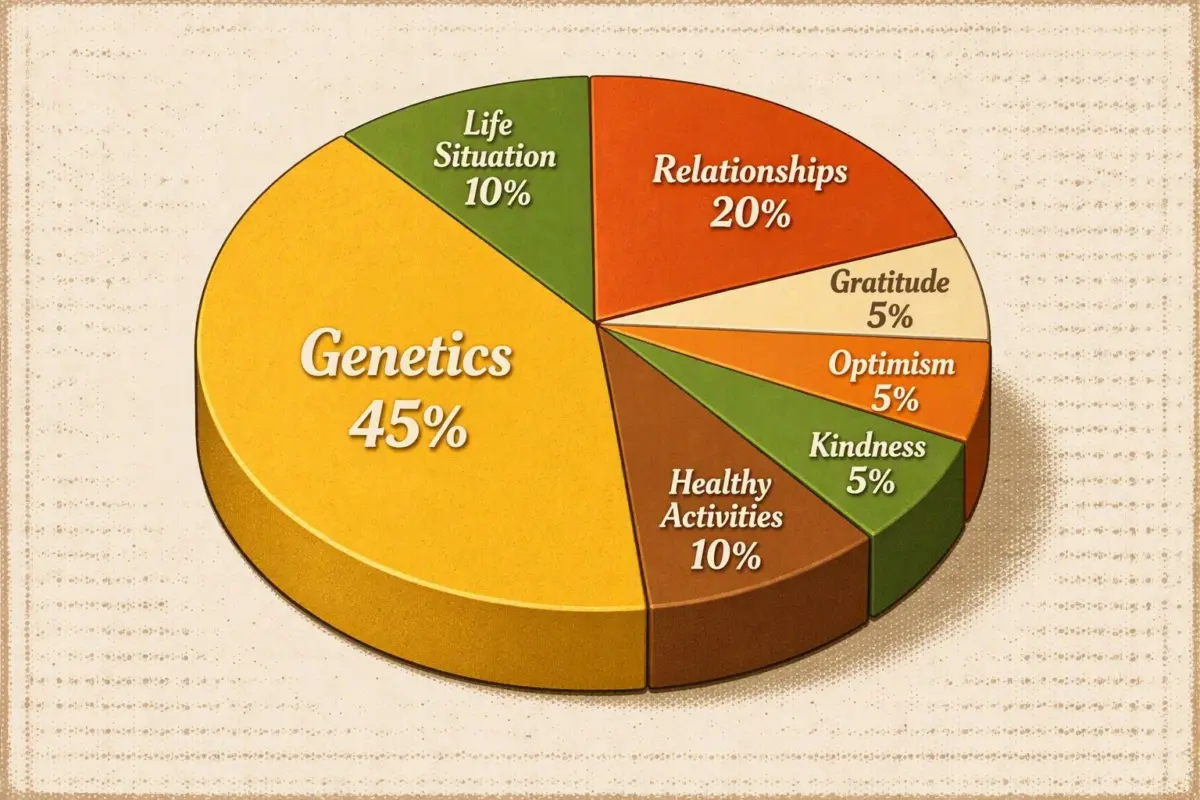
Economic growth, higher standards of living, and the feasibility of early retirement are fundamentally anchored in productivity gains. Furthermore, once basic material needs and standards of living are met, human happiness and fulfillment depend far less on absolute wealth and far more on personal choices, close relationships, physical health, and a positive outlook.

Confronting the Psychology of Fear
The persistent anxiety surrounding modern economic shifts often stems less from objective external threats and more from human evolutionary biology. As a species, humans evolved as danger-detection machines, utilizing background fear as a survival mechanism to protect against predators, disease, and scarcity.
When immediate physical survival threats are successfully mitigated in modern society, the human brain frequently redirects that evolutionary vigilance toward abstract worries. Once food and shelter are secured, anxieties shift toward social belonging, financial security, and eventually hyper-specific concerns like tax strategies, estate planning, and government-mandated retirement account distributions.

Overcoming this pervasive background dread requires self-awareness and an understanding of personal history. Childhood experiences, family attitudes toward money, and past trauma often shape an individual’s financial fears, causing them to project past scarcity onto an objectively secure present. Identifying the specific worst-case scenarios through rational analysis frequently reveals that feared outcomes are far less catastrophic than anticipated.
Taking deliberate, positive action remains one of the most effective antidotes to fear. Engaging directly with unfamiliar challenges builds resilience and competence, transforming vague anxieties into manageable experiences. For many investors, this process also involves filtering out the daily drumbeat of sensationalized news media, which disproportionately highlights worst-case scenarios, and instead focusing on constructive personal habits, physical health, and community engagement.

Viewing Technological Shifts as Experiments
Approaching modern technological revolutions through an experimental lens rather than a lens of doom helps reframe uncertainty as an opportunity for learning. The current AI boom is a prime example of a major technological shift that has sparked widespread anxiety, yet it functions fundamentally as a powerful tool for cognitive efficiency.
Much like the introduction of the internet, mobile computing, and automation, artificial intelligence acts as a cognitive productivity enhancer. While it undeniably displaces certain entry-level administrative and technical tasks, historical precedent shows that such technological leaps simultaneously drive down service costs, boost overall economic efficiency, and give rise entirely to new industries and job markets.

While the economic rewards of new technologies often concentrate among business owners and shareholders—groups that include a vast number of retail investors—the overarching reality remains unchanged. Artificial intelligence, like any sweeping economic development, presents a series of choices. Individuals can choose to view emerging innovations as a source of paralyzing fear or as a catalyst for ongoing education, adaptability, and a more engaged approach to life.
Ultimately, navigating an uncertain future requires looking past the immediate emotional turbulence of market bubbles and news cycles. By addressing the root causes of personal anxiety and focusing on tangible productivity and human connection, investors can better position themselves to face upcoming economic transitions with resilience and clarity.