
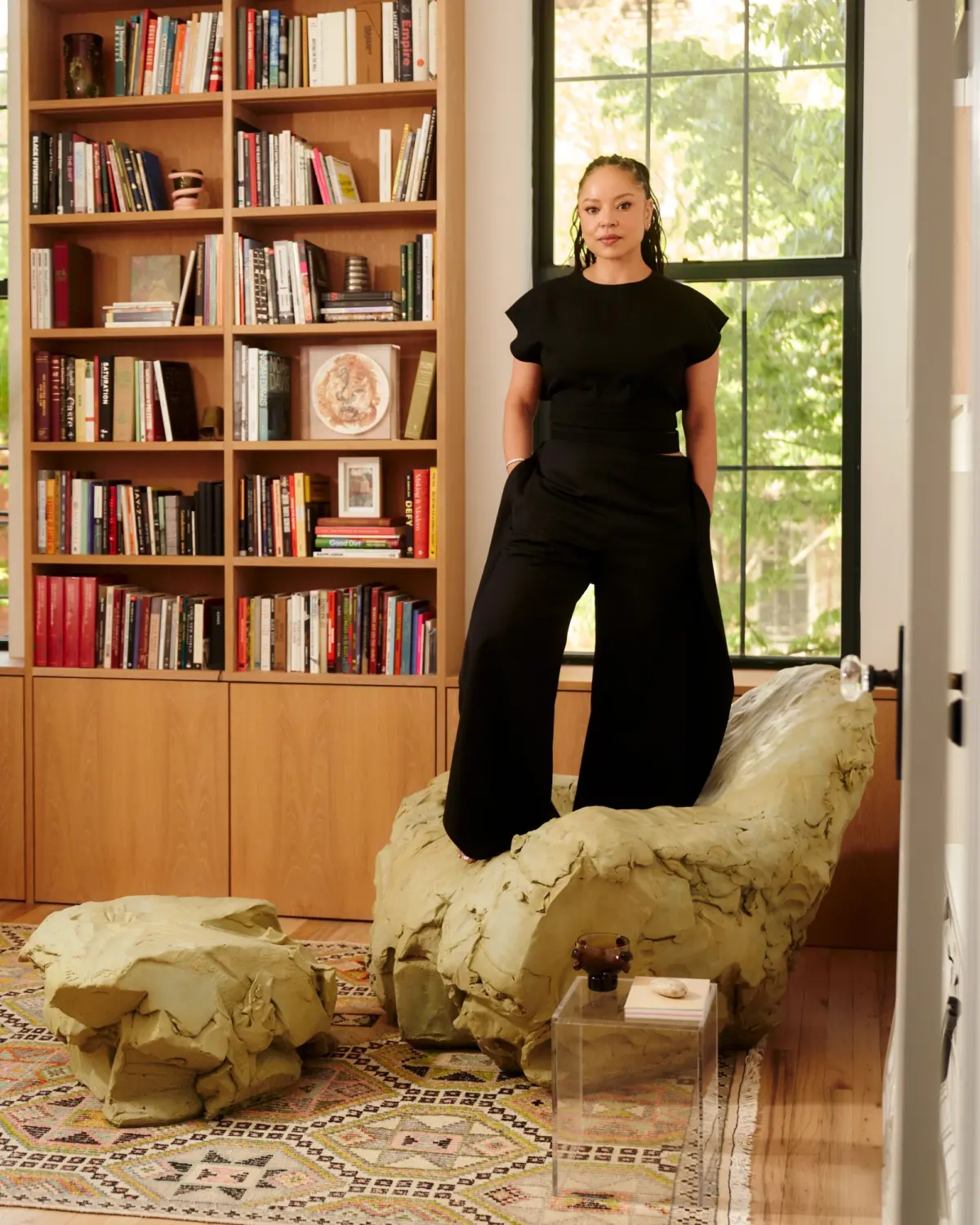
The installation of the mirrors in Joeonna Bellorado-Samuels’s Clinton Hill apartment set the tone for the entire four-year renovation project, unfolding with the kind of logistical drama usually reserved for moving a high-stakes, fragile artwork into a museum or gallery. Because the stairwells had been mismeasured, standard delivery routes failed, requiring a last-minute scaffolding setup to hoist roughly ten-foot panes of glass directly through a window. Though the unexpected construction caused a brief spectacle in the Brooklyn neighborhood—an episode Bellorado-Samuels recounts with a warm laugh, noting that the locals took the sudden street-side scaffolding entirely in stride—the incident serves as a fitting metaphor for her home. It is a space built deliberately around the complexities and mechanics of the viewing experience.

Bellorado-Samuels’s sharp eye and appreciation for structural tension are deeply rooted in her extensive career within the contemporary art world. Her journey began at the Studio Museum in Harlem before she transitioned to the prestigious Jack Shainman Gallery as an assistant to cofounder Claude Simard. Now serving as a senior director at the gallery, Bellorado-Samuels has cultivated a professional appetite for friction, an element that informs both her daily curatorial work and the architectural trajectory of her living space. That very impulse also fueled her itinerant gallery project, We Buy Gold, which cleverly plays on the intersecting themes of art, commerce, and urban space.

This inclination toward friction and spatial dialogue explains her distinct distaste for conventional, overly plush sofas. Instead, she gravitates toward seating options that are distinctly sculptural and funky, embracing pieces that challenge casual lounging. It is a design philosophy where the subtle tension between staying comfortably seated and feeling on the verge of falling down actively shapes the character of the living room.

Throughout the two-bedroom home, concept continually triumphs over conventional comfort. The expansive wall of mirrors designed by HMH Architectural Metal and Glass anchors one end of the open-plan living area, radically multiplying the room’s dimensions and reflecting the natural light pouring through the windows. The living room arrangement also features a sleek daybed from CB2, paired with a vintage armchair crafted by Rodolfo Bonetto for Driade. Nearby, a former Brooklyn school classroom side table sourced from Bedford Galleries holds an antique women’s cowry shell and fiber wedding veil from Papua New Guinea alongside a delicate light sculpture by Nandi Loaf. The artwork flanking the space includes a striking piece by Sadie Barnette, while a wood carving by Toyin Ojih Odutola serves as a personal souvenir brought back from a trip to Lagos, Nigeria.

The design choices in the private quarters are equally uncompromising when it comes to prioritizing narrative and visual impact over traditional storage. In the secondary bedrooms, practical closet space was intentionally sacrificed to maximize precious wall space for hanging art. In Bellorado-Samuels’s own bedroom, the television is discreetly stashed out of sight beneath the bed, ensuring that powerful works by artists such as Barkley Hendricks, Sadie Barnette, and Charisse Perlina Weston take absolute pride of place. The second bedroom was transformed entirely through a ten-month collaboration with millworker Paul Finsterwald—whom Bellorado-Samuels met through her gallery connections—resulting in a bespoke, floor-to-ceiling bookshelf.

The bedroom is anchored by soft linens from Cultiver and a grounding rug by Nordic Knots, complemented by an antique footstool found at a yard sale in Kinderhook, New York, and an antique console table from Bedford Galleries. The walls feature works by Kerry James Marshall and Donyel Ivy-Royal, while a nearby corner highlights Bellorado-Samuels sitting in an antique chair from Ethiopia beneath a sculptural lamp by Isamu Noguchi, paired with art by Donyel Ivy Royal.

This deep-seated instinct to prioritize objects charged with meaning, sentiment, and history traces directly back to Bellorado-Samuels’s upbringing in San Francisco. Her father, Joe Sam, was a prominent political activist and artist who frequently incorporated found materials into his creative practice. Childhood memories involve scavenging along local train tracks to collect raw materials for his art, items that would routinely find their way onto the family kitchen table. That formative experience instilled in her a specific practice of care—a profound appreciation for loving everyday objects and the physical things one chooses to live with. As she observes, all it takes is a little bit of restraint to pull a room together successfully.

Among the most poignant pieces in the apartment is a sculpture crafted by her father as a Valentine’s Day gift for her mother. Reflecting on the piece, she notes that it was likely the last sentimental gift her mother received from him before his passing. The home also houses a glass box resting on a hallway shelf, carefully filled with every single wishbone saved from her family’s Thanksgiving dinners, alongside a curated collection of stones gathered from her travels over the years. A sheepskin from Guild softens a hallway stool, while nearby bookshelves frame a sculpture by Malick Sidibé and artwork by Kerry James Marshall.

Her personal connection to the Clinton Hill building began through another cherished childhood ritual: weekend open-house tours with her mother. The two revived this long-standing tradition one Mother’s Day when Bellorado-Samuels found herself actively searching for a larger home in New York. Having lined up a series of apartments to tour over the weekend, this particular building was among the stops.

The building itself offered a rich architectural history that made falling in love with it effortless. The front portion dates back to approximately 1850, while the rear section was constructed around 1900, originally serving as a women’s home where the back annex functioned as an infirmary. After sitting vacant for years, the property was transformed into the Bull Shippers Inn before eventually falling into severe disrepair, acquiring the eerie, atmospheric aura of a neighborhood haunted house. Eventually, the neglected structure was acquired by developers, thoroughly renovated, and subdivided into 26 individual apartments.

Bellorado-Samuels remains deeply drawn to the lingering traces of these past lives—from the historic original facade and a mysterious, unexplained small window to the imperfect patchwork of exposed brick that she otherwise confesses to disliking. While professional bricklayers might view the wall as a flawed patch job, she embraces its ragtag, random character.

It is precisely this kind of layered architecture that adds essential texture to the viewing experience. Ultimately, these elements prevent the apartment from feeling like a sterile, clinical private gallery, transforming it instead into a thoughtful, lived-in proposition for coexisting with contemporary art. Rather than disappearing quietly into the background behind her collection, Bellorado-Samuels’s home pushes back, amplifies, complicates, and occasionally inconveniences the art it houses.

She notes her enthusiasm for living with diverse mediums, pointing out that while many people assume they cannot comfortably incorporate sculpture into a residential interior, she loves the dimension it brings. Questioning the instinct to surround oneself solely with safe paintings of flowers, she champions a more adventurous approach to domestic space—provided, of course, that one remembers to measure twice before attempting to hoist oversized glass panels through the window.