
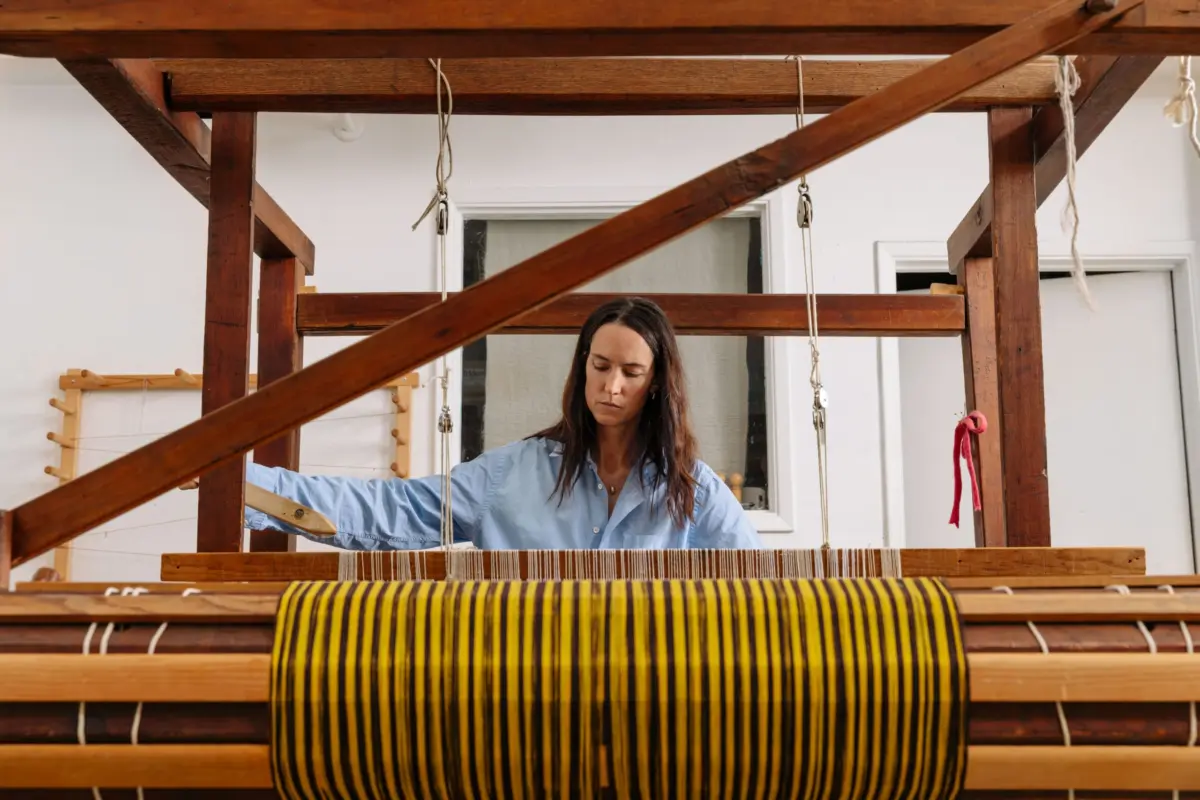
Weaving is an exercise in profound patience, meticulous calculation, and physical endurance. To begin crafting just one of her breathtaking textiles, San Francisco-based artist Marina Contro must first immerse herself entirely within the wooden architecture of her hand loom—an antique apparatus standing an imposing six feet tall.
"I thread every string through these shafts," Contro explains, detailing the elaborate preparatory ritual required before a single shuttle can be thrown. "For that, I have to sit inside the loom on the cloth beam, but when I’m tying up the pedals I’ll be under the warp on the floor."
On a recent afternoon in her studio, Contro was meticulously loading the heavy machinery with rich strands of ochre and brown cashmere. She then manipulated the fibers in deep, deliberate silence, counting out precisely eight picks, or individual stitches, for every single square of an intricate gingham pattern. The resulting creation—a tactile landscape of warmth and shadow—is more than merely functional; it is a monument to slow, deliberate craftsmanship in an increasingly accelerated digital world.
A Showcase at Blunk Space and the Commune Design Connection
The fruits of this painstaking labor are currently taking center stage in a joint exhibition alongside woodworker Noah Cohen. Running from October 24 through January 2, the exhibition is hosted at Blunk Space, a celebrated destination gallery located in Point Reyes Station, California, just steps away from the former home and studio of the late, legendary sculptor JB Blunk.

The pairing feels entirely natural given the venue’s deep ties to organic forms and master craftsmanship. Mariah Nielson, the daughter of JB Blunk, immediately recognized the profound resonance of Contro’s work within the gallery’s ethos. "Her weavings are deceptively luxurious," Nielson observes.
The artistic merit and sensory appeal of Contro’s textiles have also captured the attention of top-tier interior design talents. Nielson initially tapped Roman Alonso and Steven Johanknecht of the renowned AD100 firm Commune Design to curate the landmark show. For Alonso, the physical impact of the blankets is immediate and lasting. "Once I put one of her blankets in a client’s hands, they won’t let it go," he reports.
This widespread appreciation has translated into high-profile collaborations, including special editions like the Nebbia Woven Blanket created by Contro for Commune. These pieces marry timeless techniques with contemporary sensibilities, elevating the traditional throw blanket into a collectible work of fine art that commands the attention of interior designers and collectors alike.
Artistic Roots and Historic Influences
Contro’s journey to becoming one of the most compelling textile artists of her generation was shaped by an unconventional academic path. Growing up across Chicago and Colorado, she initially pursued an undergraduate degree in religious studies. During her studies, she developed a deep fascination with liturgical vestments—the heavily symbolic, historically rich garments worn during religious ceremonies. This early exposure to the intersection of textile artistry, history, and ritual laid the subconscious groundwork for her future artistic career.

Driven by this emerging passion, Contro enrolled in the rigorous textiles master’s program at the Cranbrook Academy of Art in Bloomfield Hills, Michigan. While at Cranbrook, she sought out the historic looms housed within the school’s iconic Kingswood Weaving Studio. Originally established by textile artist and designer Loja Saarinen in 1931—and today utilized primarily by Cranbrook high school students—the studio is a living monument to modern craft history.
"You’re so immersed in history when you’re in that space," Contro reflects, noting how the environment profoundly shaped her artistic voice. Surrounded by the echoes of mid-century design pioneers, she honed her technical mastery and developed a deep reverence for traditional tools and historic processes.
Following her graduation from Cranbrook in 2017, Contro deliberately sought out similarly inspirational, contemplative settings to fuel her creative output. Her path led her to residencies that honored the marriage of landscape, architecture, and isolation, such as Andrea Zittel’s celebrated residency program located near Joshua Tree. More recently, her artistic journey brought her to the historic Blunk House, where she lived and worked earlier this year, absorbing the raw, sculptural energy of the Northern California coast directly into her creative practice.
The Geometry of Plain Weaves and the Power of the Seam
Operating strictly within the physical parameters and mechanical confines of her vintage loom, Contro deliberately limits her technical vocabulary. She tends toward plain weaves and basic twills, preferring the honest look, natural feel, and organic drape of these straightforward structures over more overly complicated patterns.

Because her antique loom restricts her to a maximum weaving width of 48 inches, Contro is forced to think expansively about composition and scale. To create larger pieces, she frequently joins multiple panels together, transforming a structural necessity into a striking artistic signature.
These resulting seams intentionally become the visual focal points of her textiles, achieving the quiet, contemplative, stop-and-look-closer effect often found in the minimalist paintings of Agnes Martin. Whether the effect is entirely conscious or partly intuitive, Contro embraces the psychological pacing it creates for the observer. "I like rewarding the viewer for spending a little bit of time with it," she says.
Through every counted stitch, every carefully modulated hue of cashmere, and every precisely engineered seam, Contro offers a deliberate antidote to haste. In an era defined by mass production and instant gratification, her six-foot loom stands as a portal to a slower, more deliberate world—one where luxury is measured not by speed, but by the hours of silent devotion woven into every single thread.