
By THE HOLLYWOOD REPORTER
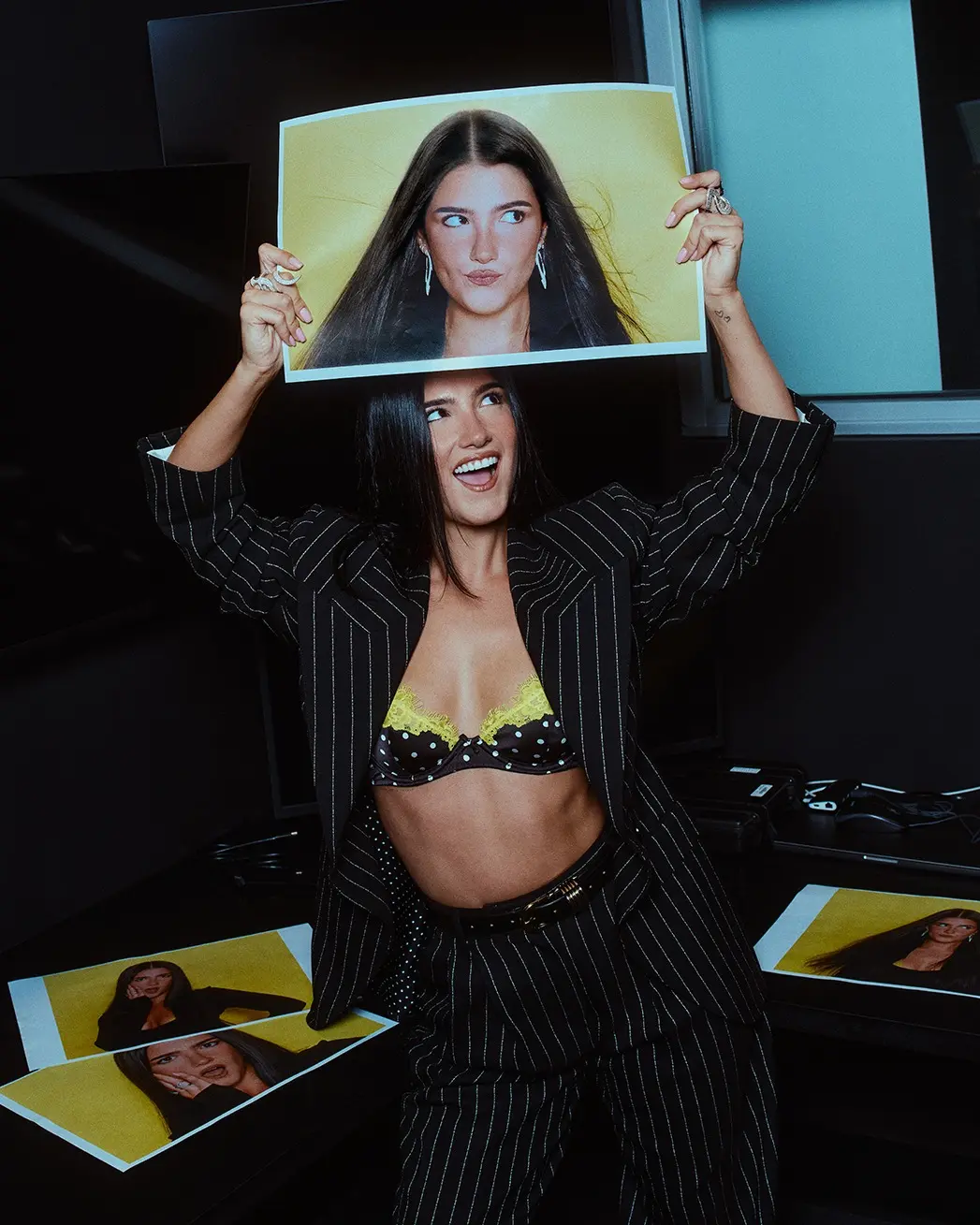
Charli D’Amelio loves to dance. Whenever a new song comes on at a photography studio in Los Angeles, the reigning queen of TikTok is instantly shimmying her shoulders and shaking her hips. Moments later, she stamps and turns like a flamenco dancer, swishing the dark fabric of her ruffly black gown while the room watches in quiet admiration.
"So pretty, stunning," says Emman Montalvan, the photographer capturing her portrait. "Gorg!"
With her glossy black hair and bright, expressive smile, Charli certainly is gorgeous. She projects the image of a classic girl-next-door brought to life by Disney—the bright, shiny face of social media who manages to make an intensely scrutinized digital existence look entirely benign.
"This is her before she becomes jaded," Montalvan observes during a break in the shoot. "Nothing calculated. Natural. She reminds me of when Britney Spears was young."
As Rihanna’s "Breakin’ Dishes" begins to play over the studio speakers, Charli effortlessly mouths the familiar lyrics: "I don’t know who you think I am…"
"Are you having fun?" a reporter asks, finding it impossible not to smile alongside her. When Charli is visibly happy, those around her tend to feel happy too—a psychological phenomenon that undoubtedly forms a core part of her immense global appeal. It makes observers want to believe that a life spent dancing in designer clothes while opening oneself up to a dizzying 160 million-plus followers—the second-most followed account on TikTok—really is as wonderful as it appears on a glowing smartphone screen.
Yet, a sudden flicker of annoyance crosses Charli’s brow, as if the question has inadvertently touched a raw nerve. Perhaps the reaction stems from the relentless demands of digital algorithms that continuously require creators to offer up the illusion of a perfect life and the constant performance of joy, regardless of what might be happening behind the scenes.
"Are you having fun?" she fires back, flashing a bright, diamond-bracelet smile before she is suddenly running gleefully down the hallway of the studio. She is closely followed by her social media manager, Alexa Davis, who films her nearly constantly with a DJI Osmo Pocket camera. Whenever Charli is having fun, there is almost always someone there to capture it.
Coming off a successful 10-month run in Broadway’s musical & Juliet—where she sang and danced as a member of the ensemble cast and earned favorable reviews—Charli quietly moved into a house of her own in Valley Village, California, earlier this year. The modest residence represents far more than just a first real estate purchase; at 22 years old, Charli has formally separated herself professionally and financially from the family with whom she originally built her extraordinary, multi-faceted career.

"I’m figuring out who I want to be," she reflects, "and that’s what I’m really excited for."
For years, Charli and her parents, Marc and Heidi D’Amelio, along with her older sister, Dixie, appeared entirely inseparable. The family relocated to Los Angeles together, signed with the same talent agency, launched co-owned businesses, and starred in a dedicated Hulu reality television series. Throughout it all, Charli remained the undisputed main attraction—the primary engine of a massive digital empire consisting of lucrative brand partnerships, media ventures, a fashion line, and more, all built upon the wholesome image of a tight-knit American family.
Now, amid public speculation regarding her finances and reports of a distancing from her relatives—allegations of financial mismanagement that her father has strongly denied, and to which none of the D’Amelios responded for comment—Charli is actively discovering who she is away from the family unit that defined her teenage years.
Her new home does not immediately resemble what outsiders might expect from a young woman who earns an estimated $18 million annually, according to Forbes. It is a relatively modest, almost nondescript two-story house situated on a quiet, tree-lined street, complete with a security gate and front door, but lacking any external markers that might scream "TikTok star."
However, stepping into the secluded backyard reveals a shimmering swimming pool, an immaculate lawn, a large stone grill, and a dedicated personal dance studio bearing a neon sign for Red Bull Dance Your Style. Red Bull, one of Charli’s prominent corporate sponsors, built the space specifically for her. Having grown up promoting consumer products online, she finds that even her backyard comes branded.
"This is very much a home," Charli says softly, her voice carrying a gentle, calming cadence. She sits cross-legged on an oversized wraparound couch in her expansive, open-concept living room—a space she designates as her personal sanctuary. Dressed in classic Levi’s and a long-sleeved black Prada top—she serves as an official "friend of the house" for the Italian luxury brand—she wears seventeen silver studs and hoops glinting at her ears.
"Sometimes I just fall asleep here," she says sleepily. "It’s so comfy, it’s a slippery slope."
She spends a significant amount of time alone at home, browsing her phone or watching her giant, wall-mounted television. Nearby on the couch rests a decorative throw pillow bearing the phrase: Just a girl who loves orcas. Charli explains that she admires orcas because of how they always seem to win their encounters with sharks.
"Lame of a life as it may be sometimes, I love just to be at home and do nothing," she admits. "I’m surrounded by a lot of peace, which is something it took me a long time to realize I need to be comfortable."
She describes herself as having been something of a "hermit" over the past year, deliberately retreating from a lifestyle in which nearly every waking moment was viewed as potential content to be shared with the public. Between October and February, she took her very first extended break from social media.

"It was a really tough decision," she recalls. "I was always told, If you take a break, you can never come back. But I think mentally I was just in a place where I needed to stop working and figure out who I was."
"I started working full-time when I was 15," she continues. "And once I started, it was, OK, this is my life now. But the other side of it was, This is all I’ve ever known. And I think it took me, really for the first time, taking a step back and being like, Who am I? What am I? Do I have a favorite color? Do I have a favorite anything? I realized I didn’t really know anything about myself, and so I had to sit with the hard truth of like, Who am I at night when everyone leaves and no one cares that I’m Charli D’Amelio, you know?"
Nearby, her 12-year-old chocolate Labrador, Rebel, stares up at her with unwavering devotion.
The sharp-eyed internet inevitably noticed when Charli stepped away from digital platforms, as well as her apparent absence from the family events that once formed the cornerstone of her public identity. She has not appeared publicly alongside her parents or sister for approximately a year, fueling widespread online rumors of an underlying familial rift.
In May, the celebrity gossip website Deuxmoi published unverified claims suggesting that Marc and Heidi D’Amelio had mismanaged Charli’s substantial earnings. By June, Marc took to TikTok to forcefully refute the allegations.
"So a website said… we took money and put it offshore," Marc said in a video, sounding visibly frustrated. "I wouldn’t even know how to do that. Come on, dude. This was never about money, it was about having this crazy, awesome experience with my family."
Tension surrounding the family dynamic surfaced again in September during an appearance on creator Quenlin Blackwell’s YouTube cooking show, Feeding Starving Celebrities. When asked directly how much money she had earned from a specific merchandise item, Charli responded with deadpan humor: "Mmm, ain’t that the question. Wouldn’t I like to know." The moment instantly went viral, spawning reaction GIFs and driving "Charli D’Amelio family drama" to the top of TikTok’s trending topics.
Charli was living the life of an average upper-middle-class teenager in Norwalk, Connecticut, when TikTok propelled her to global stardom overnight. Having trained in competitive dance for nearly a decade, she began posting videos of herself performing popular choreography in May 2019 at the age of 15, "just like everybody else was doing."
"My dream in life was to be a backup dancer," she recalls. "I was like, I want to go to the University of Nevada at Las Vegas and join their dance team, because they’d won nationals. I’m a very type A person. I had a vision board—I had a whole plan. But then the plan went sideways."
Just five months after creating her account, she surpassed one million followers. By November 2020, she made history as the first TikTok creator to reach the staggering milestone of 100 million followers. Even today, Charli struggles to pinpoint the exact catalyst for her unprecedented ascent.

"I think it was a mix of things," she says. "Happy accident."
Users watched her videos repeatedly to master her dance routines. At the same time, her sudden visibility attracted intense polarization. "Also, when I started, I got just as much hate as I got love, so people were talking, arguing with each other."
As the old adage goes, enragement drove engagement. Internet commentators debated her appearance, her dancing ability, and whether her meteoric rise was warranted. In 2019, she faced substantial criticism for performing the viral "Renegade" dance to K Camp’s track "Lottery" without crediting its 14-year-old Black creator, Jalaiah Harmon—an oversight that was later addressed when Charli and fellow creator Addison Rae performed alongside Harmon to give her proper recognition.
Shortly thereafter, the onset of the COVID-19 pandemic forced millions of young people indoors, dramatically increasing screen time as populations sought distraction. For a generation navigating unprecedented isolation, watching Charli D’Amelio dance offered a comforting digital escape.
For countless young girls, Charli came to represent the ultimate modern success story: proof that achieving global renown no longer required a traditional Hollywood agent, but could instead be achieved from a suburban bedroom simply by being oneself. The hidden catch, however, was that once personal identity became a full-time profession, the work might never actually stop.
Reflecting on that period, Charli notes that she was well on her way to becoming one of the most famous teenagers on the planet while remaining remarkably powerless over her own daily existence. "I was a child, which I didn’t really get the significance of at the time, but I can see it very clearly now."
In the summer of 2020, Charli and her family relocated to a rented mansion in the Hollywood Hills. The move was initiated at her urging because she felt "there was a lot more I could be doing," despite having already secured a Super Bowl commercial and an appearance on an ABC television special. The family signed collectively with United Talent Agency (UTA) as a packaged unit.
Marc D’Amelio brought a background in the apparel industry and an unsuccessful run as a Republican candidate for the Connecticut State Senate in 2018. Heidi D’Amelio was a former model and personal trainer. Dixie, three years older than Charli, harbored ambitions of a music career. Together, the family appeared to envision a Kardashian-style media enterprise, with Charli functioning as its teenage equivalent to Kim Kardashian. Following Charli’s viral explosion, both Marc and Dixie launched their own prominent TikTok profiles, with each family member carving out a distinct role within the newly established brand.
The dynamic reflected a classic entertainment industry narrative predating social media: a gifted minor is flooded with sudden opportunities, and the adults in her orbit quickly identify ways to capitalize on her widespread appeal. While well-intentioned, family involvement in managing a career inevitably grants relatives significant leverage over a young star’s personal image and professional choices.
In the pilot episode of Hulu’s reality series The D’Amelio Show (2021–2023), the family gathers around a table to review the comprehensive business proposals planned for the upcoming year. Greg Goodfried, a former UTA agent who transitioned into managing the family, presents the strategy enthusiastically, gesturing toward a staggering stack of 23 physical binders detailing proposed business ventures.

On camera, a young Charli looks visibly overwhelmed.
"Where is the binder where she gets to be a kid?" Heidi asks the room.
"I still have those binders," Charli tells the reporter with a wry smile. "Twenty-three major projects in a year were agreed to. I had just turned 16." (Goodfried did not respond to requests for comment regarding the project volume.)
"I’m always grateful. I know I’m very lucky," Charli emphasizes. "I don’t know what doing this without them would have looked like; I don’t know if I would have had this life."
It is a sentiment she frequently repeats, as though acutely aware that questioning the circumstances of her past success might be misconstrued as ingratitude. It highlights one of the unique psychological burdens placed upon young female stars: the societal expectation that they must display perpetual appreciation for their fortune, regardless of the personal toll it takes.
Lately, however, she has been reevaluating what it meant to spend her formative adolescent years as a full-time working professional in the entertainment sector.
"I was the youngest in every room I was in," she says. "I was surrounded by people who were the best in the business, so you trust because that’s all you have—these people who are supposed to be guiding and helping you. But people are selfish, and that’s the sad reality."
"And people have bad intentions, too," she adds. "You can’t be a trusting person. I’ve learned that the hard way."
Rebel nudges her nose against Charli’s knee, and Charli absentmindedly strokes the dog’s head.
"There are not a lot of rules and regulations when it comes to people who do what I do," Charli notes. "I didn’t start learning about and getting involved in my financials until I was about 21. I’m very fortunate to be able to be living the life that I am, but I’ve also been working nonstop since I was 15, so I should have stuff to show for it."

While traditional film and television industries developed comprehensive labor laws to protect child actors from exploitation over many decades, the digital economy of creator-driven social media has expanded at a pace far outstripping legislative safeguards. When parents operate simultaneously as business partners and legal guardians, questions naturally arise regarding who is truly looking out for the welfare of the minor.
Asked directly whether the rumors concerning her parents mishandling her money hold any truth, Charli is direct.
"No, they’re not true," she states. "I wouldn’t say that they stole my money."
Following a long pause, she adds carefully: "I think we did a lot of things as a family."
Recently, Charli has begun watching episodes of The D’Amelio Show for the first time.
"It’s kind of like watching something I never lived," she reflects. "It’s almost as if I’m figuring out what has happened in my life over these last few years. I was so disconnected in so many ways."
Noting how flat and monotone her demeanor appears on screen compared to her lively presence during the interview, she acknowledges the observation.
"I was like that. For years," she says. "I kind of stopped talking. I stopped having a personality. I stopped doing much of anything because I had so much scrutiny from the outside world. It’s taken me to now to realize maybe I was dissociating through a lot of it."
All 28 episodes of The D’Amelio Show carry mental health advisory warnings. Throughout the series, Charli and Dixie are seen grappling with the unrelenting psychological abuse inherent to massive online fame. At one notable point, a viral post predicted Charli’s death, while adult internet commentators frequently produced vulgar, sexualized content centered on her while she was still a minor.
"It’s a scary world, and it was hard on me," she acknowledges.

Her trial reflected, on an magnified scale, the pressures experienced by millions of adolescents negotiating digital environments defined by constant comparison and public judgment. Charli functioned simultaneously as a victim of toxic social media dynamics and as one of the platform’s most effective commercial advertisements.
"Have you ever seen The Matrix?" the interviewer asks.
"Is that the one where Keanu Reeves goes like this?" she asks, playfully imitating the character dodging bullets in slow motion.
After receiving a brief summary of the film’s premise—where the protagonist discovers his reality is a machine-controlled simulation and learns to fight back—Charli laughs appreciatively. "I love that, you’re giving me homework."
Charli’s struggle with anxiety predated her viral success on TikTok. "I was a kid when I started having severe anxiety," she notes. In the third grade, schoolyard bullies pulled her hair and shoved her into a bathroom stall, breaking two of her fingers. "That was the same age I started having anxiety, so maybe they are connected. I never really thought about that before."
During the reality series, her clinical anxiety became a central narrative element. She documented experiencing up to 15 panic attacks a day, while viewers watched her break down in tears over cyberbullying.
"But then I would get hate for showing my feelings," she recalls. "You’re not allowed to be upset, you’re not allowed to cry, you’re not allowed to have any emotion, you can’t be angry."
While the show marketed itself as an unvarnished look at the dark side of influencer culture, Charli feels she did not always receive adequate psychological support.
"I went untreated for most of my life," she says. "I had a life coach" from ages 16 to 19, "but I didn’t have a therapist. I probably should have had a therapist. I wasn’t medicated at all, even though I had ADHD, which I didn’t get diagnosed with until I was 18." She was subsequently diagnosed with obsessive-compulsive disorder (OCD) and trichotillomania, a hair-pulling disorder linked to anxiety and OCD.
Her adolescence was dominated by professional commitments. She ultimately dropped out of traditional high school at age 16, though friends in Connecticut ensured she was included in local prom festivities. Meanwhile, she achieved milestones most performers only dream of, including winning season 31 of Dancing With the Stars alongside partner Mark Ballas in 2022 at the age of 18. Her mother, Heidi, competed on the same season, finishing in eighth place.

Today, Charli attends regular therapy sessions. "I told my therapist," she shares, "one thing I don’t want to be is another statistic. I don’t want to be another kid who got thrown into Hollywood and let that ruin their life."
The historic cautionary tales of child stardom, stretching from Judy Garland to Britney Spears, have found a contemporary equivalent in the digital age. While modern creators no longer rely on traditional studio executives to achieve fame, the absence of old gatekeepers has done little to shield minors from new forms of professional exploitation.
Asked what ultimately prompted her to reevaluate her career path, she points directly to her stage work.
"This is probably going to sound really crazy," Charli says, "but I was doing Broadway"—referring to her role in & Juliet, a project she personally chose to pursue—"and it was the easiest thing I had ever done. And I did a good job. I showed up every day with a smile on my face, and I loved every second of it. And it reignited something in me, this love that I used to have" for dancing and performing.
Living alone in Columbus Circle in New York City during her Broadway run provided her with a sense of autonomy. For the first time, rather than standing out as the singular focal point, she operated as part of an ensemble cast, forming genuine friendships with fellow dancers.
However, following the conclusion of her theater run in September 2025, she experienced a severe psychological crash. "The most depressed I’d ever been," she rarely left her apartment and "didn’t see another human for a few months." Stepping away from social media, she concluded it was time to reexamine her life.
When her professional team continued pitching familiar endorsement projects, she began declining them. In December, she parted ways with manager Greg Goodfried. While she has yet to appoint a replacement manager, she remains unconcerned.
"I like it. I’m in charge. Now I say what I’m doing and not doing," she states, her posture straightening as her voice gains energy.
Her departure from the D’Amelio family business structure marked another major shift. Now independently overseeing her own finances, she has experienced a version of adulthood vastly different from her peers.
The internet quickly noted public signals of distance when Charli and her parents unfollowed one another on Instagram. Marc D’Amelio later stated on TikTok that communication with his younger daughter now occurs "through her lawyer." Regarding her sister, Charli notes, "I mean, that’s my sister. I’m going to love her till the day I die. But there are times where you’re figuring stuff out."

Charli continues to produce content for TikTok, dances in stylish outfits, and maintains an active vlogging presence on her YouTube channel, which commands roughly 9 million subscribers.
"Sometimes I want to record my entire day," she explains. "And sometimes I talk about whatever people are asking for. People like to feel included."
She continues to monetize her platform selectively, maintaining corporate partnerships such as her long-standing relationship with Dunkin’, which previously named two specialty beverages in her honor: "The Charli" in 2020 and "The Charli Cold Foam" in 2021.
Rather than attempting to dismantle social media or renounce the immense wealth that propelled her to prominence, Charli’s objective is simpler: she intends to be the one operating the controls.
"I’m taking the last few months of 2026 to work on getting to a place where I’m doing things I’m really proud of," she says, teasing a major upcoming project scheduled for announcement in November that remains "dear to my heart."
"Because of being told so often I didn’t deserve where I was, I felt that way for a really long time," she concludes. "Pero I’m at the point now where I can see that, like, I’ve lived a pretty amazing life, and I’m getting what I feel is like my second chance to do this the way that I want to do it."
"I love what I do," she adds. "I love the person that I’m turning out to be."
As her publicist, Nicole Perez-Krueger, gently signals that interview time has concluded, Charli’s evening dinner guests begin arriving at the house: social media manager Davis, day-to-day manager Alison Scoon, stylist Carlee Barrow, agent Ali Berman, and Berman’s 7-year-old daughter, June.
They are genuinely her friends, Charli notes, adding that they brought side dishes while she prepares to grill steaks for the evening.
"How do you do your TikToks and stuff?" young June asks curiously.

"I just dance what I feel and say what I feel," Charli replies with a warm smile, just as her social media manager raises a camera to capture the moment.