
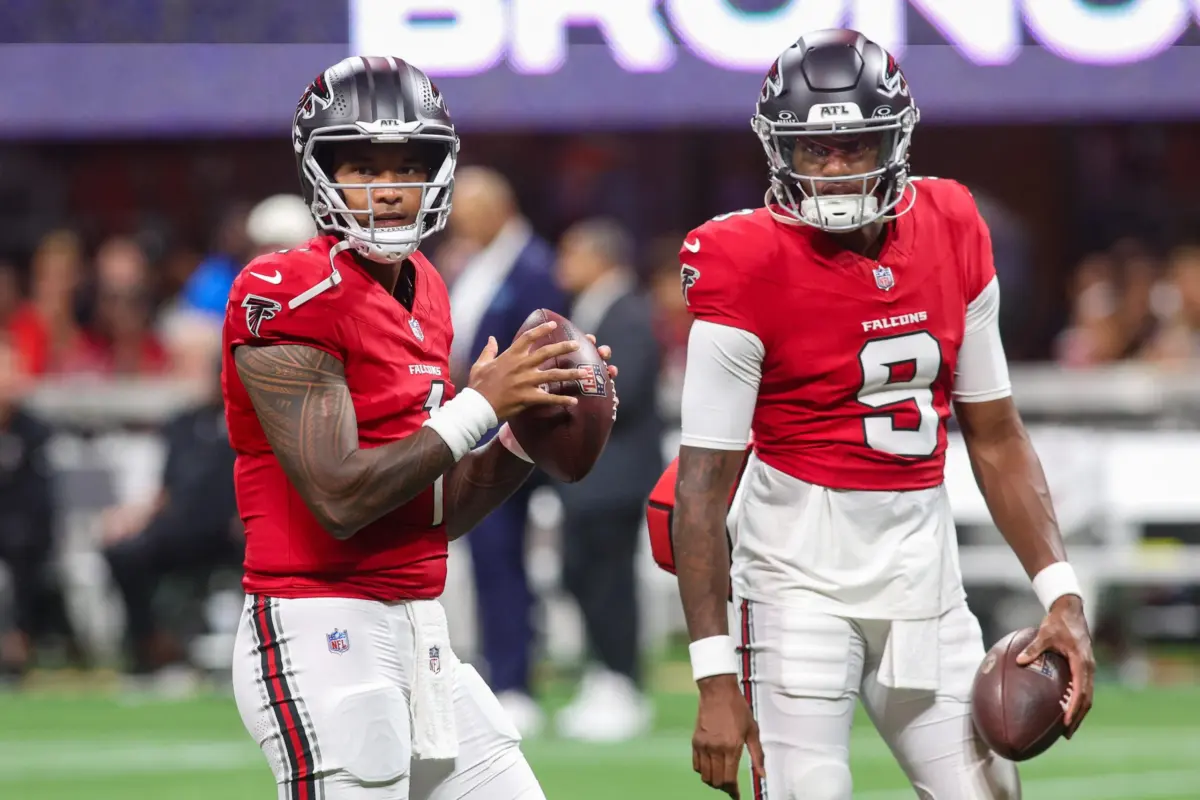
For any fan watching the Atlanta Falcons stumble out of the gate with an uninspiring 0-2 record heading into Thursday Night Football, a natural question surely came to mind: Who decided that subjecting a national television audience to the Atlanta Falcons in primetime repeatedly was a brilliant idea?
It is a fair criticism. For anyone following the team closely over the years, a rocky start to a season is hardly uncharted territory. However, the sweeping national narrative surrounding this specific iteration of the Falcons often misses crucial context, glossing over an astonishingly turbulent saga that has defined the franchise’s quarterback room throughout the 2026 season. Now, that storyline takes a massive turn as young starter Michael Penix Jr. is finally cleared to make his season debut in Week 3 against the Green Bay Packers.
Why was Michael Penix Jr. out?
The Falcons originally selected Penix with the eighth overall pick in the 2024 NFL Draft out of Washington, envisioning him as the long-term solution to the franchise quarterback void that had plagued the organization. That instability began in earnest when an ill-fated pursuit of Deshaun Watson effectively alienated Matt Ryan, forcing the front office to trade their longtime franchise cornerstone to the Indianapolis Colts and press the reset button.
Initially, the team’s blueprint allowed for a patient developmental curve. Atlanta signed high-profile free agent Kirk Cousins, coming off a devastating Achilles tear, expecting the veteran to shoulder the starting load while Penix learned the ropes. Instead, Cousins’ recovery lagged behind expectations, leading to visible struggles on the field. Penix was thrust into action for five games during his rookie season before capturing the starting job outright in 2025. Tragically, that momentum screeched to a halt when Penix suffered a season-ending ACL tear requiring complete reconstructive surgery—marking the third time in his football career that he has faced an ACL tear and subsequent surgical repair.
Although Penix received medical clearance prior to the team’s final preseason game, he revealed ahead of Week 2 that he had yet to hit specific physical benchmarks mandated by the medical staff. While he declined to elaborate on the exact nature of those metrics, the caution kept him sidelined for the opening two weeks of the season as he waited to feel entirely comfortable absorbing full-speed NFL contact. By Monday afternoon, however, the wait finally concluded, with the team officially naming Penix the starting quarterback for the marquee primetime matchup against Green Bay.
What was the plan at QB this season?
To be fair, the Falcons did enter the year with a comprehensive quarterback strategy, even if Penix’s rehabilitation timeline always carried a degree of uncertainty. The front office brought in Tua Tagovailoa as an experienced veteran presence and stopgap starter, while keeping Trevor Siemian on hand as insurance against the extensive injury histories of both Penix and Tagovailoa.
Then came the opening day of training camp, rendering those careful plans obsolete in a single morning.
Penix remained without full medical clearance. Tagovailoa found himself grounded by debilitating back spasms, unable to participate in practice. Compounding the disaster, Siemian was waived that very morning with an injury settlement, leaving the Falcons with just one healthy arm on the first day of camp: undrafted rookie free agent Jack Strand out of Minnesota-Moorhead. Scrambling for depth, Atlanta quickly worked out and signed Cooper Rush just moments before the opening practice session commenced.
With Penix watching from the sidelines, Tagovailoa, Rush, and Strand absorbed the bulk of the reps through training camp and the preseason. When Penix remained unready for Week 1, Tagovailoa drew the starting assignment, only to suffer a painful oblique injury that forced the coaching staff to pivot to Rush. In a cruel twist that felt almost custom-built to test the patience of Atlanta fans, Rush then injured his back during the team’s final walk-through of the week.
Necessity dictated that Rush start the season opener against the Pittsburgh Steelers anyway, and the results were predictably abysmal. Rush completed 12 of 22 passes for 143 yards, tossing one touchdown and two interceptions. The struggles continued into Week 2 against the Carolina Panthers, where Rush managed just 10 completions on 17 attempts for 86 yards, zero touchdowns, and another two picks. Throughout the week, the coaching staff split first-team practice reps between Rush and Penix in a desperate bid to get the latter ready for Carolina, a balancing act that likely hindered both players. When Rush was finally pulled during the game, he was replaced by Strand—a rookie who had taken zero practice reps with the starters leading up to kickoff.
That chaotic sequence of events brings the team directly to Thursday night and a hostile environment against the Green Bay Packers.
What to expect from Michael Penix vs. the Packers
The overarching question for Thursday night centers entirely on what kind of performance a rusty, untested Penix can deliver against a formidable opponent.
During training camp, the Falcons coaching staff went to creative lengths to prepare Penix for an incoming pass rush without exposing him to unnecessary contact, utilizing an exercise ball rolled directly toward him at the snap to simulate collapsing pockets. This week, Penix has finally enjoyed a full slate of starter repetitions during a condensed practice schedule. Medically cleared and fortified by a surgical reconstruction designed to dramatically reinforce the joint, Penix enters the contest with assurances that a fourth tear is structurally improbable—though any player returning from such a history inevitably battles psychological hurdles.
Those hurdles will be tested immediately by a menacing Green Bay defense. The Packers have already racked up seven sacks over their first two games, tying them for second-best in the NFL, and they enter Week 3 ranked first in the league in forcing negative-yardage plays. Meanwhile, the Atlanta offensive line continues to search for cohesion following the retirement of long-time right tackle Kaleb McGary. The team signed Jawaan Taylor in the offseason to fill the void, but his integration was delayed by injury. Taylor is expected to play through a rib injury sustained in Sunday’s loss to the Panthers, but his effectiveness at protecting the backfield against an elite pass rush remains a significant variable.
Further complicating matters is the adjustment required by the offensive line to accommodate a left-handed quarterback after spending the first two weeks blocking for right-handers Rush and Strand. A lefty alters the launch angles and backside protections of every passing play, meaning the offense must execute a seamless transition under the bright lights of primetime. If Penix is forced from the contest, Tagovailoa is expected to be active and available as the backup, sparing the offense from having to pivot back to a right-handed passer—barring a catastrophic cascade of injuries that, given the franchise’s recent history, cannot be entirely discounted.
The Falcons do possess a few subtle advantages heading into the matchup. Penix is physically fresh despite the short week, and opposing defensive coordinators have zero professional film of him operating within offensive coordinator Tommy Rees’s scheme. Furthermore, Penix boasts a significantly stronger arm than Rush, raising hopes that Atlanta can finally stretch the field vertically, unlock the immense physical traits of targets like Drake London and Kyle Pitts, and subsequently open up running lanes for dynamic playmaker Bijan Robinson.
Skepticism, however, remains entirely justified. It is difficult to envision Penix stepping seamlessly into game action after failing to see a single live snap since November 2025. While structural knee stability is less of a concern, rust, processing speed, and the sheer velocity of regular-season football could expose him to secondary risks.
At some point, however, the organization has to rip the bandage off. If Penix can shake off the rust and steer the Falcons away from a disastrous 0-3 start, the gamble will have been well worth taking for Atlanta.