
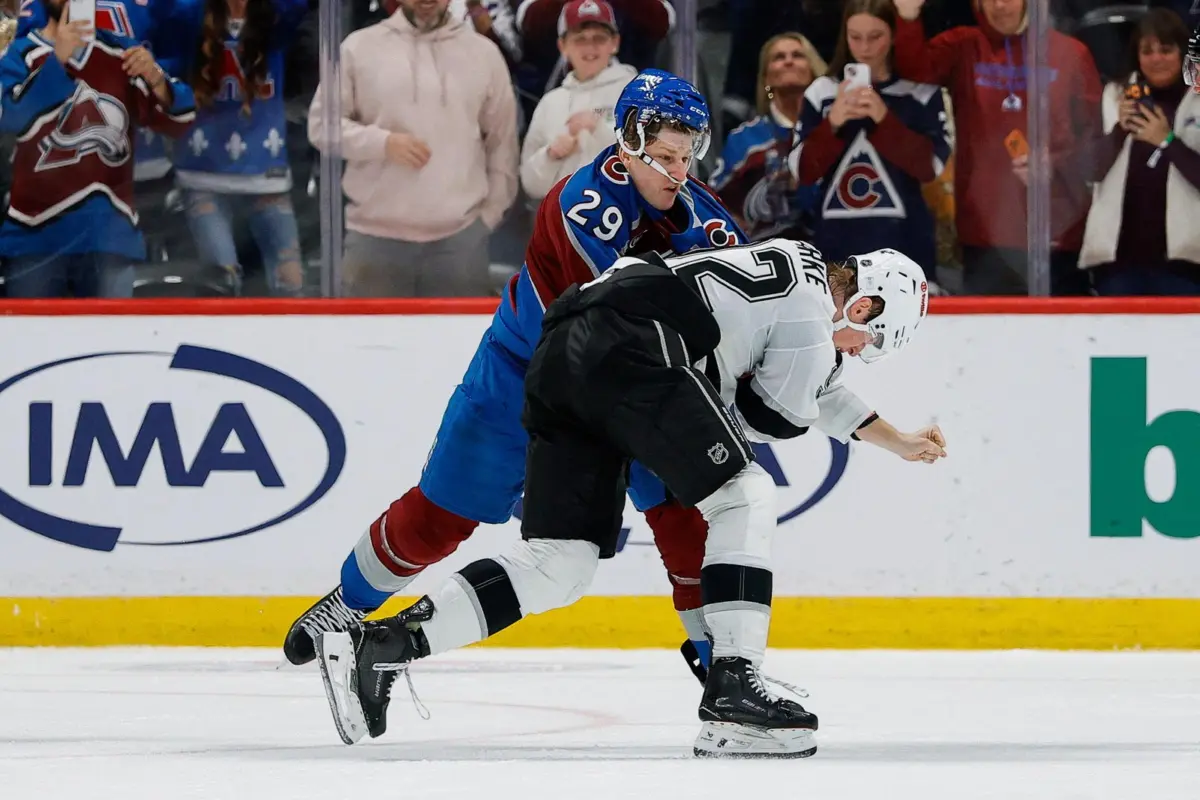
DENVER — Nathan MacKinnon has never been one to back down from a physical challenge, but there comes a point in a long and grueling NHL season when you have to wonder whether the risk of dropping the gloves is truly worth the reward for a Stanley Cup contender.
In less than two weeks, the Colorado Avalanche superstar has discarded his gloves twice in fights, a notable departure for a player who had gone 642 days between official NHL bouts. The first confrontation felt like a statement, a rare and thrilling glimpse into the competitive fire that fuels one of the league’s elite talents. The second, however, served as a stark reminder that as much as hockey fans and teammates might admire a player standing up for himself, the bigger picture demands a much higher level of caution.
MacKinnon remains the undisputed catalyst and heartbeat of the Colorado Avalanche. As a reigning Maurice "Rocket" Richard Trophy winner, he is the primary engine that drives their high-octane offense. He is a rare breed of hockey player who can completely take over a shift, a period, or an entire game using an explosive combination of world-class speed, exceptional stickhandling skill, and sheer psychological determination. He scores breathtaking goals, creates high-danger scoring opportunities out of nothing for his linemates, and dominates the ice in ways that few players in the modern National Hockey League can replicate.
Yet, that elite status does not mean he should have to answer every bell, nor does it mean he should court unnecessary danger.
The First Fight Was Justified. The Second Was a Warning Sign
The 2024-25 NHL opening night delivered a memorable and charged moment when MacKinnon actively went after Los Angeles Kings defenseman Brandt Clarke, a player who has managed to get under the skin of the Avalanche roster on more than one occasion over recent seasons.
According to MacKinnon’s post-game accounts from that night, the young Kings defenseman said something on the ice that the veteran center simply did not appreciate. Rather than letting it slide or waiting for a teammate to intervene, MacKinnon took matters into his own hands. He made it abundantly clear that he was not going to tolerate whatever was said, dropping his gloves and making Clarke pay dearly for crossing the line.
Was the retaliation justified? Within the unwritten codes of professional hockey, absolutely.
While the exact nature of the verbal jab remains private, there was an undeniably satisfying element to seeing one of the premier offensive talents in the world refuse to let an opponent run his mouth without consequence. MacKinnon sent a clear, emphatic message across the ice, decisively dropping Clarke in a decidedly one-sided physical bout.
However, a subsequent matchup against the Dallas Stars presented a drastically different scenario, highlighting the unpredictable nature of hockey enforcements.
During a hard-fought 3-2 victory over the Stars, MacKinnon found himself tangled up in a fight with Dallas forward Roope Hintz. The context of the bout added layers of intrigue: Hintz had suffered a lower-quality-of-life lower-body injury the previous season following a high-intensity play involving MacKinnon, though it was entirely a hockey play. Furthermore, Hintz had famously never engaged in a single regular-season fight at the NHL level prior to this meeting. To the surprise of many onlookers, Hintz managed to connect with a solid series of right hands during the exchange, which ultimately broke MacKinnon’s protective visor and reopened an old, sensitive cut on the bridge of his nose.
MacKinnon has consistently proven throughout his career that he is more than willing to get his hands dirty for the crest on the front of his sweater. This time, however, the visible physical consequences served as an immediate, bleeding reminder of what is fundamentally at stake every single time a generational superstar decides to trade bare-knuckle blows.
The Broader Impact on Colorado’s Championship Aspirations
Fighting will invariably remain a deeply entrenched part of hockey culture. When emotions inevitably boil over on the ice, players are expected to answer for their actions, and leaders often feel compelled to step up when a teammate is targeted. No sensible observer is suggesting that MacKinnon should be bubble-wrapped or that he should never throw another punch if the exact right moment demands it.
There is, however, a vast chasm of difference between standing your ground when a specific situation genuinely demands a physical response and putting yourself at completely unnecessary risk over a war of words or a lingering rivalry.

Put simply, the Colorado Avalanche organization simply cannot afford to lose their offensive engine—not for a multi-week stretch, not for a crucial game against a division rival, and frankly, not even for a five-minute major penalty in the middle of a tight contest.
MacKinnon is not merely another depth forward or a replaceable piece on the Colorado roster. He is the foundational player who makes the entire tactical machine go. His overall impact on the ice is virtually impossible to replicate from within the current lineup. When he is skating at full tilt, the Avalanche possess the terrifying ability to turn a routine defensive-zone possession into a high-danger scoring chance in the literal blink of an eye. Conversely, when he is absent from the bench—even for a single shift—the entire tactical dynamic, psychological weight, and momentum of the team shifts noticeably.
The franchise does not have to look far back in history to remember precisely what happens when Colorado is forced to navigate the regular season without its superstar center.
Back in December 2022, MacKinnon was forced to miss 11 consecutive games due to an upper-body injury. During that taxing stretch, the Avalanche struggled to find consistent offensive rhythm, losing five of those 11 games. If you factor in the specific game against the Philadelphia Flyers during which MacKinnon suffered the injury and had to exit early, that troubling winless tally climbs to six losses in 12 games.
It remains a stark, sobering reminder of just how heavily the Avalanche rely on MacKinnon’s nightly production, durability, and leadership. That historical context is precisely why seeing him take avoidable risks in the penalty box should give the coaching staff, management, and Avalanche fans considerable pause.
A hockey fight can change drastically in a split second. One misplaced punch, one awkward fall onto the unforgiving ice surface, or one unfortunate collision along the boards can leave a franchise player dealing with a serious upper-body or hand injury that sidelines him for weeks or months. When bare-knuckle combat is introduced into a high-speed sport, there are zero guarantees that even the toughest, most conditioned competitor will walk away unscathed.
MacKinnon’s toughness and competitive fire have never been called into question by anyone inside or outside the locker room. He can certainly handle himself in a physical altercation.
The real question facing the organization is whether the Colorado Avalanche can realistically afford to have their most important and irreplaceable player voluntarily placing himself in those high-risk situations when he doesn’t have to.
Even his teammates are well aware of the precarious stakes involved.
Fortunately for Colorado, the roster is constructed with plenty of other physical options when it comes to policing the ice and answering the bell. The team boasts established veterans and physical presences who are more than equipped to handle the rough stuff.
Whether it is team captain Gabriel Landeskog stepping up to drop the gloves, physical defenseman Josh Manson laying down the law, or young winger Zachary L’Heureux bringing energy and grit, the Avalanche have designated muscle. They can lean on almost anybody else on the bench to send a message.
What the Avalanche ultimately need from Nathan MacKinnon is not for him to risk his hands, facial structure, or long-term health in unnecessary fighting majors that someone else on the roster could easily manage. What they need is for him to stay healthy, stay out of the penalty box, and inflict maximum damage with his hockey stick by scoring dazzling goals and racking up assists.
That is where Nathan MacKinnon is at his absolute most dangerous, and that is where the Avalanche need him to be if they are to realize their championship ambitions.