
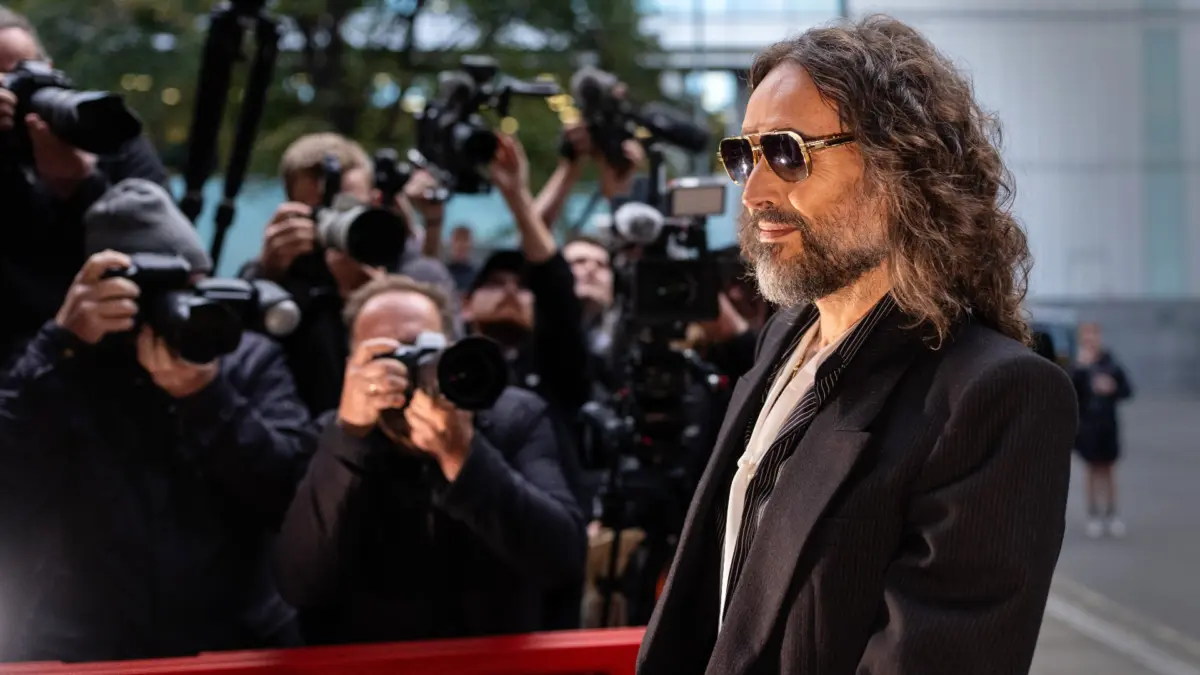
The high-profile trial of Russell Brand officially commenced at London’s Southwark Crown Court, drawing intense media scrutiny and public attention from across the globe. As the legal proceedings got underway, the prosecution delivered a stark and uncompromising opening statement, describing the disgraced actor and comedian as a "ruthless" and "calculated" sexual predator whose behavior across a decade spanned multiple workplaces and social settings.
The trial, which could last up to 10 weeks, brings together a 12-person jury consisting of eight men and four women. The selection process for the jury took place earlier in the week on Monday and Tuesday, setting the stage for the opening arguments and the presentation of evidence. On Wednesday, as the proceedings began in earnest, Brand was photographed arriving at the courthouse accompanied by his wife, Laura. According to courtroom reports, Laura remained a supportive presence throughout the session, reportedly offering warm smiles to her husband as the intricate and deeply serious details of the prosecution’s case were laid out before the court.
Brand, widely recognized for his prominent television and film career—including hosting roles on Big Brother’s Big Mouth and appearances in hit comedies such as Forgetting Sarah Marshall—faces a total of seven criminal charges. These include three counts of rape, three charges of sexual assault, and one allegation of indecent assault. The charges involve six different women and allegedly span a ten-year period from 1999 to 2009.
From the outset, Brand has strenuously denied all allegations brought against him. Speaking to a swarm of journalists gathered outside the courthouse on Wednesday morning before entering the building, Brand maintained a public posture of cautious optimism. "I feel blessed," he told reporters. "I feel, of course, concerned, but hopeful that this process will lead to good outcomes for everybody — that is my prayer." In the time since the allegations first came to light publicly, Brand has undergone a notable personal transformation, turning toward Christianity and being baptized, a development that has frequently accompanied his public statements regarding the controversies surrounding him.
The immense public interest and heavy media presence surrounding the case created significant logistical challenges at Southwark Crown Court. Court officials were forced to implement overflow arrangements, placing journalists in a dedicated "overflow room" where they were required to follow the day’s events through a video link, according to extensive coverage by BBC News. Inside the courtroom itself, reporters noted that Brand remained "very still" throughout Wednesday’s session, occasionally occupying his hands by rubbing what appeared to be a smooth pebble while listening to the arguments.
The prosecution’s case was formally introduced by lawyer Riel Karmy-Jones, who launched her opening remarks by portraying Brand as an individual who operated with calculated intent when pursuing his alleged victims. Karmy-Jones emphasized to the jury that the six women making the allegations "have never met each other, and who came forward independently of each other," highlighting the separate nature of their encounters with the defendant.
"His desire, strong desire for some form of sexual contact was indiscriminate and voracious," Karmy-Jones told the court in her opening statements, explicitly labeling Brand as a "sexual predator." To support this characterization of his past behavior, the prosecutor cited testimony from a former friend and acquaintance of Brand. According to this witness, Brand had frequently bragged about his lifestyle, describing himself as "a ladies man, a womaniser, and an expert pick-up artist." The former acquaintance alleged that Brand had set himself a personal target to "bed 5,000 women" in his lifetime, establishing specific internal "rules" designed to help him achieve that goal.
Moving into the specific allegations, Karmy-Jones outlined the accusations made by the first complainant, whose claims Brand maintains are entirely untrue. At the time of the alleged incident, the woman was in her twenties. The prosecution asserted that Brand told her "exactly what she needed to hear" and manipulated the circumstances to engage in sexual activity with her "against her will." According to the narrative presented in court, the complainant had initially assumed Brand was gay. During their interaction, she left the room to use the bathroom, instructing him to make a cup of tea while she was gone.
When she emerged from the restroom, the prosecution stated that Brand was partially undressed. "She was taken aback, she was shocked and didn’t really know what to do, and in her words, she froze a bit," Karmy-Jones told the jury. Following the alleged rape, the prosecution noted that Brand was later questioned by police regarding the incident. At the time, he stated that if the event had occurred, he had no memory of it, nor did he remember the complainant’s name, though he maintained that he "had never engaged in non-consensual activity." The first complainant stated that she had remained silent for years out of fear, feeling "too scared to say anything" because of Brand’s rising celebrity status and public profile.
The second complainant’s allegations date back to 2001, involving an incident of alleged indecent assault when she was in her thirties and working at MTV. According to the prosecution, the woman had complimented Brand on his T-shirt, prompting him to offer to give the item of clothing to her. "Make sure you give it a good wash first," she reportedly joked, offering to show Brand where the building’s restrooms were located. Prosecutors alleged that once near the facilities, Brand asked her to "come in" and grabbed her forearm. The woman began to struggle and pull back, later describing to investigators a "desperate, wide-eyed look on his face," as reported by the BBC. Brand eventually relented, releasing her arm and entering the toilet alone.
A third complainant stepped forward with allegations stemming from a 2004 party held in Soho, London. The prosecution detailed to the jury that while the woman was engaged in a conversation with Brand, he suddenly lurched forward, grabbed both of her breasts, and squeezed them with his hands. The woman was reportedly left "shocked" while Brand maintained a "big, weird grin" on his face. He then allegedly grabbed her arm and pulled her toward the toilets. Later that same evening, as they were driving to another venue, the prosecution stated that Brand exposed himself, pulling out his penis and instructing the complainant to "suck it." Karmy-Jones noted that while Brand simply laughed at her immediate refusal, he appeared to accept it at that moment.
The fourth complainant’s allegations center around an incident that occurred between 2004 and 2005 at Capital Radio. The prosecution stated that Brand aggressively "grabbed" the woman’s face with both hands and pushed her against a wall. According to Karmy-Jones’ summary of the counsel’s brief, Brand "also grabbed her body, at her breasts, sides and buttocks — aggressively." The complainant attempted to push him away, but "he was too strong," continuing to kiss her face, neck, and chest area while keeping a tight grip on her body until she finally managed to push him off with enough force to escape. Brand denies all of these claims.
The fifth complainant is reportedly the youngest of the women involved in the trial. She alleged that she met Brand in London in 2009 when he was performing a live show at the Hammersmith Apollo. The interaction initially began with consensual vaginal sex. However, Karmy-Jones told the jury that the woman "did not really enjoy the experience," finding it "very awkward" and feeling that "it could have been anyone." Following this, the prosecution alleged that Brand raped her anally while she explicitly asked him to stop. "She spent months and years blaming herself for what had happened, and became extremely anxious and continued to be unwell as a result," Karmy-Jones told the court.
Prosecutors stated that following this encounter, the woman received a text message from Brand. When she responded by asking why he was messaging her, Brand allegedly replied, "Because you’re dirty, and I wanna push you further." The fifth complainant told the court she answered, "I think you pushed me far enough — you treated me like an animal." According to the testimony, Brand immediately replied with an apology saying, "I’m sorry," and the woman never saw or heard from him again. When interviewed by police regarding this specific allegation, Brand provided a formal statement maintaining his innocence. "In that statement he set out that he has never engaged in non-consensual sexual activity, and that any accounts had been reinvented or imagined after a defamatory documentary and subsequent press reporting," the counsel informed the court.
The sixth and final complainant alleged sexual assault, stating that Brand demanded a massage while she was working with him in 2009. When she refused his demand, Brand reportedly became unhappy and insisted he would not complete his work task unless she complied. The prosecution alleged that he then dropped to his knees "and placed his head directly into her groin area." The woman made a formal complaint about the incident at the time in 2009, and the matter reportedly went "higher up the ladder," though she felt at the time that her concerns were not taken seriously by management.
Throughout the opening days of the trial, the defense’s overarching position has been reiterated to the jury: Brand denies every single allegation leveled against them by the six women. Toward the conclusion of Wednesday’s court proceedings, the jury was reminded once more of the prepared statement Brand previously provided to law enforcement. In it, he asserted that he had never engaged in non-consensual sexual activity throughout his life, and maintained that the accounts presented by the complainants were either "reinvented or imagined" in the wake of a critical documentary and subsequent extensive press reporting.
As the legal teams prepare to call further witnesses and present additional evidence, the courtroom proceedings at Southwark Crown Court are expected to continue for several weeks, with legal estimates suggesting the trial could extend up to a full duration of 10 weeks.