
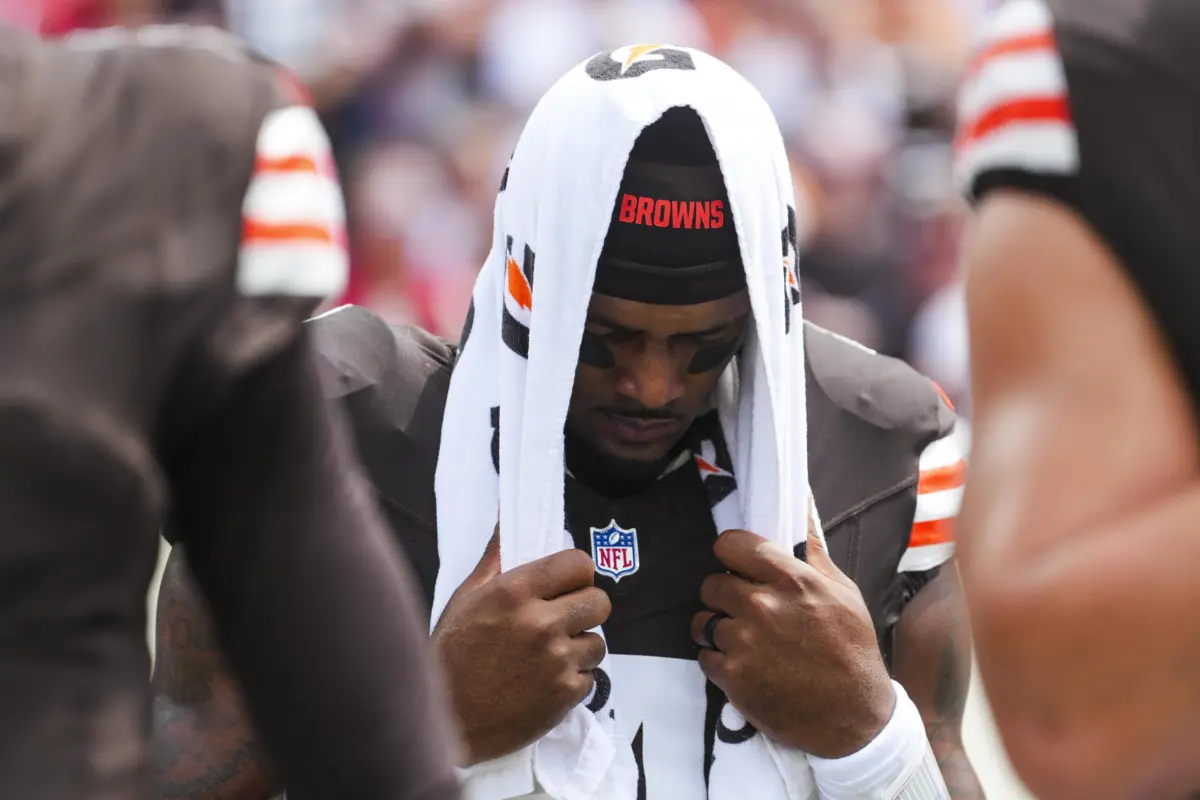
It was virtually impossible to tune into a recent broadcast of Thursday Night Football without being relentlessly confronted by veiled references, cautious framing, and outright revisionist history regarding Deshaun Watson’s deeply troubling past. In what has rapidly unfolded as one of the most thoroughly disheartening and transparent rehabilitation campaigns in modern sports media memory, the broadcast booth went to extraordinary lengths to polish a tarnished image. Broadcaster Kirk Herbstreit, in particular, leaned heavily into praising Watson for the better part of the game, deftly repackaging the quarterback’s alleged sexual misconduct involving 27 different women as mere "past troubles" and framing the Cleveland Browns’ recent gridiron success as an inspiring tale of raw perseverance against adversity.
The evening’s media coverage set the tone early with a sit-down interview conducted by reporter Taylor Rooks and Deshaun Watson. Across the entire segment, the conversation never once directly addressed the women he allegedly abused. Instead, the dialogue relied heavily on vague, sanitized references to criticism aimed at "Deshaun Watson the person," treating his controversies with the detached casualness of a minor public disagreement, as if his greatest transgression was a controversial culinary preference. Viewers were subjected to a prolonged stream of hollow platitudes as Watson pontificated about the personal struggles he has allegedly pushed through, his desire to achieve greatness, and his fundamental disagreement with anyone who dares question his character. On multiple occasions, Watson dropped jaw-dropping remarks about his own pressing need to forgive others. Truly, the man accused by dozens of women of predatory sexual behavior presented himself as the aggrieved party, suggesting that his grandest takeaway from the ordeal was finding it within himself to forgive the fans who dare to boo him.
The sports world is certainly no stranger to the whitewashing of past indiscretions, particularly when those indiscretions involve violence or misconduct against women. It has long followed a depressingly predictable cycle: initial silence and public relations crisis management, followed by a quiet period of rehabilitation, and ultimately a return to business as usual under the bright lights of the stadium. Yet, what makes the ongoing situation surrounding Watson distinctly unique is the aggressive fervor with which announcers and media personalities are attempting to actively erase his off-field actions, shifting the narrative entirely toward a superficial focus on on-field performance. Herbstreit’s commentary during Thursday Night Football crossed the line from standard broadcast cheerleading into something genuinely vile as he explicitly highlighted fans booing Watson, his early struggles as the signal-caller for the Browns, and his supposed triumph in overcoming all of that noise to guide the franchise toward victory.
Conspicuously absent from the evening’s extensive narrative was any mention of Watson’s lengthy NFL suspension, the franchise-altering, backbreaking contract the Browns handed him upon his arrival, or the substantial financial settlements paid to women to ensure their permanent silence. Any viewer tuning into a Cleveland Browns game for the very first time on that Thursday night would have been forgiven for walking away with the distinct impression that Watson was merely a tragic victim of irrational fan expectations, rather than a player who strategically leveraged a two-tier justice system and tens of millions of dollars to pay off his accusers rather than face a genuine accounting of his actions in a court of law.
To look at the situation with absolute clarity requires stripping away the broadcast gloss: if Deshaun Watson were not a multi-millionaire with access to the immense financial resources required to settle out of court with his accusers to the tune of an estimated $50 million, the trajectory of his life and career would look entirely different. At the absolute minimum, he would have been forced to endure the grueling process of legal discovery, a phase that could easily have unearthed damaging evidence capable of breathing new life into stalled criminal proceedings. Fortunately for Watson, the socio-economic reality of modern justice is rarely equal, and the immense security provided by his lucrative NFL contracts ultimately insulated him from facing criminal charges or meaningful, lasting consequences.
During the critical, high-pressure final drive of regulation, Herbstreit casually referred to Watson as "much maligned," while fellow broadcaster Al Michaels chimed in with emphatic capitalization, seemingly eager to make light of a deeply serious situation. This was never simply a routine story of a professional quarterback struggling to find his rhythm on the field or playing subpar football. At its core, the situation involves a player whose alleged serial abuse alienated a massive segment of the fan base, particularly when the Cleveland organization deliberately chose to support, protect, and insulate him rather than make the principled decision to cut ties, absorb the temporary competitive hit, and move forward.
The current reality is the culmination of a catastrophic convergence of organizational incompetence. Had the Browns not panicked and handed Watson the most fully guaranteed quarterback contract in the history of the National Football League, they could have easily cut ties with him two years ago when his on-field performance plummeted. Instead, he has lingered on the roster like a malignant tumor, granted the opportunity to start simply because he has managed to perform marginally better than two remarkably poor alternative options on the depth chart. It is an unenviable predicament that closely mirrors choosing to contract a mild illness simply because the other available options are exponentially worse.
Despite the heavy PR push, the objective truth of the matter is that the Cleveland Browns are winning football games primarily because their defense is legitimately fantastic, carrying the heavy lifting of the team while Watson plays just well enough to avoid actively sinking them. A close examination of Watson executing the quarterback position reveals an offense that is hardly benefiting from individual brilliance. On the whole, Watson has looked remarkably mediocre, frequently missing wide-open receivers downfield and struggling to consistently orchestrate a game-winning drive. Cleveland secured victories over the Tampa Bay Buccaneers only after their opponent struggled significantly, over the Carolina Panthers while they were missing several key starters, and over the Pittsburgh Steelers against a declining veteran quarterback. Credit is due to the team for executing the games directly in front of them—as winning is ultimately every professional squad’s baseline job—and the Browns’ defense deserves immense praise for their stellar play. However, Watson is hardly the catalyst behind this team’s success; rather, he is merely a passenger benefiting from the relentless hard work of his teammates.
In an era dominated by identity-driven sports broadcasting, telling the unvarnished, complicated truth is rarely deemed compelling or profitable by networks. Focusing instead on defensive stalwarts, highlighting the contributions of middle linebacker Carson Schwesinger, or shining a light on a dynamic pass rusher like Jared Verse simply does not fit the preferred quarterback-centric narrative that leagues and broadcasters love to peddle. Quarterbacks have reigned supreme over NFL media coverage for decades, yet Deshaun Watson has earned neither praise nor focused rehabilitation, and under the weight of his history, he never truly will. The decision by those involved with Thursday Night Football to transform a premier sports broadcast into an explicit vehicle for attempting to cleanse the public image of a serial abuser remains a profound disappointment to viewers everywhere.