
In the demanding world of professional hockey, one athlete’s misfortune routinely paves the way for another’s defining moment. When the injury bug tears through an NHL roster, it strips away a proven contributor’s invaluable talents, but it simultaneously hands a lesser-known skater, a journeyman, or a rising prospect an unfiltered audition to prove they belong on the game’s grandest stage.
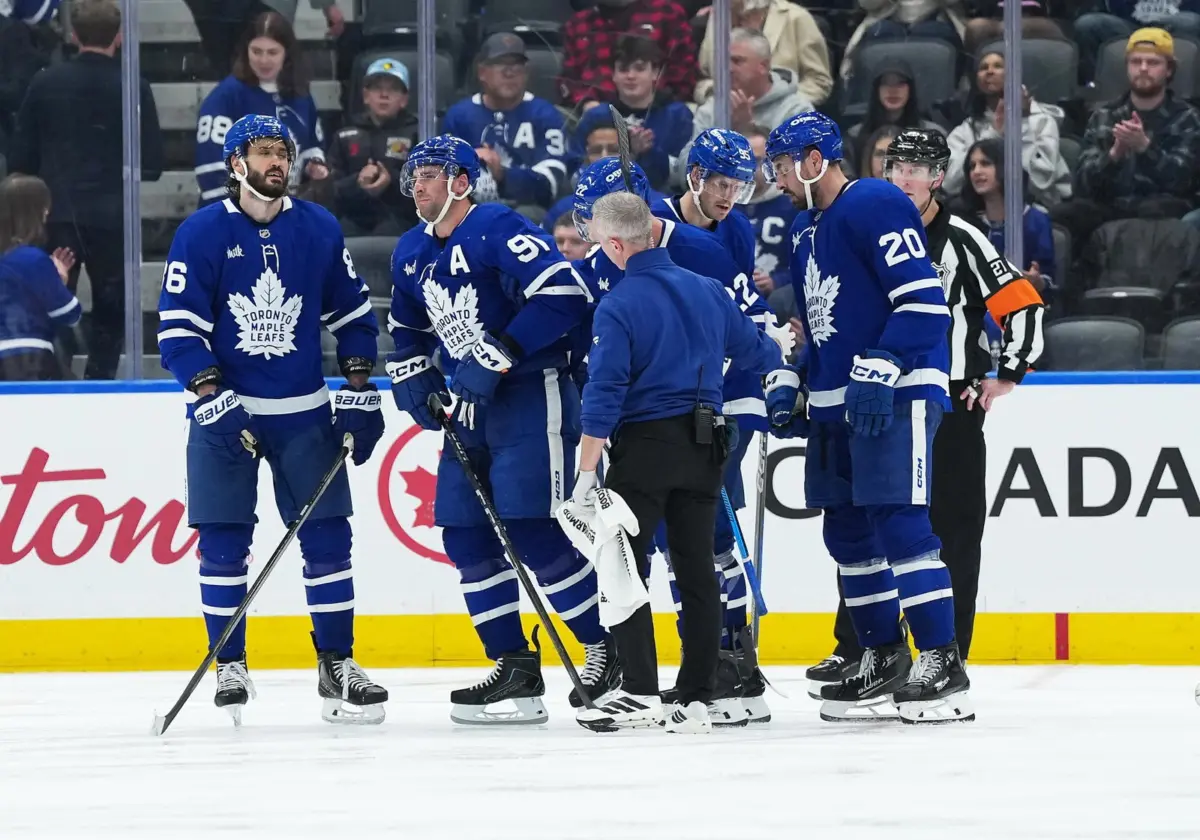
For the Toronto Maple Leafs, that harsh reality struck on Thursday night during a hard-fought matchup against the Buffalo Sabres. Star center John Tavares suffered a lower-body injury that immediately triggered concern across the organization. Following further evaluation, the Maple Leafs officially announced on Saturday that Tavares would be sidelined on a week-to-week basis, dealing a notable blow to a team striving to cement its status as a frontrunner in the fiercely competitive Atlantic Division.
While Toronto will undoubtedly miss Tavares’ veteran presence and remarkable consistency, the veteran pivot was once again producing at an elite point-per-game pace to start the campaign, racking up seven points through his first seven games. His absence leaves a massive void down the middle. Rather than panicking, the Maple Leafs coaching staff and front office have opted to view the situation through an opportunistic lens, redistributing crucial minutes and elevated roles to other members of the roster.
"You know, John was playing well too. That’s a tough one for us," Maple Leafs coach Jim Hiller said following the team’s morning skate on Saturday. "You know, just on the heels of Tanev, too. So those are two veteran players, and you just got to find a way."
Depth Centers Given the Reins
The ripple effects of Tavares’ absence were immediately visible on Saturday night when the Maple Leafs suited up against the New York Islanders, ultimately dropping a 4-1 decision. With their top-six structure altered, Hiller turned to depth forwards Nick Paul and Colton Sissons to shoulder heavier responsibilities.
Paul found himself thrust into the role of Toronto’s second-line center for the contest, flanked by talented youngster Easton Cowan and star sniper Kirill Marchenko. It is a significant promotion for a player who has quietly gone about his business in a limited sample size this season, posting three assists and four points across nine games while averaging a modest 15 minutes and 46 seconds of ice time. That usage aligns closely with Paul’s career baseline; the 31-year-old has averaged 15 minutes and 22 seconds of ice time across 546 career games.
Lately, however, Paul’s usage has begun to trend upward. In three of his last five appearances, he has logged at least 17 minutes and five seconds of ice time. With Tavares out of the lineup indefinitely, hockey analysts and fans alike should expect Paul to maintain that enhanced workload moving forward. Interestingly, he played just 14 minutes and 36 seconds against the Islanders, though that lower total was largely an anomaly driven by a disciplined game in which the Maple Leafs took only two minor penalties.
Meanwhile, fellow veteran Colton Sissons has also positioned himself to capitalize on the shifting landscape of Toronto’s forward group. The 32-year-old has notched two goals and three points in nine games this season, averaging 15 minutes of ice time per night. Yet, much like Paul, Sissons has seen spikes in his usage, logging at least 16 minutes and 50 seconds in two of his past four outings.
Sissons embodies the exact brand of hard-nosed, gritty hockey that Hiller wants his entire lineup to exhibit on a nightly basis. That stylistic fit has earned him the coach’s trust, and he started Saturday’s game against the Islanders skating on a line alongside budding star Gavin McKenna. The logic from the coaching staff is straightforward: if a depth forward cannot produce offensive results while playing alongside a dynamic talent like McKenna, they likely cannot produce points with anyone on the roster.
The depth of Hiller’s trust in Sissons was further underscored late in the third period against the Islanders, when the coach deployed the veteran forward with the goaltender pulled in search of a crucial faceoff win on his strong side.

McKenna Elevated to the Power-Play Spotlight
Speaking of McKenna, the exceptional young talent is also poised to reap the benefits of Tavares’ absence by stepping into a more prominent offensive role. Specifically, McKenna is getting a major promotion to the Maple Leafs’ first power-play unit.
When Tavares was healthy and anchoring the power play, McKenna was utilized as a complementary piece on Toronto’s second man-advantage group. With the veteran center sidelined, however, McKenna has been bumped up to skate alongside elite superstars Auston Matthews, William Nylander, Kirill Marchenko, and defenseman Darren Raddysh. This high-octane grouping has the potential to supercharge McKenna’s development while simultaneously injecting a fresh spark into Toronto’s top power-play configuration.
If Tavares is forced to miss a month or more of action, the Maple Leafs will inevitably feel the pinch. While the veteran center may no longer possess the exact explosive offensive gear he showcased when he first arrived in Toronto as a prized free agent, he remains a vital, intelligent component of the team’s tactical framework. The organization will undoubtedly welcome him back with open arms whenever he is cleared to return to the ice.
In the interim, however, Tavares’ injury could ultimately yield positive dividends if it serves as a catalyst for other players to step out of the shadows and prove they possess another gear.
"Obviously John’s a big piece," Easton Cowan said regarding the injury. "Unfortunately, you know, things like that happen. So I feel like just the next man up. We’ve got a lot of good players. So I’m just looking to, you know, get two points here tonight and keep it rolling."
The Challenge for Leafs Brass and Blue-Collar Contributors
Ultimately, the Maple Leafs will require their blue-collar competitors to contribute meaningfully across the board to weather this storm. Players like Paul, Sissons, and Raty may not possess the generational natural talent of a Tavares or a Matthews, but if they remain opportunistic and squeeze every ounce of value out of their increased playing time, Hiller and general manager Brad Chayka will be thrilled with the returns.
If those depth options successfully answer the call, Chayka will be spared from having to aggressively scour the trade market to artificially patch the holes in his roster. Chayka notably carved out an open roster spot through a previous trade involving Raty; therefore, if the internal candidates fail to seize their golden opportunities, management will not hesitate to strike on the trade front to address the team’s evolving needs.
The sooner Tavares makes his triumphant return to the lineup, the better positioned the Maple Leafs will be for a deep run. But the immediate void he leaves behind functions as the ultimate carrot for Hiller and Chayka to dangle before the rest of the roster. How the supporting cast responds to these expanded roles will go a long way toward deciding Toronto’s positioning within the Atlantic Division standings as the autumn schedule progresses.
The initial return against the Islanders yielded a negative result, but with a softer schedule awaiting the club as the month of October winds down, the Maple Leafs must capitalize on the terrain ahead.
The Buds undoubtedly possess an abundance of high-end, elite talent at the top of their lineup, but extracting maximum productivity from their hardworking depth pieces remains the defining challenge for the front office and coaching staff. Time will tell whether those supporting players rise to the occasion or if sweeping changes are ultimately on the horizon in Toronto.