
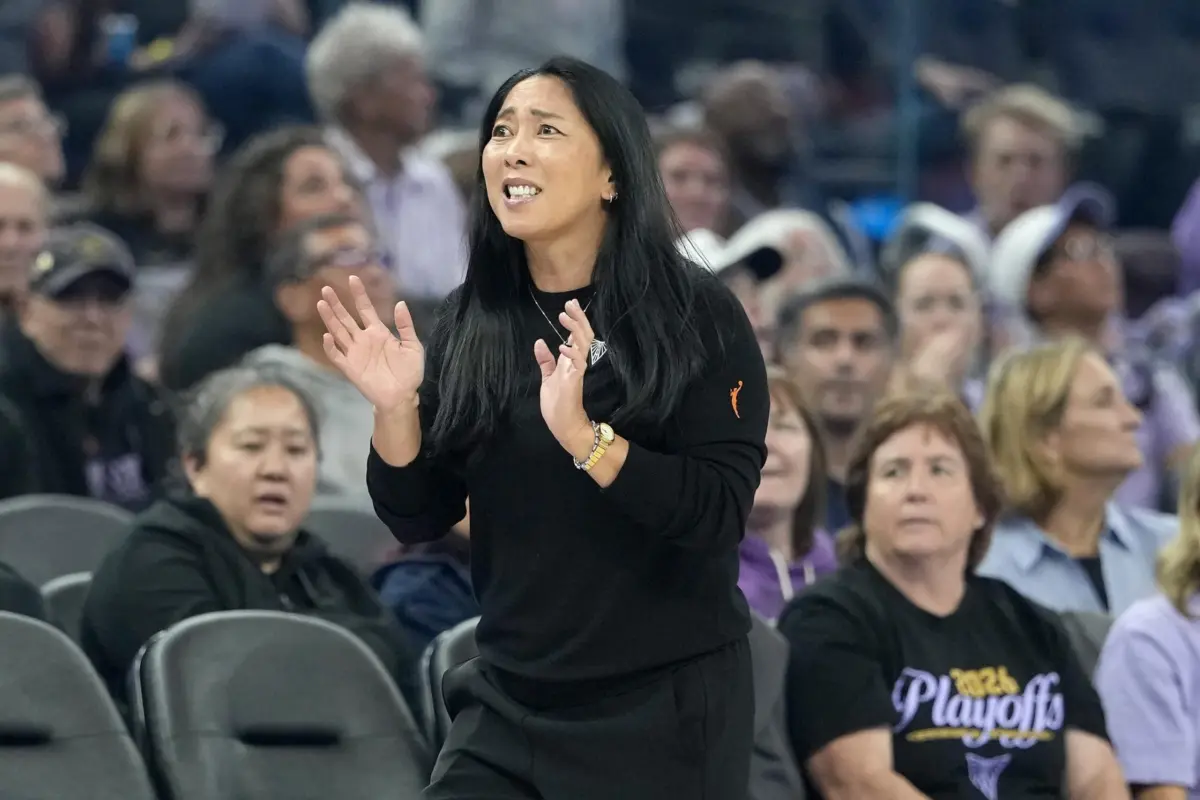
Evaluating the WNBA Coach of the Year award is an inherently peculiar exercise. The accolade is typically bestowed upon the tactician who has most visibly exceeded external expectations. Because the media maintains limited inside access to professional team locker rooms, practices, and analytical planning sessions, it can occasionally prove difficult to precisely parse who deserves the credit—and who deserves the blame—for a given team’s weekly performance on the hardwood.
Still, evaluating these achievements remains a fundamental part of covering the league.
Last season, Golden State Valkyries head coach Natalie Nakase emerged as the near-universal choice for the WNBA’s Coach of the Year award following an impressive inaugural campaign. Under normal circumstances, claiming the league’s top coaching honor in a team’s very first year would mean a manager likely wouldn’t win it again for at least a few seasons, as voters naturally look to spread recognition or wait for new narratives to emerge.
Yet, after considerable evaluation of the competitive landscape, the compelling case for Nakase points toward a repeat honor. She has successfully orchestrated one of the most remarkable franchise transformations in recent memory, turning the Valkyries from a gritty fringe playoff team in their debut season into one of the most thoroughly dominant forces in the WNBA.
The Valkyries have systematically maximized their roster’s potential, anchoring the second-best record in the league at 31-12. Furthermore, they boast the absolute best point differential across the WNBA, outscoring their opponents by an average of 7.2 points per contest. That dominant margin even manages to outpace the formidable Minnesota Lynx and their impressive +6.9 net rating.
A vast majority of that sustained success has been powered by a suffocating, elite-tier defensive identity. The Valkyries currently command by far the best defensive rating in the WNBA, locking opponents down with a staggering 99.4 defensive rating. For context, the second-best defensive rating in the league belongs to the Washington Mystics at 103.8, highlighting just how wide the statistical chasm is between Golden State and the rest of the competition. The Valkyries restrict their opponents to a meager 75.1 points per game; the next-lowest opponent scoring average is the Mystics’ 82.5 points per game.
As noted, Natalie Nakase captured the Coach of the Year award last year as well, and conventional voting patterns dictate that coaches rarely receive the honor in back-to-back seasons. However, looking at precedent across other major WNBA accolades provides a compelling counterargument. If superstar forward A’ja Wilson can repeatedly claim the Most Valuable Player award year after year due to her sustained excellence, why shouldn’t Nakase be similarly rewarded for significantly outdoing her own exceptional Year 1 performance?
The Valkyries were universally praised for being exceptionally competitive during their first year post-expansion. At various points during the early days of that debut season, observers wondered if other recent expansion additions, such as the Portland Fire and the Toronto Tempo, might follow a similar trajectory toward immediate competitiveness. Instead, both the Fire and the Tempo currently wallow among the bottom three records in the league, finishing their respective campaigns in a vastly different reality than the one the Valkyries navigated last season when Nakase guided the franchise to the eighth seed with a 23-21 record.
Rather than remaining stagnant or suffering the typical regression associated with young expansion franchises, Nakase and her dedicated coaching staff ensured that the organization would take another massive competitive leap forward in Year 2. They built directly upon an already robust defensive framework to transform the roster into an absolute powerhouse on that end of the floor. Today, the Valkyries are no longer viewed merely as a feel-good playoff story—they are a legitimate championship contender, achieving this status despite not carrying a single player who averages 15 points or more per game.
Nakase has masterfully managed the minutes, player loads, and rotations of a deep Golden State roster throughout the grueling WNBA calendar. She has successfully instilled a profound level of confidence in backup point guard Kaitlyn Chen, who is currently playing through a breakout career year. She has maintained unwavering trust in Veronica Burton, utilizing her as a foundational franchise cornerstone. Consequently, advanced analytics consistently rank Burton as one of the most impactful and effective players in the entire league.
Moreover, Nakase has figured out how to extract maximum value from veteran contributors like Tiffany Hayes and Kayla Thornton. While both players have experienced more reduced, specialized on-court roles this season, they continue to serve as absolutely critical components of the team’s collective success. Nakase has also played an instrumental role in elevating center Kiah Stokes into a legitimate Defensive Player of the Year candidate through her precise defensive schemes and clear role definition.
Naturally, questions remain regarding whether the Valkyries are fully prepared for deep postseason success or if they are simply a dominant regular-season juggernaut. Right now, it remains slightly too early to tell for certain, though the upcoming weeks of high-stakes basketball will provide those definitive answers. Even so, the Coach of the Year award is fundamentally a regular-season accolade, and no tactician in the league has done a more thorough, effective job of maximizing their personnel than the second-year Valkyries head coach.
Other Candidates Considered for WNBA Coach of the Year
While Nakase ultimately stands out as the most deserving recipient for her continuous growth and defensive mastery, there were several other exceptionally strong candidates under consideration for the WNBA’s top coaching honor this season.
Minnesota Lynx head coach Cheryl Reeve deserves a tremendous amount of credit for the way she has navigated a complex and demanding campaign. Reeve successfully empowered rookie point guard Olivia Miles, expertly managed Napheesa Collier’s extended absence due to injury, and helped forward Natasha Howard achieve a career-best year. The Lynx functioned as one of the most consistent teams in the league all season long, and had they finished the regular season significantly ahead of the Valkyries in the standings, Reeve’s candidacy would have been particularly salient. Ultimately, however, Reeve was working with a fundamentally more talented roster than Nakase inherited. With players like Napheesa Collier, Olivia Miles, Natasha Howard, Kayla McBride, and Courtney Williams all earning All-Star nods over the past two seasons, the Lynx boast immense firepower, yet they currently sit just a single game ahead of the Valkyries in the fiercely contested league standings.
Washington Mystics head coach Sydney Johnson also merits serious consideration for the award. Few analysts or pundits could have reasonably projected that the Mystics would occupy their current position in the standings at this stage of the year. It has become abundantly clear that Johnson has proven to be the absolute ideal tactical fit for a young, energetic squad spearheaded by emerging talents Shakira Austin, Sonia Citron, and Kiki Iriafen. Under Johnson’s guidance, the Mystics fielded the second-best defense in the entire WNBA while consistently extracting maximum production from hard-working role players such as Michaela Onyenwere and Cotie McMahon.
Meanwhile, Las Vegas Aces head coach Becky Hammon remains a perennial candidate for the Coach of the Year award. The Aces once again rank firmly among the elite tier of WNBA teams, holding a stellar 30-13 record despite facing significant adversity, including the midseason departure of Chennedy Carter and a devastating ACL tear suffered by NaLyssa Smith. Yet, Las Vegas will undoubtedly be heavily rewarded across other categories on the end-of-season ballots. Given that the Coach of the Year voting history heavily emphasizes teams that dramatically exceed external preseason expectations, Hammon finds herself in a challenging position for this specific honor, considering she routinely deploys two Team USA Olympic guards in Jackie Young and Chelsea Gray alongside the undisputed best player in the world in A’ja Wilson.