
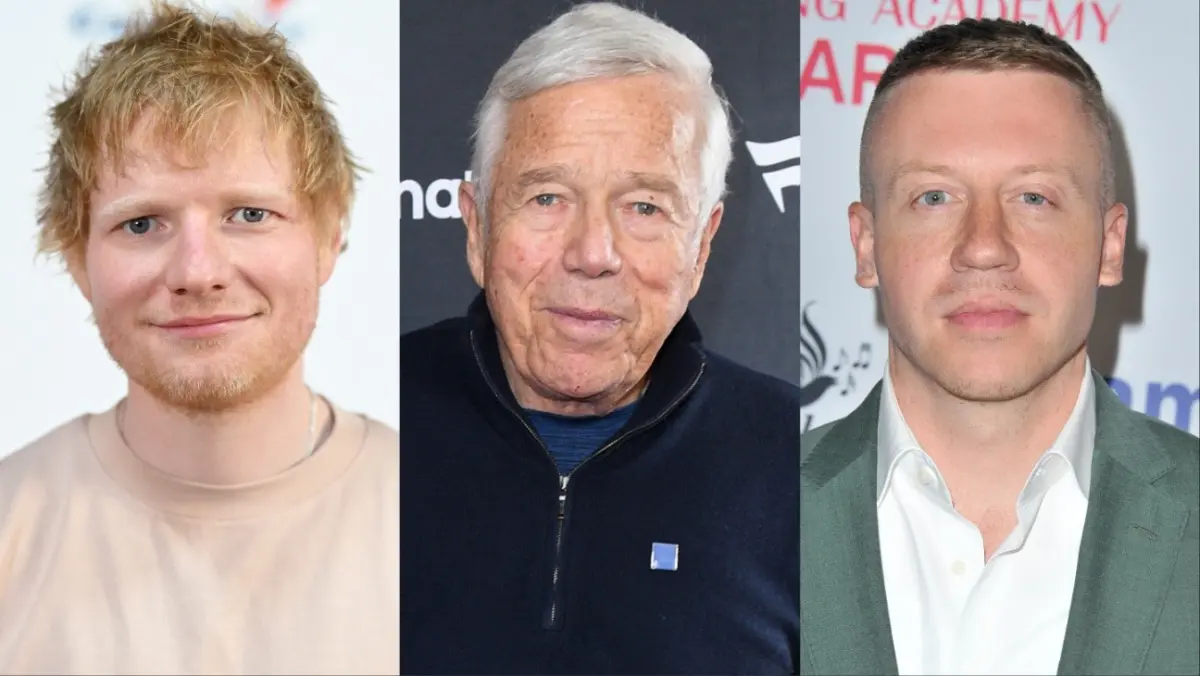
The controversy surrounding Macklemore’s removal from Ed Sheeran’s U.S. Loop Tour continues to generate industry-wide shockwaves, with new reporting shedding light on the intense behind-the-scenes negotiations, high-stakes phone calls, and venue ultimatums that ultimately brought the rapper’s tenure as an opening act to an abrupt end. Fresh details have emerged regarding assurances allegedly given to prominent NFL stadium owners prior to Macklemore’s final performance, illustrating how a clash over political speech, major sports venues, and live music promotion collided into a major industry crisis.
According to reporting published by The Wall Street Journal, communications intensified rapidly between Ed Sheeran, the promoters of the Loop Tour, and a powerful cohort of NFL stadium owners following Macklemore’s initial stage remarks. The friction began on September 4 at MetLife Stadium, where the Grammy-winning rapper declared "Free Palestine" from the stage before performing his pro-Palestinian song, "Hind’s Hall." The overt political statement immediately drew intense scrutiny from advocacy groups, concertgoers, and venue stakeholders alike.
Following the September 4 concert, representatives for several high-profile NFL owners—including New England Patriots and Gillette Stadium owner Robert Kraft, Carolina Panthers owner David Tepper, Atlanta Falcons owner Arthur Blank, and Philadelphia Eagles owner Jeffrey Lurie—reportedly reached out to the Messina Touring Group, the promoters handling Sheeran’s U.S. tour. According to the WSJ, the venue representatives and promoters engaged in urgent discussions regarding Macklemore’s political commentary, during which assurances were allegedly provided that the rapper would not bring up the issue of Palestine during his subsequent performances.
Despite those reported discussions, Macklemore took to the stage the very next night during the second consecutive concert at MetLife Stadium on September 5 and doubled down on his message. Addressing the audience directly, the artist stated that one of the reasons he wanted to join the tour was to stand on stages across America and voice two words very dear to his heart: "Free Palestine." He added a direct appeal to the audience, stating that his message was directed toward all of his Jewish brothers and sisters, and emphasizing that criticism of Israel, apartheid, or genocide should in no way be interpreted as a criticism of Jewish people as a whole.
The second night’s remarks were swiftly amplified across mainstream media outlets and social media channels. The comments followed an escalating public campaign calling for the rapper’s removal from the tour, spearheaded by the Israeli-American Council, which had formally petitioned Ed Sheeran to drop the artist. Additional pressure mounted from prominent advocacy groups, including StopAntisemitism and the Combat Antisemitism Movement, as well as fellow recording artist Pink, who publicly joined the chorus of voices calling for Macklemore’s exclusion from the remaining tour dates.
As public pressure mounted and media scrutiny intensified, private discussions at the executive level reached a boiling point. The WSJ detailed a critical, 40-minute phone call between Robert Kraft and Ed Sheeran regarding the unfolding controversy. During the conversation, Kraft reportedly expressed sympathy for the Palestinian people while maintaining his position that Macklemore’s stage comments constituted hate speech rather than protected free speech, drawing a firm line regarding what would be permitted within his stadium.
With concerns growing over the potential cancellation of upcoming tour dates and the severe financial and logistical implications of losing access to major NFL stadiums across the country, the Messina Touring Group ultimately made the decision to act. On September 14, Messina released a public statement confirming that Macklemore had been dropped from the remaining eight dates of the U.S. tour.
Explaining the decision in a statement provided to Rolling Stone, Messina stated that they had been notified by venues hosting the upcoming U.S. dates that they would not permit concerts to take place with Macklemore on the lineup. The promoter noted that proceeding with the original lineup would have resulted in the cancellation of the entire tour, directly impacting hundreds of thousands of fans. After thorough discussions with various stakeholders, the decision was made that Macklemore would not perform on the remaining support dates.
The announcement prompted extensive public statements from the key figures involved. Macklemore took to Instagram to share a lengthy reflection on the controversy, beginning with the assertion that he did not view himself as a victim. He emphasized that Ed Sheeran, Pink, and himself all possessed careers, financial stability, global audiences, and the luxury of returning safely to their families, arguing that the true victims of the ongoing conflict were the Palestinian people.
Ed Sheeran also issued a detailed statement addressing his perspective on the removal of his opening act. He explained that after Macklemore’s performances in New Jersey, venues on the upcoming tour schedule communicated that they would pull out of hosting the events if the rapper remained on the bill. Sheeran noted that these venues based their stance on the manner in which Macklemore conveyed his message during the performance rather than the entirety of his underlying message.
Sheeran described spending days speaking at length with various venues in an attempt to build a bridge, specifically mentioning his conversation with Robert Kraft. He also engaged in direct discussions with promoters and activists on both sides in an effort to find a mutually acceptable resolution, but ultimately confirmed that the decision made by the venues and promoters was final. Sheeran reiterated clearly that Macklemore’s departure was a decision made by the promoter and venues, noting that Macklemore’s touring contract was held with the promoter rather than with him directly.
The fallout from Macklemore’s removal extended far beyond the initial announcement, sparking a broader boycott from other artists scheduled to support Sheeran on the tour. In a significant show of solidarity with the "Thrift Store" rapper, fellow tour openers Finneas, Lukas Graham, Aaron Rowe, and Sheeran’s backing band, Beoga, all announced their decisions to pull out of the remaining tour dates.
The controversy took a philanthropic turn on September 16, when Macklemore announced that he would donate his entire earnings from the Loop Tour—amounting to approximately $1 million—to six organizations providing humanitarian support to Palestinians. Alongside the donation, the rapper publicly challenged Robert Kraft to match his financial contribution. In response to the challenge, Kraft subsequently donated $2 million to support charitable causes, bringing the high-profile standoff to a close with substantial financial contributions directed toward humanitarian relief efforts.