
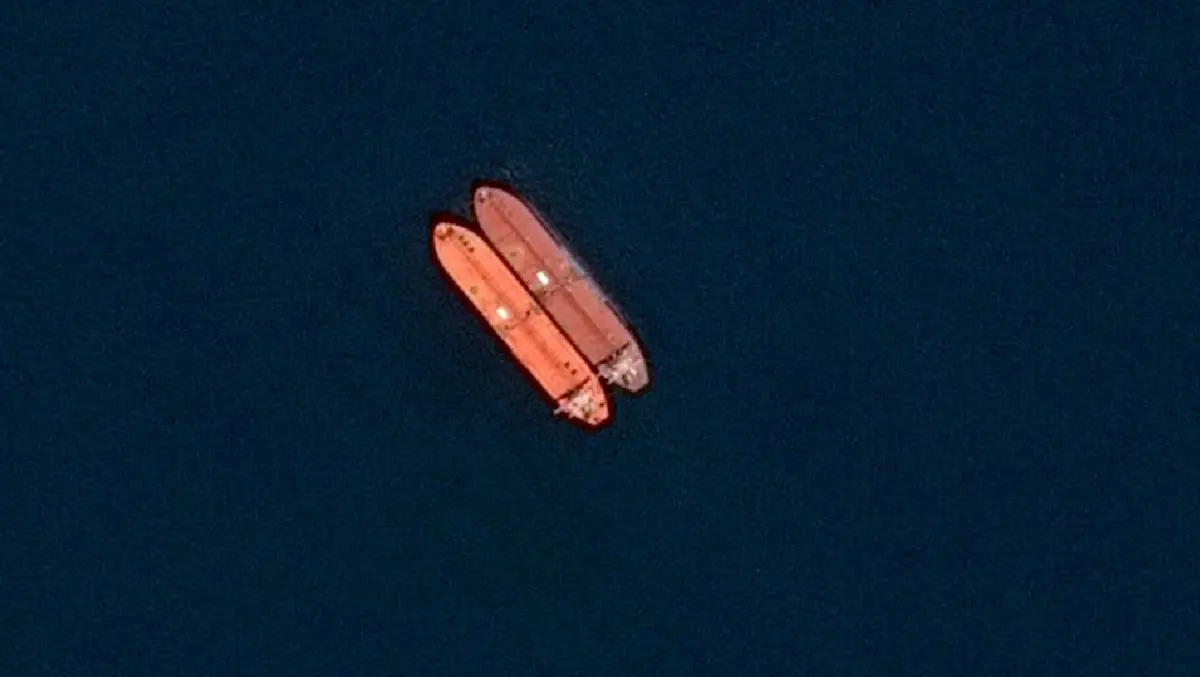
Saudi Arabia and neighboring Persian Gulf energy exporters have increasingly resorted to off-grid, ship-to-ship crude oil transfers off the coast of Oman to maintain exports, as regional military conflict and infrastructure strikes choke off traditional maritime and overland transport routes.
Facing the effective closure of the Strait of Hormuz by Iran and severe damage to Saudi Arabia’s critical East-West pipeline by Iran-aligned Houthi forces, state energy producers are adopting shadow logistics historically used by sanctioned nations to keep energy moving to global markets.
The double disruption has struck at the core of global energy supply chains. Pre-war estimates indicated that nearly one-fifth of global petroleum passed through the narrow waters of the Strait of Hormuz. However, amid the ongoing war involving the United States, Israel, and Iran, Tehran moved to close the vital waterway, using control over the maritime chokepoint as leverage during diplomatic negotiations. Simultaneously, Houthi forces in Yemen have asserted control over the Bab al-Mandeb strait at the southern entrance of the Red Sea, effectively blocking tankers seeking alternative passage through the area.
Compounding the maritime blockade, Houthi drone attacks recently damaged Saudi Arabia’s 1,200-kilometer (746-mile) East-West pipeline. The high-capacity pipeline was constructed as a strategic bypass mechanism designed to pump crude from the Kingdom’s primary eastern oilfields across the desert to the port of Yanbu on the Red Sea. With the pipeline knocked offline and the Red Sea transit corridor rendered perilous by the situation in Bab al-Mandeb, Riyadh’s primary overland safety valve has been severely compromised, leaving state energy giant Saudi Aramco with few traditional options to deliver crude to international buyers.
Key Coastal Ports Become Central Energy Lifelines
To prevent a complete stall in exports, Gulf producers have pivoted toward deepwater hubs situated just outside the immediate chokepoint of the Persian Gulf. Two ports have emerged as indispensable staging grounds for these alternative export operations: Sohar in Oman and the Port of Fujairah in the United Arab Emirates.
Sohar, located on Oman’s northern coast outside the Strait of Hormuz, is a major deepwater industrial hub equipped to handle heavy bulk cargo, petrochemical products, and container traffic. Its strategic geography allows commercial shipping lines to bypass the narrow Gulf bottleneck while retaining direct overland and short-sea connectivity to Arabian Peninsula markets.
Further north along the Gulf of Oman, the UAE’s Port of Fujairah operates as one of the world’s largest bunkering and crude oil storage complexes. Fujairah’s open-ocean anchorage gives supertankers a crucial offshore staging area to execute ship-to-ship transfers and energy exports beyond the reach of the Strait of Hormuz.
These offshore anchorages lie close to the maritime boundaries designated by the Persian Gulf Strait Authority, a newly established Iranian entity formed to manage and enforce transit rules through the Strait of Hormuz. Iranian authorities have repeatedly targeted ships accusing them of using unauthorized shipping lanes—specifically the southern transit route closer to Omani territorial waters—to navigate the waterway.

In response to the heightened threats, the United States military has reportedly been assisting scores of secretive ship-to-ship oil transfer operations since early May, aiming to preserve the flow of energy exports out of the region.
The Mechanics of Offshore "Dark" Transfers
Ship-to-ship (STS) transfers are complex maritime exchanges where liquid cargo—primarily crude oil or liquefied natural gas (LNG)—is transferred directly between two ocean-going vessels positioned at sea. While long utilized in standard maritime logistics, the process becomes significantly more challenging and hazardous when deployed under shadow conditions to avoid military targeting or regulatory detection.
Executing an STS transfer requires meticulous nautical coordination and favorable weather and sea conditions to prevent hull collisions or catastrophic spills. Under standard technical procedures, one vessel—typically a larger supertanker or storage ship—maintains a steady heading or drops anchor in deep water. A second maneuvering ship approaches slowly until the hulls of both vessels align in parallel. Large, pneumatic rubber fenders are deployed along the ship sides to absorb physical impacts caused by ocean swells.
To maintain secrecy and avoid detection by regional military forces or tracking systems, participating tankers frequently switch off their Automatic Identification System (AIS) transponders—a defining feature of "dark" fleet operations. After mandatory mechanical and safety checks are completed, high-capacity pumps on the discharging tanker force the crude oil through heavy-duty connected hoses into the receiving vessel’s tanks, while crew members closely monitor line pressure, vessel stability, and weather shifts throughout the operation.
Shift Toward Shadow Tactics Across the Gulf
The loss of Saudi Arabia’s pipeline infrastructure has transformed these risky maritime transfers from a secondary contingency into an operational necessity. The 1,200-kilometer East-West pipeline historically provided the Kingdom with the capacity to move millions of barrels per day directly to Yanbu, completely bypassing the Persian Gulf. With that infrastructure damaged, Saudi Arabia has had to recalibrate its export strategies.
Industry analysts note that Gulf energy producers are adapting rapidly to the changing logistics landscape. According to Rishi Rajanala, a research specialist in Oil Americas at LSEG Data & Analytics, Riyadh’s primary alternative involves shipping crude directly from its Gulf terminals through the Strait of Hormuz to conduct ship-to-ship transfers at anchorages outside the strait, such as Sohar in Oman. Rajanala noted that while Gulf producers had already been moving a portion of their exports via these alternative methods, total volumes remain constrained by tanker availability, elevated freight rates, and rising insurance costs, keeping flows well below pre-war levels.
Despite these operational constraints, transfer volumes have shown a measurable increase. Rahul Choudhary, Vice President of Upstream Research at Rystad Energy, observed that crude exports routed through Hormuz edged higher during the first two weeks of the current month, exceeding 2 million barrels per day—an increase of approximately 1 million barrels per day compared to August levels.
Choudhary noted that this upward trend is expected to strengthen further, as demonstrated by Saudi Aramco offering additional crude loadings to Asian refining clients out of Sohar. He added that Saudi Arabia is likely to lean even more heavily on dark tanker activity in the coming days to offset lost export capacity at Yanbu on the Red Sea coast.

Saudi Arabia is not alone in relying on these tactical maneuvers. Independent tracking services and news reports have identified other regional producers, including Kuwait and Qatar, occasionally utilizing similar ship-to-ship transfer tactics to transit cargoes past the Strait of Hormuz.
Data from TankerTrackers, an independent platform that monitors global oil shipments using satellite imagery and AIS data, highlights the sharp escalation in these offshore operations. The platform reported last week that an average of 7.15 million barrels per day of crude oil was exchanged via ship-to-ship transfers globally over a 14-day period—representing a 56 percent increase compared to the previous month.
High Operational Risks and Insurability Challenges
While ship-to-ship transfers allow Gulf nations to maintain critical revenue streams and deliver energy to key buyers in China, India, South Korea, and Japan, the practice carries significant operational hazards. Compared to standard berth-to-ship loading at specialized port terminals, open-ocean transfers are inherently less efficient and present far higher safety risks.
Industry experts warn that unregulated STS transfers frequently rely on aging vessels with poor hull maintenance, uninspected transfer hoses, and disabled AIS tracking, operating without standard marine insurance cover. Operating under dark conditions in open waters significantly increases the likelihood of collisions, structural failure, and uncontained environmental contamination.
The operational and environmental risks are further complicated by severe friction within the global maritime insurance industry. Oscar Seikaly, Chief Executive Officer of NSI Insurance Group, emphasized that traditional commercial underwriters view ship-to-ship transfers in high-risk zones as particularly complex. A single maritime casualty can involve vast liabilities, including physical vessel damage, cargo loss, environmental cleanup costs, collision liabilities, and specialized war-risk coverage.
Seikaly explained that commercial underwriters routinely respond to such volatile conditions by imposing strict navigational warranties, demanding additional security protocols, charging steep war-risk premiums, or excluding conflict zones altogether. During wartime disruptions, commercial insurers are generally unwilling to extend broad policies that cover high-risk ship-to-ship transfers.
Because the majority of the crude being moved belongs to state-owned national oil companies, Gulf governments have been forced to shoulder the financial risk directly. Many producers rely heavily on sovereign self-insurance arrangements and private market solutions. As Seikaly pointed out, when commercial insurers restrict coverage during high-risk conflict periods, the underlying financial and environmental liabilities ultimately remain with the producing countries rather than being transferred to commercial insurance markets.