
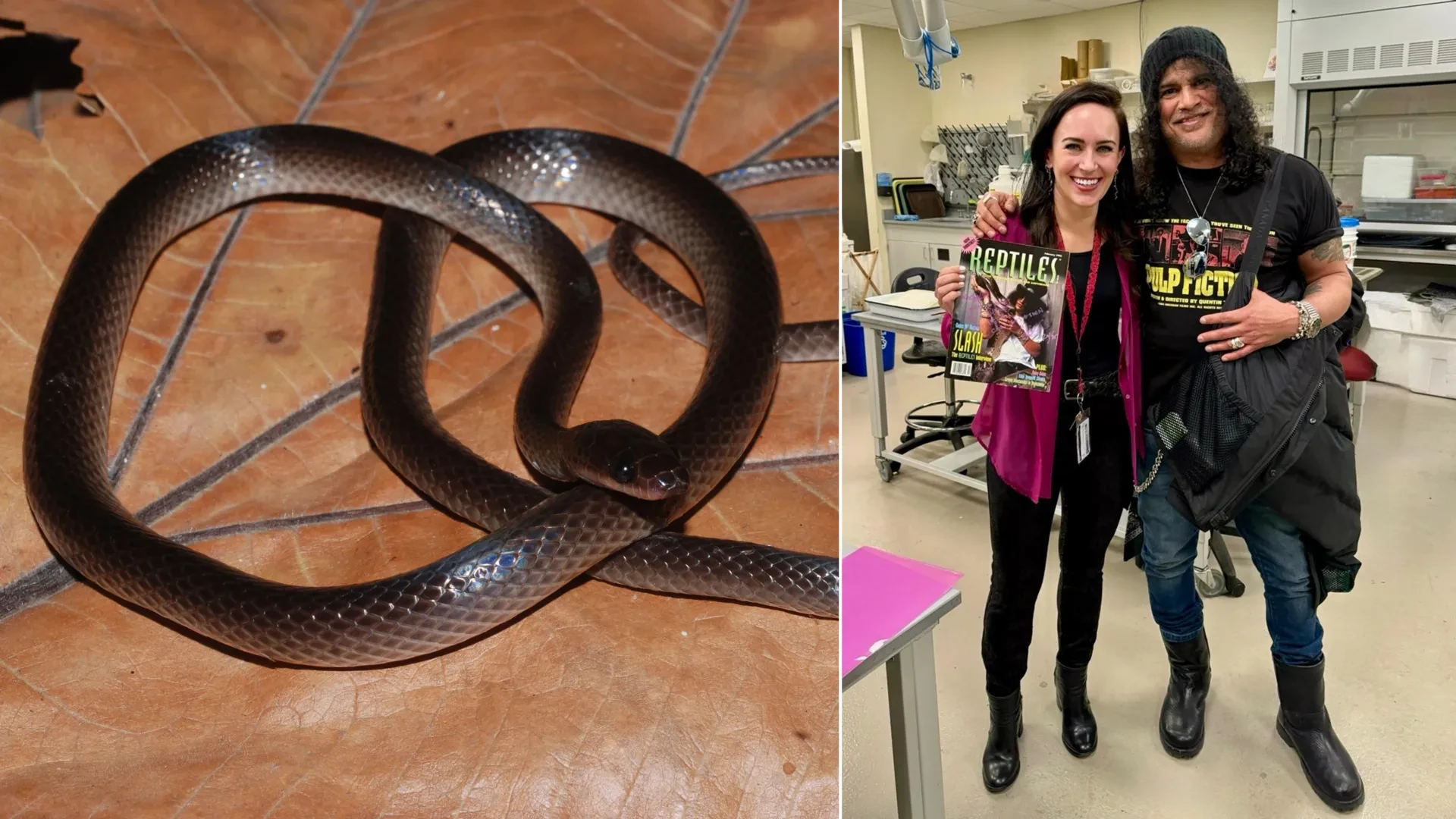
For decades, Saul Hudson—better known to the world simply as Slash—has cemented his legacy in music history as the iconic, top-hat-wearing lead guitarist of Guns N’ Roses. Known for blistering guitar solos and helping define the sound of hard rock, the legendary musician has spent a lifetime cultivating a parallel passion that few casual fans might suspect. Beyond the arenas, recording studios, and endless world tours, Slash has harbored a lifelong fascination with reptiles, maintaining a deep appreciation for herpetology and consistently lending his voice and support to zoos, museums, and natural history institutions around the globe.
Now, that decades-long passion has unexpectedly intersected with the world of professional taxonomy, earning the rock star a unique and prestigious scientific honor. A team of international researchers has officially named a newly identified snake species native to the tropical forests of New Guinea Lielaphis slashi, commonly referred to in scientific circles as Slash’s groundsnake.
For the man himself, the accolade comes as a profound surprise that bridges his lifelong fascination with the natural world and his public persona. "As a long time herpetophile, I am extremely honored and humbled to have Lielaphis slashi from New Guinea named after me. It is really exciting, I never would have imagined this moment would arrive," says Slash, reflecting on the distinct recognition.
A Childhood Connection to Slash
The journey toward naming a newly discovered reptile after a rock icon began decades ago in the mind of a young fan who would eventually grow up to become a professional scientist. For Dr. Sara Ruane, the Field Museum’s Associate Curator of Herpetology and the senior author of the research paper published in Zootaxa that officially describes the new species, the connection is deeply personal and spans most of her life.
"Guns N’ Roses has been one of my favorite bands since I was in first grade, and by fifth grade, I had already told my teacher that I wanted to be a herpetologist—a scientist who studies reptiles—when I grew up," recalls Ruane. Her dedication to the field blossomed early, setting the trajectory for her academic and professional career.
The pivotal moment in bridging her two passions occurred when she was twelve years old. Thumbing through a copy of Reptiles Magazine delivered to her home mailbox, she came across a striking cover feature. "It had a picture of Slash holding his pet reticulated python on the cover, and I thought, ‘This guy is so cool,’" she remembers.
Years later, after completing her rigorous scientific training and establishing herself as a professional herpetologist with the authority to assign official scientific names to newly recognized species, Ruane found herself reflecting back on that childhood magazine issue. Seeking inspiration for a name, she decided to revisit the old interview that had captured her imagination years prior.
"I reread his interview, and he talked about how much he loves museums and zoos and natural history, and about how when he was a kid, he’d go outside and look for snakes—it was all stuff that I really related to, and it made me think that he’d be a great person to name a new species after," explains Ruane.
Her opportunity to honor the rock legend finally materialized after years of fieldwork and laboratory analysis, culminating in the formal description of a striking, reddish-brown snake measuring approximately 28 inches in length that had been carefully collected from the dense, biodiverse forests of the world’s second-largest island.
A Mysterious Snake From New Guinea
The discovery of Lielaphis slashi highlights the immense ecological significance of New Guinea, the massive tropical island situated just north of Australia and politically divided between Indonesia and Papua New Guinea. As the second-largest island on Earth, trailing only Greenland, New Guinea boasts vast, untamed tropical rainforests that harbor an extraordinary concentration of biological diversity. Much of this rich ecosystem remains poorly documented, leaving scientists with vast tracts of wilderness to explore and countless species yet to be formally described.
The story of how this particular specimen came to scientific light began years before its official classification. During a routine night of fieldwork in 2006, Dr. Chris Austin, a professor and curator of herpetology at the Louisiana State University Museum of Natural Science, encountered a snake in the New Guinea wilderness that did not immediately match any known records. Recognizing that he might be looking at something unique, Austin collected the specimen for further study.
"These New Guinea groundsnakes are nocturnal, so the best way to find them is at night. They are typically found just after sunset at the base of large trees where they are looking for something to eat," notes Austin, who served as a co-author on the descriptive research paper.
Conducting scientific fieldwork in these environments, however, comes with substantial occupational hazards. Austin emphasizes the caution required by researchers navigating the island after dark. "When working at night in New Guinea you need to be very careful as there are several highly venomous species that look very similar to the non-venomous groundsnakes," he explains.
The path from that nocturnal field encounter in 2006 to a formal scientific description involved collaborative networks across institutions. After completing her doctoral studies, Ruane worked alongside Austin at Louisiana State University in 2016. The two researchers began a concerted collaboration aimed at untangling the taxonomy and evolutionary relationships of New Guinea’s notoriously understudied snake populations, a partnership that continues to yield significant scientific insights.
Genetics Reveal a New Species
When the reddish-brown New Guinea groundsnake was first brought into a laboratory setting, its distinctiveness was not immediately apparent through visual inspection alone. To the untrained eye—and even to experienced herpetologists—many snake species share physical similarities that can easily mask hidden evolutionary divergences. Unlocking the true identity of the specimen required rigorous laboratory work and modern analytical techniques.
"Using multiple cutting-edge genetic analyses, we found that L. slashi is genetically distinct from other similar snakes in the same genus," explains Tianqi Huang, the study’s lead author and a post-doctoral researcher at the Field Museum working alongside Ruane.
The process of species delimitation in modern herpetology relies on a holistic approach that combines molecular data with morphological examination. The research team paired the molecular genetic evidence with detailed physical traits, meticulously documenting subtle differences such as the exact counts and arrangements of scales when compared with closely related species.
Furthermore, the team expanded their investigation beyond the laboratory bench and the microscope. "The combination of physical characteristics, like differences in numbers of scales when compared with other species, and the genetic evidence is what led us to realize that it is an entirely new species. We also used ecological modeling to show that L. slashi‘s preferred habitat is different from similar snakes," Huang adds. This multifaceted approach provided undeniable proof that the specimen represented a lineage entirely unknown to science.
What Slash’s Groundsnake Eats
Despite the excitement surrounding its formal discovery and classification, scientists emphasize that much of the fundamental behavior and ecology of Slash’s groundsnake remains shrouded in mystery. Observing secretive reptiles in their native, heavily forested environments presents persistent logistical hurdles for field researchers.
"It’s incredibly hard to observe snakes in the wild before they slither away, so our knowledge about L. slashi is limited," admits Ruane.
Nevertheless, the physical anatomy of the newly named species provides critical clues regarding its daily habits, predatory strategies, and ecological niche within the New Guinea rainforest. By examining skeletal structures and dental characteristics, researchers can infer how the animal interacts with its environment.
"Snakes in this genus often have large teeth in the back of their mouths, which New Guinea groundsnakes may use to grab on to and eat small, slippery-scaled lizards and the eggs of other reptiles; this snake isn’t grasping and squeezing its prey like a boa constrictor," Ruane explains, shedding light on the animal’s specialized feeding mechanisms.
While Guns N’ Roses earned a notorious reputation decades ago as the "most dangerous band in the world," the rock band’s new reptilian namesake poses zero threat to human beings. Lielaphis slashi is entirely non-venomous and lacks any biological capability to produce toxins capable of harming a person, making it a peaceful, albeit elusive, resident of the forest floor.
Threats to New Guinea’s Forests
While Slash’s groundsnake is harmless to humans, the reverse is far from true. Human activity, commercial development, and industrial expansion pose severe and growing threats to the fragile ecosystems that sustain L. slashi and countless other endemic species across New Guinea.
"The habitats that Slash’s groundsnake is from are under threat from industries like coffee farming and mining," warns Ruane. The rapid conversion of pristine tropical forests into agricultural plots and resource extraction sites places immense pressure on biodiversity-rich regions that have barely been cataloged by science.
This ongoing environmental pressure underscores the profound urgency driving modern taxonomic research. Naming and formally describing species is not merely an exercise in cataloging nature; it is a foundational prerequisite for effective environmental stewardship and wildlife conservation.
"That’s part of why describing the species that live there is important. Every species should be recognized in order for us to better understand how ecosystems work, how everything fits into the environment. We can’t conserve animals or other living things that we don’t know about," Ruane points out.
By formally documenting and describing species such as Lielaphis slashi, researchers are able to construct a clearer, more comprehensive map of New Guinea’s intricate biodiversity. This scientific foundation equips conservationists, policymakers, and local communities with the vital data necessary to identify which fragile organisms and vulnerable habitats are most at risk as the global climate shifts and industrial pressures mount across the region.
The collaborative research study describing the new species reflects contributions from a multidisciplinary team of scientists, including Tianqi Huang of the Field Museum and Rutgers University; Chris Austin of the Louisiana State University Museum of Natural Science; Justin Bernstein of Slippery Rock University and the American Museum of Natural History; Bulisa Iova of the Papua New Guinea National Museum and Art Gallery; Jackson Roberts of the Virginia Museum of Natural History; Jeffrey Frederick of the University of Kentucky; and Sara Ruane of the Field Museum.