
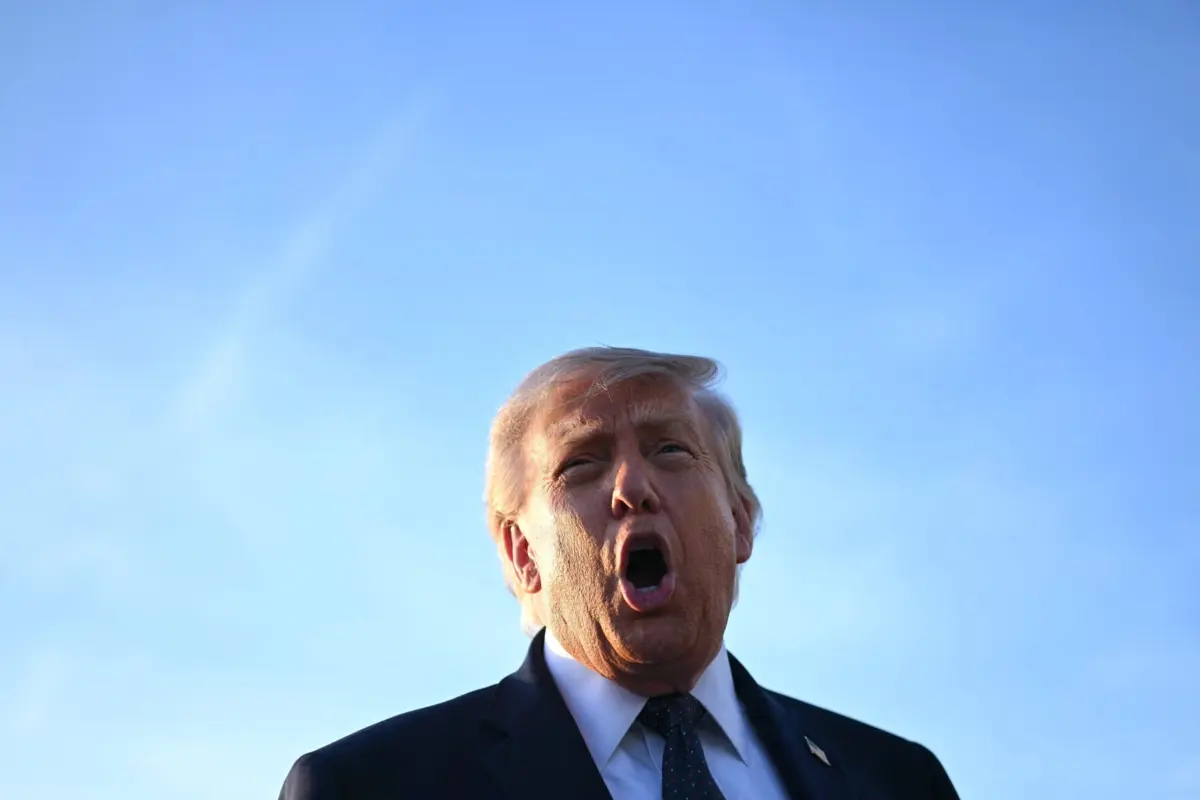
President Donald Trump has responded in characteristic fashion to the recent, escalating debate around artificial intelligence safety by declaring that these concerns are part of a long line of hoaxes "generated by the Radical Left Dumocrats, for purposes of destroying our Country." The remarks mark a significant escalation in the intersection of national politics and emerging technology, coming at a time when lawmakers, industry leaders, and the public are grappling with the rapid evolution and societal footprint of modern AI.
On Saturday, Trump began his public musings on artificial intelligence by writing on his social network, Truth Social, that "many people think that the words ‘Artificial Intelligence’ are inaccurate, and very ineloquent, relative to AI, or Artificial Intelligence." Seeking to rebrand the terminology, he posted an online poll where his followers could vote on a new name for the technology, offering options such as "Superior Intelligence," "Extreme Intelligence," or "Supreme Intelligence." The poll remained ongoing as of publication time, reflecting the president’s frequent use of social media engagement to drive public discourse on major policy topics.
A couple of hours later, Trump followed up with a post claiming that attempts at "the decimation, or destruction, of AI" are one of "many" Democratic hoaxes. He explicitly grouped these technology concerns alongside past political controversies, comparing them to what he termed "RUSSIA, RUSSIA, RUSSIA, UKRAINE, UKRAINE, UKRAINE, Global Warming, Impeachment Hoax #1, Impeachment Hoax #2, Men in Women’s Sports, [and] Transgender for Everyone."
Trump then insisted that he "will not stand by and let this happen," adding that this so-called hoax "began with an attack on our Data Centers, until people realized how wealthy and prestigious they were for the Communities in which they were built." According to the president’s narrative, after "the crazed Data Center attack has largely failed," critics have turned their attention and are now "going straight at AI."
Despite the president’s assertions, Trump did not offer any concrete evidence to back up his claim that widespread suspicion of AI and the physical infrastructure powering it is manufactured rather than organic and sincere. In reality, scrutiny over the environmental, electrical, and spatial demands of AI infrastructure has come from a bipartisan spectrum of lawmakers and local communities. Both Republicans and Democrats have raised pointed concerns regarding data centers, culminating recently in New York becoming the first state to halt permits for large-scale data center projects due to resource and grid strain.
The president’s weekend social media posts also echo his previous comments delivered at a golf tournament the weekend prior. During those remarks, he stated that while he is open to establishing "guardrails" for the burgeoning sector, he also argued that "you have a lot of negative forces that are bringing it up that shouldn’t be bringing it up."
Expanding on his administration’s vision for the technology, Trump went on to say on Saturday that he will "cherish [the AI industry,] help it, and watch over it, as it grows." However, his support is accompanied by plans for structural oversight. Trump announced that he is forming a dedicated "AI Force," patterned after the Space Force that he established during his first term in office.
"To that end, I will be announcing, in the near future, the AI ‘Czar’ — Only High I.Q. individuals need apply!" he added.
The president did not elaborate on what the specific duties and jurisdictions of the proposed AI Force and the new AI czar will entail. The role of federal technology oversight has shifted previously within administration circles; venture capitalist David Sacks stepped down as Trump’s earlier AI and crypto czar earlier this year, subsequently transitioning to co-chair the President’s Council of Advisors on Science and Technology.
The broader national debate surrounding AI safety intensified significantly following a high-profile industry departure. An AI researcher recently announced they were quitting Anthropic over profound concerns that leading artificial intelligence companies "earnestly believe it could kill us all by the end of the decade" and are "gambling with our lives" through the rapid pursuit of advanced systems.
In response to mounting internal and external pressure, Anthropic CEO Dario Amodei subsequently released a strategic plan to "pace the frontier," a framework that received apparent endorsements from prominent industry figures including OpenAI CEO Sam Altman and SpaceX CEO Elon Musk. Meanwhile, various critics of the tech sector have suggested that focusing heavily on these existential, sci-fi-scale threats serves primarily as a distraction from AI’s more immediate, tangible harms, such as workforce displacement, copyright issues, misinformation, and the intensive power consumption of data centers.
The intersection of political alignment and industry ambition was further highlighted when Nvidia CEO Jensen Huang was called onto the stage by the president during the All-In Summit, an event co-hosted by David Sacks. During the appearance, Huang voiced agreement with Trump’s characterization of the AI backlash as a "hoax" and insisted to the audience that "we’re not going to let" an AI slowdown happen under any circumstances.