
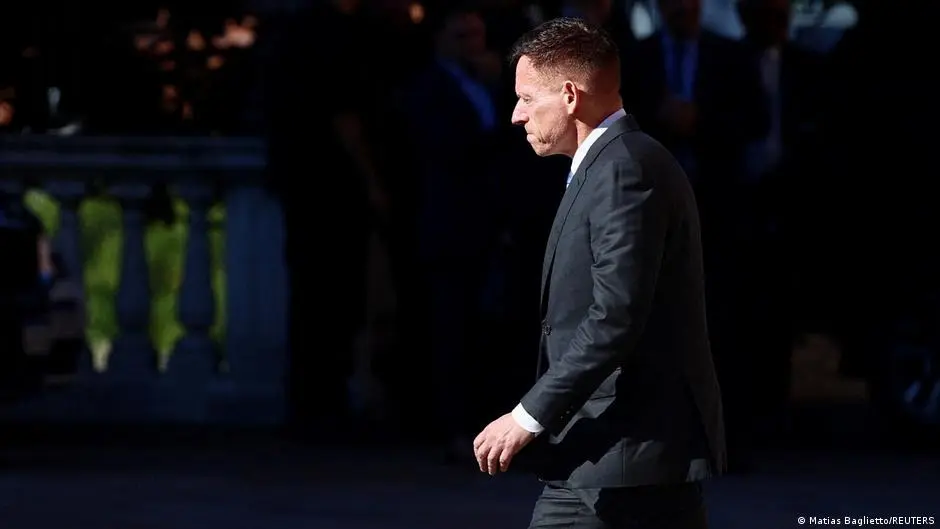
He may not command the daily headlines or dominate social media feeds with the relentless showmanship of Donald Trump or Elon Musk, but Peter Thiel has established an undeniable claim as one of the most consequential power brokers of the modern era. Operating behind the scenes across high finance, state intelligence, and national politics, the German-born billionaire has spent decades quietly building an empire that bridges Silicon Valley innovation with statecraft, emerging not only as one of the world’s wealthiest individuals but also as an architect of the contemporary political landscape.
Born in 1967 in Frankfurt am Main, then part of West Germany, Thiel’s early life was marked by frequent movement. When he was just one year old, his family emigrated to the United States, later relocating to Southern Africa, where they lived in South African-occupied Namibia between 1971 and 1977. This peripatetic upbringing preceded a return to the United States, where Thiel would eventually plant the seeds of a venture capital career that altered the trajectory of modern consumer and governmental technology.
Thiel’s ascent to prominence began in the late 1990s as a founding figure of PayPal, the digital payments provider where he worked alongside fellow tech mogul Elon Musk. Following PayPal’s sale, Thiel cemented his reputation as an astute investor by becoming the very first outside backer of Facebook, providing critical early-stage capital that helped propel the social media platform into a global communications behemoth. Over the ensuing decades, Thiel diversified his vast portfolio, securing significant equity in high-growth enterprises such as Musk’s aerospace manufacturer SpaceX and artificial intelligence research company OpenAI, alongside dozens of other technology ventures. Today, Forbes estimates his personal fortune at $35.7 billion (€31.1 billion).
Yet among all his corporate endeavors, none has generated as much controversy or wielded as much geopolitical influence as Palantir Technologies. Founded by Thiel as a surveillance, artificial intelligence, and big-data analytics firm, Palantir quickly distinguished itself from standard commercial software companies by focusing on sovereign intelligence and defense applications. Over the years, the company has secured lucrative contracts worth billions of dollars with agencies such as the Pentagon and the U.S. Immigration and Customs Enforcement (ICE).
Palantir’s growing presence at the intersection of state authority and automated intelligence reached a flashpoint in April when the company published a 22-point corporate manifesto. The document, which detailed a worldview unapologetically prioritizing military technological superiority and national security enforcement, drew fierce condemnation from civil liberties advocates and political commentators who warned that its ideological framework carried the distinct hallmarks of "techno-fascism."
Despite the controversies, Palantir has embedded itself deeply within the intelligence and defense architectures of multiple Western governments. However, that integration has recently begun to face friction. Several prominent European nations, including the United Kingdom, the Netherlands, France, Germany, and Spain, have initiated reviews of their contracts or moved to sever certain military and governmental connections with the American data firm over critical national security and sovereignty concerns.
Even as European governments reassess their technological dependencies, Thiel has continued to expand his global presence. The billionaire recently relocated his personal residence to Argentina, where he has engaged in high-level discussions with the country’s right-wing president, Javier Milei. The outreach comes as Milei’s administration advances sweeping legislative reforms designed to attract foreign capital, offer tax incentives to overseas corporations, and establish the South American nation as a prime hub for massive artificial intelligence data centers.
Early Trump support paid off
Thiel’s foray into statecraft is not limited to software contracts; his impact on electoral politics has been equally profound. Long before Silicon Valley executives began courting conservative figures, Thiel was an early institutional backer and informal adviser to Donald Trump during his first bid for the White House. At a time when Northern California’s technology industry was overwhelmingly aligned with the Democratic Party, Thiel made the provocative move to donate $1.25 million to Trump’s 2016 presidential campaign. He went on to deliver a high-profile address at the Republican National Convention that summer, publicly breaking with the prevailing political consensus of his peers.
Aside from a brief donation hiatus between 2023 and 2025, Thiel has consistently served as one of the Republican Party’s most generous and influential patrons, bankrolling conservative campaigns, think tanks, and candidates, including current Vice President JD Vance.
Thiel’s political ideology has frequently defied conventional categorization. Generally characterized by scholars and political analysts as a libertarian nationalist, Thiel has long advanced the foundational thesis that "technology is the alternative to politics." In his writings and speeches, he has voiced a deep skepticism toward regulatory bodies, democratic bureaucracy, and institutional liberal elites, viewing the slow, compromise-driven mechanics of representative government as fundamentally inefficient when compared to private corporate governance.
"It’s bordering on fascism," noted Max Chafkin, who authored a definitive 2021 biography detailing Thiel’s career, during an interview with Time magazine. "He talks about how companies are better run than governments because they have a single decision-maker — a dictator, basically. He is hostile to the idea of democracy. That’s pretty scary when you consider the role the companies that he’s been involved in play."
The roots of Thiel’s philosophical outlook trace back to his undergraduate and legal studies at Stanford University in California during the late 1980s and early 1990s. Frustrated by what he viewed as a monolithic liberal consensus dominating campus culture, Thiel founded The Stanford Review, a student-run conservative and libertarian publication designed to counter prevailing university orthodoxy. The publication became an intellectual springboard for like-minded students and served as an early template for Thiel’s lifelong campaign against progressive cultural values and what he currently derides as "woke" ideology.
Christianity, the antichrist, and AI
Thiel’s worldview is deeply intertwined with his religious convictions. Raised in a devout Christian household, his faith continues to shape his ideological framing of world events. Thiel has described himself as a "small ‘o’ orthodox Christian," a theological stance that informs his traditionalist and conservative political alignment. While observers have pointed to the apparent paradox between his traditionalist religious values and his personal life as an openly gay man married to American financier Matt Danzeisen, Thiel has routinely embraced ideological and personal contradictions throughout his career.
In recent years, Thiel’s philosophical rhetoric has taken an increasingly theological turn, centering heavily on the concept of the antichrist. He has embarked on a global lecture circuit exploring this theme, presenting an interpretation that diverges from traditional biblical depictions. Rather than portraying the antichrist as a single mythological tyrant, Thiel conceptualizes the entity as an institutional or political force that threatens human civilization by manipulating public anxiety surrounding technological progress. In Thiel’s framing, this force seeks to halt human ambition by lulling societies into stagnation and decadence under the deceptive promise of "peace and safety."
Under this paradigm, Thiel has characterized various high-profile public figures and regulatory institutions as agents of this anti-technological stagnation. He has publicly cast environmental activist Greta Thunberg as a modern "Luddite who wants to stop all science," arguing that climate-focused limits on industrial growth represent a surrender to technological decline. Similarly, Thiel views government attempts to impose guardrails on artificial intelligence as existential threats to Western competitiveness. His theological critiques even extended to the Vatican; in July, Thiel publicly accused Pope Leo XIV of "working for the Chinese communists" after the pontiff issued a global warning regarding the severe "risk of dehumanization" posed by unregulated artificial intelligence.
Underpinning these ideological crusades is Thiel’s acute awareness of the practical utility of high-level political and business relationships. Over several decades, he has maintained strategic alliances with influential figures across industry and governance, including Trump, Musk, and senior lawmakers.
"I’ve built some great friendships over the years with people I’ve worked with," Thiel told the Washington Post in an interview in 2014. "And I think that’s a really important part of what enables one to be successful in the long run in our society."
Using Vance to future-proof his interests?
Nowhere has Thiel’s cultivation of personal and political relationships yielded greater returns than in his partnership with Vice President JD Vance, widely regarded as the heir apparent to the modern conservative movement and the leading Republican figure poised to succeed Trump.
The relationship between the two men began in 2011, when Vance was a student at Yale Law School and attended a guest lecture delivered by Thiel. The interaction left an immediate mark on Vance, who was undergoing a significant intellectual and religious transformation. Writing in the Christian literary publication The Lamp, Vance recalled how meeting the billionaire investor fundamentally challenged his preconceptions about faith and intellectual capability, noting that Thiel "defied the social template I had constructed — that dumb people were Christians and smart ones atheists."
Following that initial encounter, Thiel assumed the role of mentor to Vance, eventually guiding him into the venture capital sector and later serving as the primary catalyst for his political career. When Vance transitioned into national politics, Thiel played a pivotal role in repairing ties between Vance and Trump, helping smooth over Vance’s past criticisms of the former president and paving the way for his inclusion on the 2024 presidential ticket.
Thiel’s backing extended well beyond advice and introductions. During the 2022 midterm elections, Thiel poured $15 million into an independent expenditure committee supporting Vance’s Ohio Senate bid—the largest individual financial donation ever made to support a single candidate in U.S. Senate history.
Political analysts view Thiel’s early investment in Vance as a masterclass in strategic future-proofing. As influential voices and rival tech executives increasingly call on governments to slow the development of artificial intelligence, Thiel’s defense and analytics empire faces potential regulatory and geopolitical headwinds. Yet by anchoring his influence within the highest levels of the executive branch and cultivating key political alliances both in Washington and abroad, Thiel has ensured that his commercial ventures and ideological project remain insulated from external pressures, keeping him positioned at the helm of global power.