
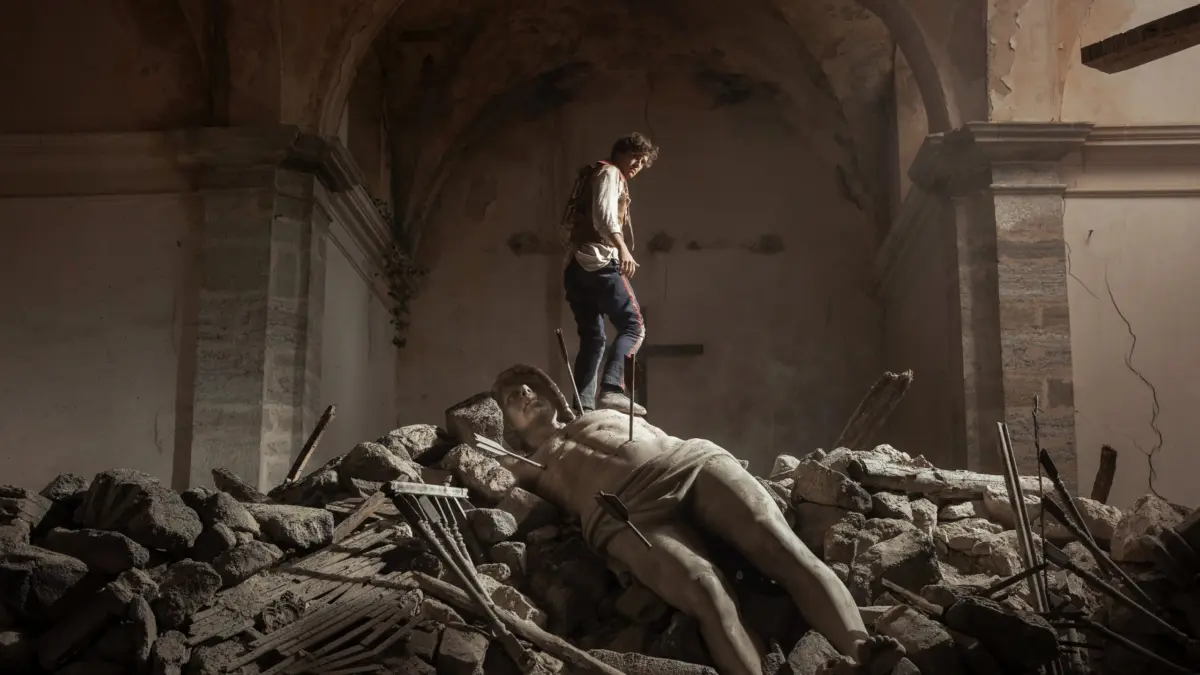
The 2026 edition of the Toronto International Film Festival officially wrapped on Sunday, concluding 11 days of cinematic celebrations, star-studded red-carpet appearances, and enthusiastic audience participation. Closing out the festival with significant momentum heading into the upcoming awards season, Javier Calvo and Javier Ambrossi’s sweeping Spanish-language gay epic La Bola Negra (The Black Ball) captured the prestigious top People’s Choice honor.
The film, which has rapidly become one of the most talked-about titles on the international festival circuit, recounts the deeply moving story of three generations of queer men whose lives remain interconnected through enduring love and profound loss. Written alongside Alberto Conejero, and directed and produced under the creative moniker Los Javis by the Spanish duo of Calvo and Ambrossi, the emotional drama secured a coveted distribution home when Netflix acquired it out of the Cannes Film Festival specifically for a high-profile awards season push.
La Bola Negra first became the center of an intense, highly competitive bidding war following its triumphant world premiere at Cannes. During that festival, Los Javis shared the festival’s best director prize for the film in a tie with Paweł Pawlikowski for Fatherland. Reflecting on their latest major win in Toronto, Los Javis shared a heartfelt statement with festival organizers and attendees.
“This is a deeply personal film, but it also carries a message about the importance and the necessity of expressing who you are,” the directing duo said. “So, knowing that audiences have connected with it and made it their own is the greatest gift we could receive.”
The runner-up race for TIFF’s top audience prize was equally competitive. Peter Farrelly’s I Play Rocky, which charts the tumultuous and challenging behind-the-scenes production of the classic 1976 boxing film that ultimately went on to win three Academy Awards, captured the first runner-up spot. Meanwhile, the second runner-up position went to Sian Heder’s Being Heumann, a poignant feature that originally earned the honor of opening the Toronto International Film Festival on Sept. 10.
As Sunday morning brought the announcement of all 12 audience and juried awards, the festival celebrated a massive turnout. In total, 294 films hailing from 70 countries screened for cinephiles and industry professionals over the course of the 11-day event. The coveted People’s Choice awards are uniquely determined by the votes of festival attendees. To maintain the absolute integrity of the voting process and prevent festivalgoers from casting multiple ballots for the same film, TIFF rigorously matches email addresses against verified ticket-buyer information and cross-references vote origins with strict IP address verification methods.
In other major audience categories, the People’s Choice award for best international film was presented to Simon Stone’s Elsinore. Director Lee Chang-dong’s Possible Love finished as the first runner-up in the international category, while Hur Jin-ho’s The Assassins claimed the second runner-up position.
The People’s Choice award for best documentary went to Barry Avrich’s Darlene Love: I Know Where I’ve Been, an intimate and inspiring cinematic tribute to legendary musical icon Darlene Love. In the documentary race, James Marcus Haney’s Black Sunflowers earned the first runner-up designation, with Mila Aung-Thwin’s The Ultra Runner following closely behind as the second runner-up.
For fans of late-night and genre cinema, the audience award for best Midnight Madness title went to Matthew Rankin’s Ladies and Gentlemen, Brian Mulroney, presented in partnership with the National Film Board of Canada. The first runner-up in the Midnight Madness block was Paolo Strippoli’s atmospheric thriller The Spiral, while Sabu’s Arrested Memory secured the second runner-up spot.
Beyond the primary audience choices, juried and sidebar sections highlighted incredible global talent and localized storytelling. The highly competitive Platform prize was awarded to director Theja Rio for Angh, a powerful feature set against the backdrop of a deserted village in remote India during the early 1960s.
In the Canadian cinema categories, Serville Poblete took home the best Canadian feature film prize for Sunburn, a charming and grounded hang-out movie set within St. James Town, a bustling high-rise community located in Toronto.
“This is for everyone I grew up with, and all the dreams we had as kids. This film is for them,” Poblete said emotionally while accepting the award on stage.
Adding to the emotional weight of the morning ceremony, the best Canadian Discovery Award was presented to Cody Lightning for Smudge The Blades, a heartfelt and gritty drama centered on an Indigenous underdog hockey team. Taking the stage to accept the honor, an emotional Lightning dedicated his victory to his late mother, veteran filmmaker Georgina Lightning, who tragically passed away just weeks before the film’s world premiere at the 2026 edition of the festival.
“She died doing something she loved. She was filming when she was hit,” the director shared, visibly fighting back tears as the audience listened in solemn support. “Winning this means so much. I don’t make films to win awards. I just tell stories. This one is for my mum.”
International sidebar prizes also highlighted stories of resilience and cultural identity from around the globe. The NETPAC award, which is specifically given to recognize the best Asian film directed by an emerging talent, was awarded to Palestinian director Hosam Abu Dan for Thirteen in Gaza.
“We are so proud that the voice from Gaza has reached you, and that through this film we were able to share with the world one human story among the many painful stories of Gaza,” the filmmaker expressed in a prepared statement.
Meanwhile, the FIPRESCI prize, which honors the best first feature film across select festival sidebars, was awarded to David Turpin for Ancestors, a striking debut feature set within a dreamlike, stylized 1980s London. In the short film categories, the best animated short film trophy went to Into The Betaverse, directed by Varun Raman and Tom Hancock. The best international short film prize was claimed by Elia Kalogianni for Mammalia, while Michael Del Monte triumphed in the Canadian short film category with his intense mixed martial arts drama Fight Kid.
Despite the vibrant energy of the screenings and the enthusiasm surrounding breakout crowd-pleasers like La Bola Negra, the 2026 edition of the Toronto International Film Festival also highlighted ongoing conversations regarding its position within the broader international film circuit. In recent years, TIFF’s traditional role as an indispensable autumn launchpad for the awards season has increasingly found itself somewhat overshadowed by the early-fall festival lineups in Venice and Cannes, where the most heavily anticipated, high-profile Oscar-contending films routinely secure their very first looks.
This dynamic is further underscored by Toronto’s unique operational approach, where major celebrities routinely travel to town purely to attend high-profile festival premieres, yet the event continues to host no official press conferences to help studios market their films ahead of the competitive awards race, nor does it maintain an official competitive jury structure for its main feature selections.
As broader industry contractions take hold and major Hollywood studios have progressively scaled back their involvement or chosen to shun the traditional film festival circuit altogether, the atmosphere in Toronto has evolved. This year, celebrities attached to independent features made frequent red-carpet appearances across the city, happily stopping to take selfies with eager fans, though largely operating without the historic glitz, intense industry pressure, and traditional glamour traditionally associated with the Croisette or the Lido.