
There are certainly worse reputations for a real estate professional to cultivate in a competitive local market than being affectionately known as "the trash guy."
Joseph Fitzpatrick learned this firsthand while walking down the street one afternoon with his young daughter. As they crossed the road, he overheard a child excitedly point him out to their mother. The youngster did not recognize Fitzpatrick from a billboard, a bench advertisement, or a slick digital marketing campaign, but rather from Clean It Up Joe, a community-driven sanitation campaign. Fitzpatrick had launched the initiative months earlier, sparked entirely by a frustrated Facebook rant lamenting the state of overflowing public trash cans during the peak tourist season.
What began as a spontaneous venting session on social media quickly snowballed into a GoFundMe campaign, which in turn evolved into a permanent, repeatable community program. Years later, local residents still photograph overflowing public receptacles, tag the specific geographic coordinates, and utilize the designated Clean It Up Joe hashtag. Fitzpatrick and a dedicated network of volunteers then routinely respond to clear the mess.
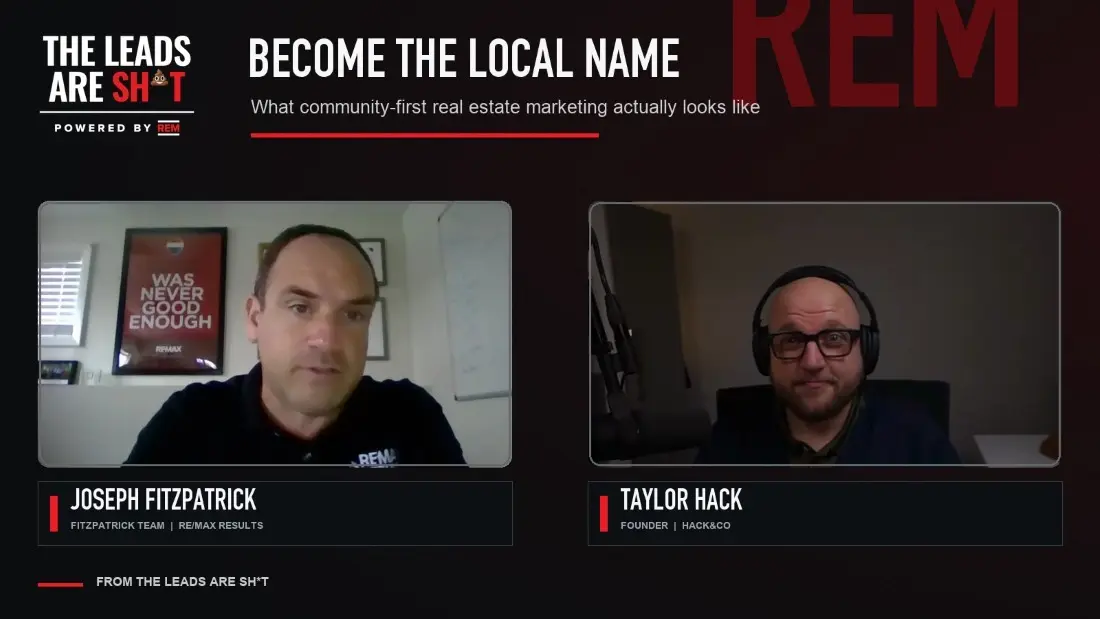
The compelling origin story surfaced during a recent discussion on the industry podcast The Leads Are Sht*, hosted by Taylor Hack, illuminating a fundamental truth that many real estate professionals consistently struggle to grasp. True, effective local marketing rarely begins with a calculated corporate campaign. Instead, it frequently originates from simply doing something genuinely useful for the neighborhood—something tangible enough that people vividly remember who stepped up to do it.
Specific Beats Generic
Most real estate agents desperately want to be recognized within their geographic farm areas. The underlying problem, however, is that standard notions of "being involved" are far too vague to leave a lasting impression on the average consumer. Sponsoring a little league team or putting a logo on a local charity golf tournament banner rarely moves the needle because those efforts lack a distinct, memorable identity.
Clean It Up Joe succeeds precisely because it is hyper-specific. The moniker is catchy and effortless to remember. The direct action is remarkably easy for any community member to understand. When local residents encounter a localized public sanitation problem, they immediately know what steps to take, and Fitzpatrick’s personal name remains permanently attached to the proactive response.
The exact same philosophy drives the Fitzpatrick Team running club, another community-focused initiative spearheaded by the group. The team regularly purchases official entries to local running races and gifts them directly to community members who are willing to commit to training through a structured couch-to-10K program. They organize four separate 10-week programs over the course of a single year, meaning the visible community activity maintains a presence for roughly 40 weeks annually.
Neither of these endeavors explicitly asks anyone to list a house or sign a buyer representation agreement. Yet, both initiatives successfully generate repeated, entirely positive contact points with people living right in their backyard.
That consistency and repetition matter immensely in modern real estate. A one-time financial sponsorship might generate a solitary photograph and a fleeting social media post that disappears from feeds within hours. Conversely, a genuinely useful public program that citizens encounter repeatedly throughout the calendar year possesses the structural power to build actual, organic local recognition.
Consistency Creates the Brand
While Fitzpatrick’s individual community projects vary significantly in execution, they share a remarkably resilient underlying structure built on long-term commitment.
Many real estate agents enthusiastically adopt a high-visibility tactic, only to abandon it the moment results do not materialize within thirty days. Fitzpatrick did not describe a single viral growth hack or overnight tactic that suddenly transformed him into a household name within his local market. Instead, he detailed years of persistent, consistent activity spanning running clubs, grassroots cleanup campaigns, community events, targeted social media engagement, direct mail campaigns, and traditional prospecting.
That steady, measured approach is undeniably less glamorous and far less exciting than promises of overnight internet fame, but it is also drastically more practical for working professionals. Market recognition compounds over time only when the underlying activity is specific enough for the public to remember and consistent enough for them to ultimately believe in the agent’s sincerity.
Connect the Marketing to Client Value
Deep community visibility, while vital, serves as only one foundational pillar of a comprehensive business strategy. During the podcast discussion, Fitzpatrick also detailed a hyper-targeted weekly letter campaign specifically structured around the immediate, active needs of serious home buyers in the area.
Instead of merely setting up an automated MLS property portal search and waiting passively for matching inventory to cross his desk, his team takes a much more aggressive, proactive approach. They carefully identify the exact micro-neighborhoods where their current active buyers desperately want to live, and then write hundreds of personalized, targeted letters directly to homeowners on those specific buyers’ behalf. The immediate, tactical purpose of the outreach is to demonstrate tangibly to the buyer clients that the real estate team is actively working behind the scenes to create unlisted opportunities, rather than simply monitoring a public web portal.
According to Fitzpatrick, the targeted letter campaign simultaneously yielded significant unexpected listing opportunities. By mid-September, the initiative had directly contributed to six completed real estate closings and approximately $60,000 in gross commission income within his specific local market. This return was measured against an estimated annual mailing cost of roughly $30,000.
Industry experts emphasize that these financial metrics should not be interpreted as a universal return-on-investment promise guaranteed to work across all markets. They represent specific gross commission figures achieved by one particular team operating in a unique local ecosystem, and the exact same campaign could easily perform quite differently elsewhere. However, the truly valuable takeaway for professionals lies in the overarching campaign structure: a single well-designed activity can effectively serve a current client’s immediate needs, introduce the real estate team to future prospective home sellers, and build broader local brand awareness all at the exact same time.
That strategic integration stands in stark contrast to sending generic, mass-produced "I have a buyer" marketing letters that lack any genuine buyer motivation or localized context behind them.
Make the Activity Easier to Do
To help agents struggling with execution, Fitzpatrick also shared a practical procedural adjustment for professionals who routinely avoid proactive prospecting simply because the idealized version of the task feels too overwhelming or difficult to maintain.
His team utilizes a hybrid approach they informally refer to as "door knocking slash door hanging." Under this flexible framework, an agent might set out with the initial intention of knocking on 50 front doors in a target neighborhood. However, if an interaction turns unexpectedly hostile, if the local weather suddenly deteriorates, or if the agent simply loses their psychological momentum halfway through the route, they are permitted to leave their marketing materials as door hangers at the remaining homes on the street.
The underlying objective of the adjustment is not to pretend that leaving a passive door hanger is identical in conversion value to having a deep, face-to-face real estate conversation with a homeowner. Rather, the goal is to prevent a single difficult moment, awkward encounter, or bout of fatigue from completely derailing the entire prospecting activity for the day.
Fitzpatrick applies that exact same pragmatic mindset to traditional phone prospecting as well. Instead of demanding an unrealistic, punishing volume of 400 outbound calls a week from every single agent on his team, he sets a baseline expectation of one intensely focused hour of calls a day, fully acknowledging that steady consistency over months is infinitely more valuable than an impossible target that ultimately gets ignored out of sheer frustration.
Discussions surrounding real estate marketing are far too often dominated by the endless search for the elusive, perfect campaign. The recent conversation on The Leads Are Sht* offered a much more grounded, realistic alternative for modern practitioners.
Choose to do work that is genuinely useful to the community. Make the core offering easy for the public to understand. Build a business system sustainable enough that you can keep executing it week after week, month after month. Give people a compelling reason to remember your name long before they ever find themselves in a position where they actually need to hire a real estate professional.
Accepting a reputation as "the trash guy" may not align with the polished, immaculate personal brand that many real estate agents initially envision for themselves. Yet, in Fitzpatrick’s case, it means his entire community knows his name, understands exactly what he does, and knows without hesitation that he will show up when called upon.
Ultimately, that is what a real estate brand is built to do.