
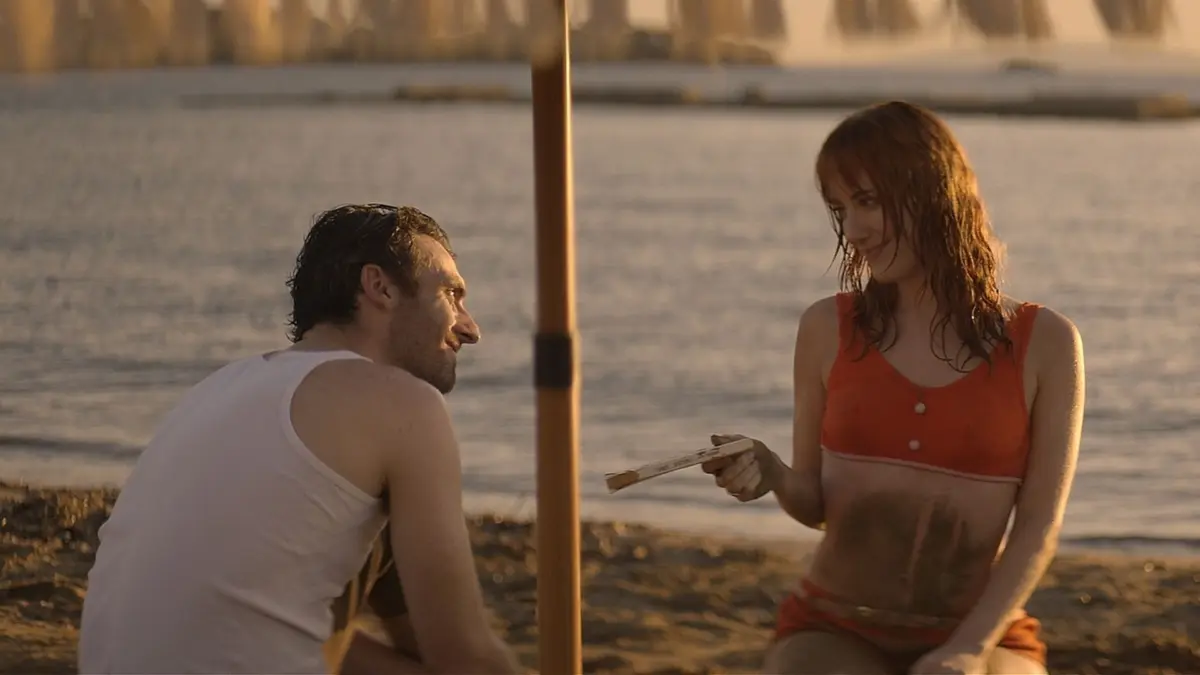
In a dark, dystopian future where an authoritarian Regime dictates who belongs and who is cast aside, the machinery of state power turns its full, calculating weight toward a single individual. The Regime deploys a cold, calculating Interrogator to break down a man designated simply as the Suspect, setting a ruthless plan of psychological manipulation into motion. Yet, as the psychological chess match unfolds between the two men, the master plan reveals potential vulnerabilities that could upend the entire system.
This tense psychological narrative forms the core of The Flaw, a new Greece-Latvia co-production based on Antonis Samarakis’ acclaimed novel of the same name. Recognized as a modern Greek classic and a major bestseller, the novel provides the foundation for this striking cinematic adaptation. The film also marks the feature-film directorial debut of writer-director Theophilos Papastylianos, whose previous credits include Algorhythm and Showtime.
The Flaw is set to make its world premiere in the Baltics on Wednesday, November 18, competing in the prestigious Baltic Film Competition at the 30th edition of Estonia’s Tallinn Black Nights Film Festival (PÖFF).
The production boasts a prominent British cast at the forefront of the narrative. David Dawson, known for portraying Derek Jarman in Elsinore, steps into the role of the meticulous Interrogator. Arthur McBain, whose credits include After the Flood and Napoleon, takes on the role of the targeted Suspect. The supporting ensemble features recognizable international talent, including Ralf Little, Angela Brouskou, Lyne Renée, Sarah Akokhia, and Georgia Small. Behind the camera, the film’s visual style is shaped by cinematographer Thodoris Zacharakis and editor Yannis Chalkiadakis. The production is steered by producers Panos Papahadzis and Papastylianos, alongside co-producers Alise Rogule and Lina Yannopoulou, with international sales handled by Jacques Kruger.
Ahead of the film’s festival premiere, director Theophilos Papastylianos sat down to discuss the timely urgency of The Flaw, its distinct visual approach, the dynamics of its cast, and the complex, puzzle-like structure that defines the storytelling.
How did you approach adapting the novel after you read it?
Papastylianos explains that revisiting the acclaimed book as a filmmaker offered a completely fresh perspective compared to his first encounter with the text years prior.
"It was my second time reading the book, and it was a revelation for me because the perspective was completely different," Papastylianos says. "I wasn’t reading it as a teenager, like the first time. Now, I was reading it as a director."
When sitting down to draft the screenplay, the director was acutely aware of the time lag inherent in independent filmmaking, particularly when dealing with complex international co-productions.
"The most important part when I wrote the script was to take a step back and say, ‘Okay, this is an amazing idea, but the film is going to be released in five to seven years. Is it going to be amazing in seven years?’"

That said, the film feels scarily timely.
Despite the years spent bringing the project to the screen, the themes embedded in Samarakis’ mid-century classic have only grown more urgent in contemporary society. Papastylianos notes that this resonance was driven largely by instinct as he observed global sociopolitical shifts.
"It was instinct because I was seeing how the whole world was progressing and how society was changing," he explains. "I felt this book was timeless, and as the years go by, it’s going to become more up to date all the time."
At the same time, the director admits mixed feelings about the film’s uncanny contemporary relevance.
"The weird thing for me is that, in a sense, I’m happy that the film is up to date. But on the other hand, I’m sad because that means our society and the world are taking a very dramatic shift towards a place that is not good."
Can you talk a bit about the themes of totalitarianism and beyond that The Flaw explores?
While state oppression and government control form the visible backdrop of the narrative, Papastylianos views political totalitarianism merely as a surface layer for a deeper philosophical allegory about human nature and perception.
"For me, the totalitarian regimes and everything is just the first level," he notes. "I wanted the film to act as a strong allegory. You have the regimes, the governments, or society, that is all around us. But I actually think that each one of us is a regime by himself."
Elaborating on this internal autocracy, the director points to how deeply ingrained personal biases shape everyday interactions and societal polarization.
"We perceive the world through our own eyes and our own perspective, and through our own prejudice. So, by definition, we are a regime by ourselves," Papastylianos says. "Imagine a hunter walking in the woods, and all of a sudden, he sees a deer. So he lifts up his rifle and looks through the scope. At that moment, he sees prey. If he could just take a moment and lower the scope, he would see a deer again. And I think it’s the same thing with people."
He points to how quickly modern society categorizes individuals based on superficial attributes or rigid ideological lines, citing recent global health crises as a prime example.

"We meet somebody, and we judge them right off the bat — their sexual orientation, [how they look], how political or non-political they are. During COVID, for example, there were two groups of people: the anti-vaccine and the vaccine people, but nothing in the middle. But for me, that’s the interesting thing: people meet in the middle."
The two protagonists in The Flaw go through an evolution, but I didn’t fully notice it until the end…
The psychological transformation experienced by the Interrogator and the Suspect is designed to be imperceptible to the audience until the final pieces fall into place.
"What we were aiming for was a slow change that the characters go through," Papastylianos explains. "We wanted to be so slow that you realize that the characters you’ve been seeing from the beginning, all of a sudden, at the end, are completely different characters."
The film has some spectacular-looking buildings. How did you think about locations?
Visually, The Flaw draws heavily from architectural brutalism and stark geometry to establish its oppressive atmosphere. Production took place across contrasting European landscapes, combining elements from Greece and Latvia.
"We shot in Greece, and we also shot in Riga in Latvia," Papastylianos says. "Riga was a very important part of the whole process in order to get that feeling of brutalism and all this dark, timeless sensation."
Merging the distinct architectural identities of Greece and Riga posed a significant logistical and creative hurdle, requiring meticulous planning from the design and camera departments.
"We had to combine Greece with Riga, and that was a challenge, so we could get a timeless space and locations where you don’t know they were actually shot in two different countries. The production design team did an amazing job. And lighting and framing were very important for us. I believe that when we shoot, we make conscious choices that actually affect people’s subconscious."
Every visual composition was treated as an intentional narrative tool. "So every shot is there for a reason. Every close-up is there for a reason. We choose what we want to show or what we don’t want to show the audience."
The Flaw features Greece and Latvia as locations. But the two lead characters are played by British guys. Tell me a bit about the casting decisions.

Collaborating with a British cast required an unorthodox approach to conveying character motivation and emotional tone during pre-production. Rather than relying solely on traditional directorial notes, Papastylianos utilized visual art to communicate his vision to the actors and the casting director.
"It was amazing to work with all these guys. They are amazing professionals," he says. "I actually sent paintings, portraits, to the casting director. And I said, ‘Look, this is the energy that I’m looking for as a character.’ I used a lot of Amedeo Modigliani in terms of the paintings that I sent, because he has this energy and these figures that are surreal, but at the same time, they’re actual people."
On set, Papastylianos favored a collaborative environment that gave his principal actors the autonomy to interpret their roles organically.
"My process with the actors once they know the scenes is this. When they ask me what I think about a scene and the characters, I always say to them, ‘I don’t have anything to say to you. You know the script. You know the scenes. You know your character. Just present your approach.’ You need to give actors space so they can breathe on their own."
Tell me a bit about Greek theater and film actress Angela Brouskou and her role of the "Head"?
Angela Brouskou’s portrayal of the "Head" was conceived not as a traditional human antagonist, but as a physical embodiment of institutional power and ideology.
"What we were aiming at was that the Head should not be a natural person but should be on the edge of becoming an idea," Papastylianos explains. "She represents the Regime. She is the Regime. So you have a character, but the way she’s depicted, sometimes you think that she is a non-character. It’s like she’s becoming the idea of the regime. She becomes a persona that turns into an idea."
David and Arthur have such a fascinating dynamic and chemistry that keeps shifting. How did you approach their characters’ relationship?
The evolving dynamic between Dawson’s Interrogator and McBain’s Suspect hinges on the concept of duality and hidden psychological depths.
"For me there was a key thing. One is the alter ego of the other," Papastylianos notes. "So, our big challenge was to [make sure you] see hidden qualities that slowly start coming out more and more."
To establish this intangible connection before cameras rolled, the director shared specific auditory and visual references with the actors. "Before the shoot, I showed them the paintings, the portraits, that I had shared with the casting team. And I also gave them two pieces of music they could listen to. I truly believe that our work has a lot to do with the energy of the people."

I am glad you mentioned music because that seems to play into the characters and story of The Flaw very strongly…
Music and sound design function as active participants in The Flaw, shaping the psychological tension alongside the dialogue and cinematography. Papastylianos worked closely with composer Dimitris Fessas to forge a distinctive sonic landscape.
"We wanted to have these rough-edged, train-like pieces," the director says. "We wanted to use a lot of the electric guitar combined with violins or violas, and then he actually used a traditional Greek instrument called the Cretan lyra. There are actually scenes where the Cretan lyra is having this discussion with the electric guitar. And then a violin steps in, and the whole sensation is a little bit out of this world — in a good sense."
The musical architecture was tailored specifically to mirror the internal trajectories of the two central figures, culminating in an intricate auditory synthesis.
"We created the melody of the Interrogator and the melody of the Suspect, but in the end, these two melodies have to interweave. The sound design was also an important [element of that]. We paid so much attention to every detail, especially sound-wise."
Talking to you makes me understand why I experienced The Flaw as pieces of a puzzle slowly emerging and a bigger picture coming into view.
Reflecting on the interviewer’s observation, Papastylianos affirms that the piecing together of disparate narrative elements is precisely the intended journey for viewers engaging with the film.
"I think that’s the best way to describe it. That’s amazing how you put it," he concludes. "Yeah, the whole film is pieces of a puzzle that have to come together."