
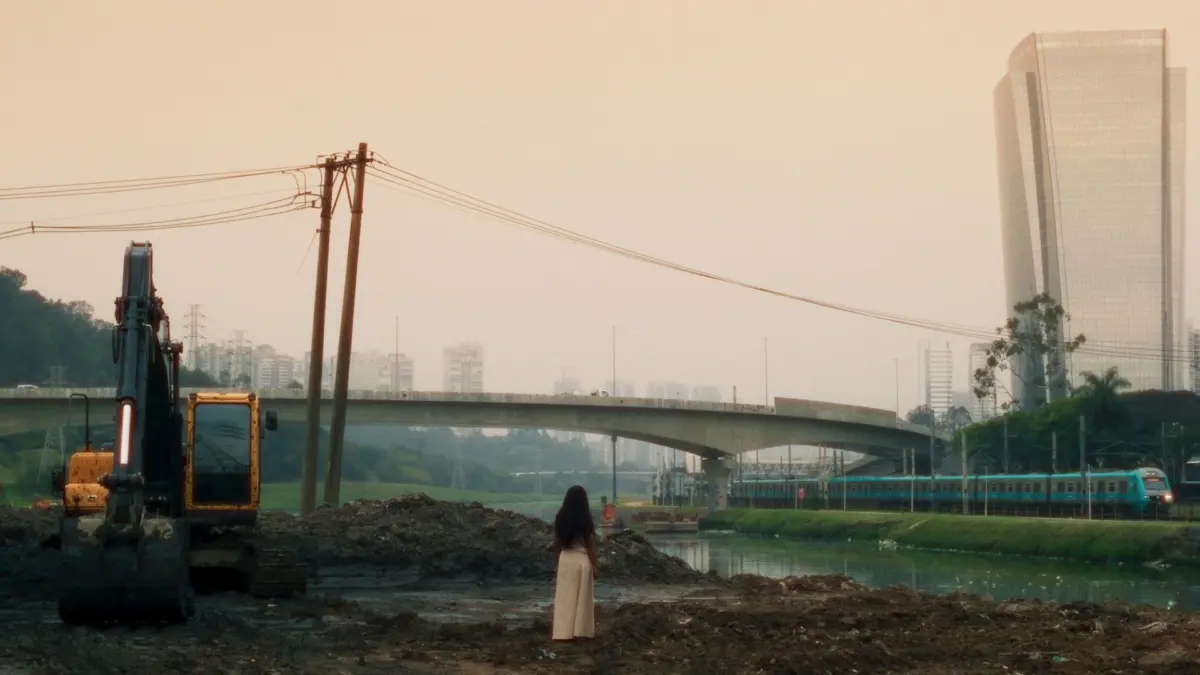
On the rugged, contested peripheries of São Paulo, Brazil, a pig-like creature steps through the dense canopy of the indigenous Guaraní territory, offering a perspective of the world that resists centuries of erasure.
“My name is Rete, I am a peccary,” the animal tells the audience, its voice carrying an ancient weight. The creature shares the memories of what began unfolding across the land when European colonizers first laid anchor and settled the region. “One day, those who are many started arriving,” Rete recalls. Slowly, the unyielding stones brought by the newcomers began to swallow the earth, narrowing the paths of ancient rivers, choking out native flora, and squeezing the indigenous wildlife into ever-dwindling corners of their ancestral home.
Deep within this same indigenous territory, a Guaraní leader and woman named Jera Rete finds herself caught in the friction between the forest and the metropolis. In her recurring nightmares, the sprawling concrete expanse of the city violently invades her village. Yet, these visions are not merely sources of dread; an old woman persistently visits her dreams with counsel, and even the natural world speaks back. The river itself carries a voice—provided one is willing to quiet down and listen.
These elements form the bedrock of Arrow for a Stone Heart (Flecha para Um Coração de Pedra), a poetic debut feature directed, written, and shot by Luiza Calagian. Crafted in deep, collaborative partnership with the local Guaraní indigenous community, the documentary-fiction hybrid transports viewers straight into the emerald heart of the forest sitting on the doorstep of one of the world’s largest urban centers. The film’s narrative structure deliberately departs from conventional filmmaking conventions because the Guaraní experience and articulate reality through an entirely different lens. From their vantage point, myths, dreams, and profound relationships with non-human entities fluidly connect disparate temporalities and perspectives.
The cinematic, occasionally hallucinatory journey that the movie takes audiences on vividly elucidates the decades-long history of the community’s resistance and territorial struggle. Through Calagian’s lens, cinema emerges not just as an artistic endeavor, but as a vital opportunity for intercultural understanding and, ultimately, real-world change.

Arrow for a Stone Heart celebrates its world premiere in the Rebels with a Cause Competition at the 30th edition of the Tallinn Black Nights Film Festival (PÖFF) in Estonia, marking a major international platform for the provocative Brazilian feature.
A Collaborative Vision Rooted in Seven Years of Trust
Calagian co-wrote the film alongside Jera Rete, anchoring the production in authentic indigenous leadership. Calagian also served as cinematographer and shared editing duties with Caio De. The project was produced by Vinicius Toro and Sabrina Zimmermann, with Bruno Cucio executive producing. Utopia Docs is managing international sales and distribution.
Ahead of the world premiere, Calagian reflected on the lengthy genesis of the project and its distinctive aesthetic, voice, and rhythm.
“I kind of grew up with this film. It’s been seven years now,” the filmmaker explains. Over that extended period of creation, the project evolved organically. “The film began to transform as well, and at a certain point, I understood that it wouldn’t make sense for me to try to tell the story, which is the story of the Guaraní. It had to be told from their point of view and from their perspective rather than one that comes from the West.”
Translating that ambition into a cohesive cinematic language presented a unique challenge. “The mission became how do we bring the Guaraní cosmology, the Guaraní philosophy, the way that they see, organize, narrate and symbolize reality into the structure of a film, which is by its nature a Western thing,” Calagian notes. “Pero this also opened up the possibilities of transformation that this art has.”

One of the foundational elements Calagian explored was the profound role of dreams within Guaraní culture. “The Guaraní are very, very, very connected to their dreams,” she explains. “They don’t understand dreams just as something that your mind creates or something that your imagination creates, but the dream for them is a form of connecting to other dimensions, other beings, other spirits, to people who are not here anymore, and to gods.”
Blurring the Boundaries Between Fiction, Reality, and Spirit
As the production developed, Jera Rete transitioned from a community subject to an essential creative collaborator. “She embraced the project to the point that she became a co-writer,” Calagian shares. “She also started organizing who was going to be in the film. The main characters other than her are her two daughters. One of the girls, her youngest, plays the river, and the older daughter, who also appears briefly at the end of the film, voiced Rete, the peccary. So everything kind of revolves around Jera. She is the leader of this village, and she became not only the co-writer but also the whole heart of the film.”
The director also developed a deep affinity for Rete the peccary, an animal that eventually became the visual symbol of Calagian’s production company, Mata Fechada Filmes. “For me, it is a symbol,” Calagian says. “It has a lot to do with the magic of cinema. The Guaraní say it has the capacity of moving and traveling between worlds and entering different dimensions, different perspectives and visiting the gods.”
The ecological devastation wrought by human expansion and the enduring scars of colonization serve as central motifs throughout Arrow for a Stone Heart. The river, for instance, is regarded by the Guaraní as one of the wisest and most powerful spiritual presences in their universe.
“Even before colonization, when everything was more in harmony, the Guaraní were very careful and very respectful of those river spirits because they can be dangerous — they are not to be messed with,” the filmmaker highlights. “That’s why I wanted to include this character, the river, to tell her side of the story. Despite all of this destruction, there is still life in the river, which is amazing. Somehow, nature finds a way to survive, even in such adverse conditions. She represents an anthropomorphic presence.”

Language and phrasing were similarly chosen with meticulous care to accurately reflect the indigenous worldview. The recurring phrase “those who are many,” for example, is deliberately utilized throughout the film. “That is the common way they call the people who invaded,” Calagian notes.
Challenging Historical Monuments in São Paulo
Calagian’s relationship with the Guaraní community is deep-rooted, extending well beyond the timeline of this single film. For more than a decade, she has collaborated with the indigenous population on communication initiatives designed to amplify their voices and secure their rights.
“We were working on a campaign to make the government recognize the indigenous lands that they had inside the city, one of the biggest metropolises in the world,” the filmmaker recalls. “There is a big historical dispute around the history of colonization, especially in São Paulo. There is a regional culture that celebrates the colonizers who were responsible for invading this territory, which has always been Guaraní territory.”
This ongoing ideological battle directly inspired the film’s title, Arrow for a Stone Heart. The phrase operates on multiple levels: it plays on the common English idiom for cold or cruel individuals, while serving as a direct critique of the statues, monuments, and urban markers that glorify colonial history.
“There are still a lot of historical monuments, a lot of street names, a lot of public political symbols that celebrate the colonizers, the people who killed and enslaved the indigenous people,” Calagian emphasizes. “We understood how important this dispute between narratives was, and that’s how this project was born.”