
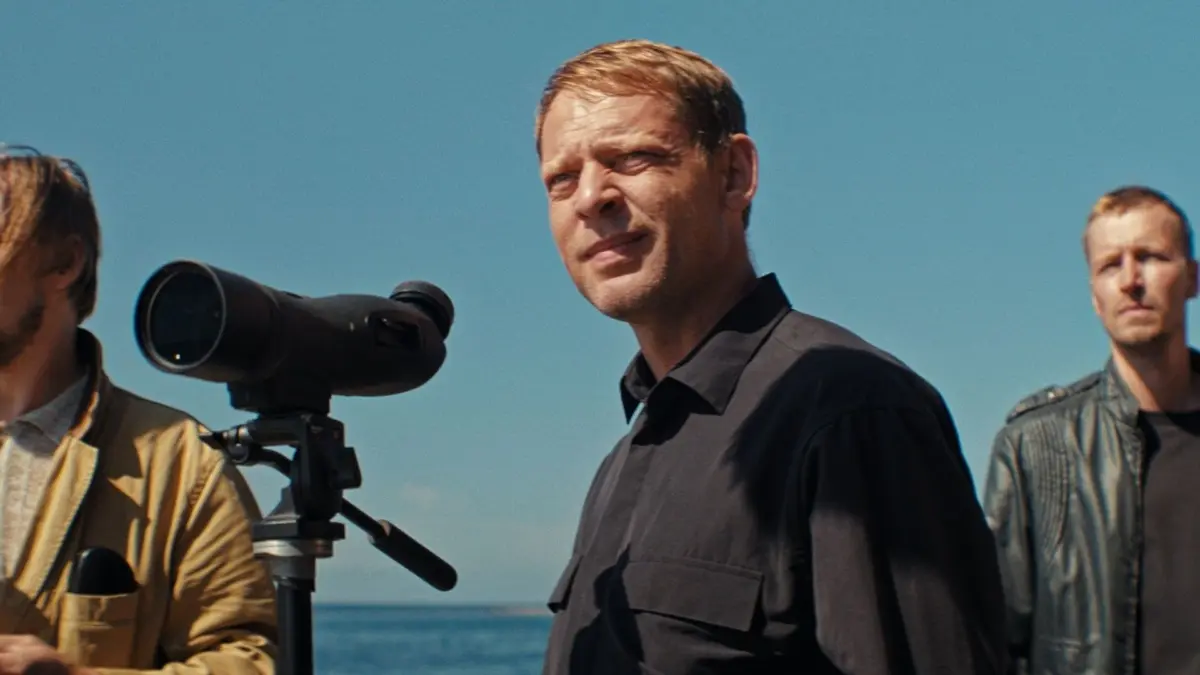
Once upon a time, Princess Niina lived in her castle, courted by three distinct suitors: The Mentor, The Writer, and The Stonemason. This is, more or less, how the film Mo Amor begins. Described as a tender, modern, and very timely Estonian fairy tale exploring love in all its forms alongside the complexities of identity, the film is poised to make its world premiere at the 30th edition of the prestigious Tallinn Black Nights Film Festival (PÖFF).
Written, directed, and co-produced by Eeva Mägi—whose previous credits include Mo Mamma, Mo Papa, and The Weight of All the Beauty—the cinematic story is told from the perspective of a photographer named Kaur.
"Princess Niina is adored by three suitors, yet remains restless, searching for something she cannot quite name," teases the official synopsis on the PÖFF website. "Then she sheds her crown and reveals her true self. Inviting her former lovers to a secluded summer home, the stage is set for a strange reunion where memory, myth, and reality begin to intertwine, old wounds resurface, and love takes unexpected forms."
Mo Amor is scheduled to receive its world premiere on Monday, November 16, competing within the festival’s high-profile Critics’ Picks Competition. Mägi is no stranger to this section; her previous feature, Mo Papa, opened Tallinn’s Critics’ Picks section last year and earned a special mention from the jury.
Mägi produced Mo Amor alongside Sten-Johan Lill, who also served as the film’s cinematographer. The editing was handled by Jette Keedus. The cast features familiar faces from Mo Papa, including Ester Kuntu and Jarmo Reha—the latter of whom is recognized as one of this year’s 10 rising stars in Tallinn’s Black Nights Stars showcase—alongside Tambet Tuisk, Andres Mähar, Sander Roosimägi, and Ivor Mikker.
Ahead of the film’s high-profile Tallinn world premiere, Mägi spoke about the deep-seated inspirations behind the project, how themes of identity are frequently co-opted in political rhetoric, and the deliberate lyrical quality that defines Mo Amor.

"I always have personal stories intertwined with stories that I want to tell for society or that society needs to be told," the filmmaker shares regarding her creative motivations. "I had this idea about what if love actually survives the truth, since we lie so much to people we love just to pretend we’re someone else or are sometimes so afraid to reveal who we are. But then also, transgender people are facing so many obstacles, at least in Estonia, and society is still very prejudicial towards them. So I wanted to tell a universal love story, make a transgender person a hero and show a trans man’s fairy tale."
At the same time, Mägi is quick to emphasize the broader emotional truth at the heart of her narrative. "Of course, there is no such thing as transgender love and ordinary love. It is all just pure love," she notes.
The creative decision to frame Niina’s journey of self-discovery and transformation as a fairy tale emerged organically during the filmmaking process. "I thought it would be even more powerful if I told it as a fairy tale because fairy tales allow us to talk about very difficult topics in very beautiful and universal ways," she explains, adding that the approach "also shows that everything is possible."
"I had the feeling that it had to be a fairy tale because this story in our society is still being seen as a fairy tale—people don’t think it’s realistic," Mägi continues. "लेकिन I think we have to tell these fairy tales until they become part of our real life."
Mägi’s collaborative process often relies on bringing back trusted actors from her past projects. Operating within a small budget and an open creative framework—shooting without a rigid, pre-written script—allows the team to explore characters and storylines organically to see where the journey takes them.
"I’ve been working with the same actors and actresses for years now," she says. "Both Jarmo Reha, who is Kaur, and Ester Kuntu, who’s playing Niina, were also in Mo Papa. Tambet Tuisk, who’s playing The Writer, was in two of my previous short films, and he’s also part of Mo Hunt, which is my next feature film—and Jarmo is there again, too. So, these actors and others [on the production] are already used to my method. We are all surfing on the same wave of chaos."

The cast also includes Ivor Mikker, who is not a professional actor. Explaining how he became involved in the project, Mägi shares, "I met him at a bar. He’s my friend. He’s studying sculpture at the Estonian Arts Academy."
When considering the casting process, the question naturally arose as to whether a transgender actor could be found for the leading role. "We couldn’t find a transgender actor to play in the film because we don’t have any [in Estonia]," the writer-director explains. "So, I talked to the trans community, and they thought that it was okay if Ester, as a woman, is playing Niina and Jarmo, as a man, is playing Kaur. And we are not so much concentrating on the transition period."
Avoiding clichés was a deliberate choice for the production. "We didn’t want to concentrate on the transitioning period and use a lot of makeup and do all these stereotypical things that a lot of films do," Mägi states.
Instead, Mo Amor incorporates distinctive formal choices, such as recurring photo camera sounds followed by still frames that punctuate the narrative before moving images resume. "The process itself is always guiding us," the filmmaker emphasizes. "And when we started shooting, I realized that I wanted to have these still frames because Niina and Kaur are photographers. I wanted to somehow make the film reflect this profession and use it as part of the cinematic storytelling."
The physical production of Mo Amor took place over the course of 17 days at the filmmaker’s boathouse on Vilsandi Island in the Baltic Sea, Estonia’s westernmost populated island. "This place is amazing," Mägi says of the remote location. "It’s very cinematic. And as we didn’t have any budget, as always, I decided to basically shoot it at home."
Looking ahead, Mägi is already deep into post-production on her next feature film, Mo Hunt. Much like the distinct tonal shifts between Mo Papa and Mo Amor, her upcoming project promises a completely different cinematic experience.

"The visual language is different," Mägi notes. "It’s a hybrid film, a staged documentary. I don’t want to repeat myself. And it’s also the outcome of the fact that we don’t have everything planned. We really go into the process and let the story guide us. And I guess every story has its unique ways of being reflected."
The initial concept for Mo Hunt centered on the story of a ballerina who becomes an illegal surrogate. "We started staging this ballerina, and then I had a feeling that I had to collect stories from different artists about how they have experienced the thin line between artistic creation and manipulation," the director recalls. "Artistic creation can become exploitation or mental abuse. I was wondering how far I can push actors just for the sake of art. I understood that there are boundaries, there are limits. So, then I started to get interested in this topic and started collecting different stories from different artists."
That thematic exploration ultimately shaped Mo Hunt into a staged documentary. "All the people in the film are playing actors, but they are presenting the stories of different artists," Mägi explains. "So, the film combines what’s happening in the fiction film with what’s actually happening in artists’ hearts and minds."