
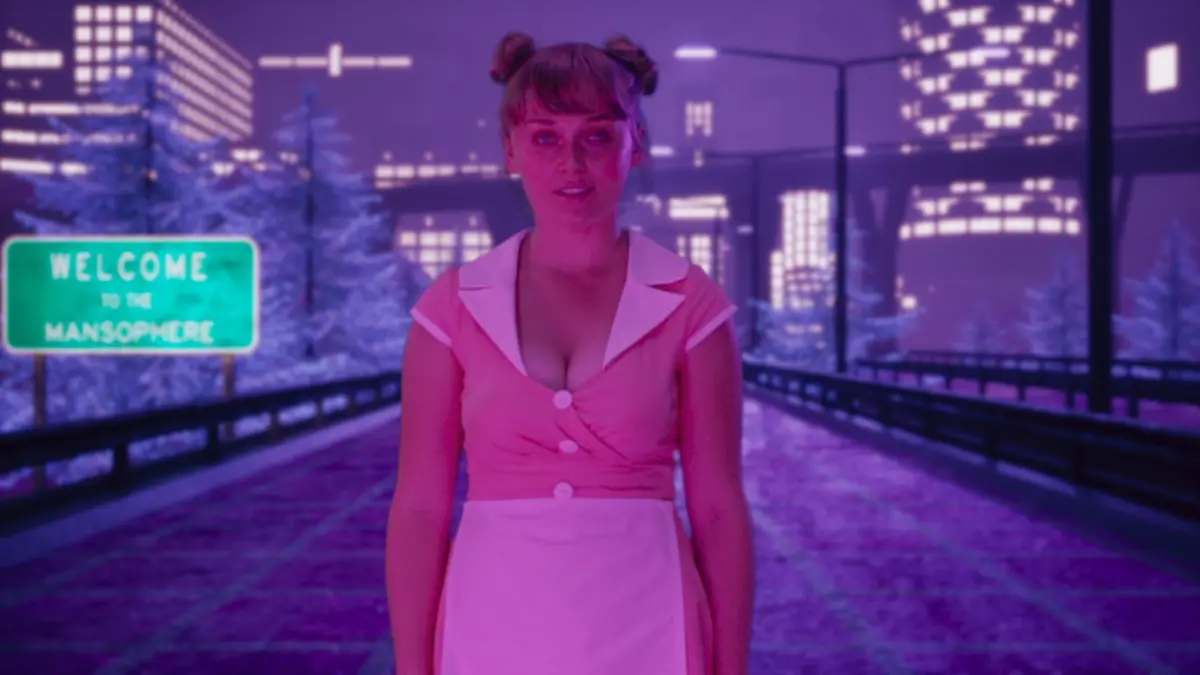
U.S. filmmaker Dylan Stephen Levers makes his feature-length directorial debut with Pop Pop, a cinematic parable that confronts audiences with unusual, memorable visuals and sounds while posing unsettling questions suited to an era defined by virality, digital nihilism, the manosphere, and political radicalization.
True to an independent spirit and pop art fashion, the film operates as a cinematic mash-up of meme culture, cyberspace journeys, and alt-right protests. It explores toxic masculinity, cancel culture, and a sea of identity crises without offering any apparent lifeboats.
Pop Pop is scheduled to receive its world premiere on Sunday during the 30th edition of the Tallinn Black Nights Film Festival (POFF) in Estonia. It is fitting that the film debuts within the festival’s Rebels With a Cause Competition program, a section known for highlighting boundary-pushing independent cinema.
Written and directed by Levers, Pop Pop features a cast that includes Cashton Tate Rehklau, Trevor Jonathan Lown, Lena Kutscher, Austin Davis, Djuna Knight, Kevin Confoy, and Marta Kotzien. Rehklau and Lown star as Dustin and Dibz, best friends who have recently survived their senior year of college and now share an apartment in New York City alongside an internet series. Faced with the question of where to go next in life, the two friends ultimately embark on very different paths.
Dustin becomes increasingly immersed in a radical worldview, focusing on attracting attention and gathering followers through provocative online posts. Meanwhile, Dibz finds meaning in social justice activism and experiences his first crush on a man, forcing him to reconsider his own identity. The film blends fictional narrative scenes with footage captured during real-life political protests and psychedelic animations that transport the audience deep into the digital world, including the subcultures of the manosphere.

The production is a Body by Lulz Films project, co-produced by Grease NYC. Consuelo Althouse serves as the film’s cinematographer, with Josh Coll handling editing duties. Producers on Pop Pop include W. Ian Ross, Dylan Stephen Levers, and Consuelo Althouse, while Stefanie Abel Horowitz, Josh Bierne-Golden, and Erin Magill serve as executive producers.
In an official director’s statement, Levers notes that he began writing Pop Pop back in 2016, “as angry white men were gathering online, sharing extremist ideas about immigrants, Islam, women, and the supposed destruction of the ‘white race.’ What the media dismissed as a fringe movement soon became a significant political force.”
The filmmaker ultimately decided to explore what it means to be a man in the modern world. Ahead of the film’s world premiere, Levers sat down to discuss Pop Pop, his core inspirations, his hopes for the project, and how the United States and the wider world might find a way to become less divided—or at least divided with less rage.
The Origins of a Pandemic-Era Project
Discussing the origins of the project, Levers explains that he began writing the script many years ago. While the coming-of-age tale remains an evergreen fixture in film and television, the director felt a noticeable gap in contemporary storytelling.
“Especially in the U.S., there were things coming out like Girls and Frances Ha that so many of my friends were really identifying with because they talked very eloquently about young womanhood and graduating from being a girl to an adult. But I thought, ‘Well, where’s the conversation around men?’” Levers says.

To develop the script, Levers drew upon his background in theater, treating the writing process like workshopping a new play. He convened groups of actors every six months to hammer away at the text and refine it. By February 2020, the project felt ready to go into production, only for the COVID-19 pandemic to hit three weeks later and shut down the world.
Although the project initially felt dead on arrival, the social and political upheavals of the summer of 2020 brought the themes of the narrative even further to the forefront. Set in the middle of the 2016 U.S. election cycle, the film’s explorations of masculinity, community, and digital existence took on heightened relevance.
Capturing Real Protests on Camera
One of the most striking elements of Pop Pop is its inclusion of real-life political marches and protests. Levers conducted extensive research in 2019 by attending various alt-right protests, including the "Straight Pride" event in the Boston area featuring parade marshal Milo Yiannopoulos.
Recognizing the stark visual and production value of these events, Levers consulted with cinematographer Consuelo Althouse, who brought an extensive background in documentary filmmaking to the project. Althouse suggested that the production could actually shoot within real protests to capture authentic textures and atmospheres.
Following advice from a political consultant, the crew traveled to Washington, D.C., in December 2020 to film during a "Stop the Steal" protest led by Ali Alexander—an event that ultimately functioned as a dress rehearsal for the events of January 6. Watching the news coverage weeks later, the filmmakers recognized several individuals from their own production footage.

When filming inside these unpredictable environments, safety remained the absolute priority. The filmmakers established clear protocols, designating a reunion meeting point and ensuring that neither cast nor crew members were placed in physical danger. By identifying simply as an independent media outlet, the crew was able to capture the raw and chaotic reality of the day without staging fake crowds.
Blending Digital Aesthetics and Retro Tech
The visual language of Pop Pop bridges modern cyber-realities with retro computer aesthetics, featuring loud typing sounds and vintage pop-up windows. Levers envisioned the computer screen almost as an independent character designed to prime the audience for the rules of digital existence.
The digital space depicted in the film incorporates both custom-made animations and real memes popular around 2016, ranging from mainstream touchstones like Drake and Barack Obama to the political compass meme. Levers notes that a personal dream for the film’s release is for viewers to compile a listicle of the various memes hidden throughout the runtime.
The title Pop Pop serves a dual purpose, reflecting both the shattering of institutional social contracts over the past decade and the nature of pop filmmaking itself—swallowing disparate cultural imagery, putting it through the wringer, and metabolizing it into something new.
Independent Resilience and Ensemble Performances
Bringing Pop Pop to the screen required significant perseverance, with Levers working a demanding day job producing large events for brands and balancing schedules to keep the production afloat. Early development on the film also benefited from contributions by actors Zazie Beetz and her husband, David Rysdahl.

Levers praises the dedication of his young ensemble cast, particularly leads Cashton Tate Rehklau and Trevor Jonathan Lown, hoping the project serves as a strong introduction for the entire cast to a wider international audience.
Fostering Dialogue and Community Building
Reflecting on the overarching message of Pop Pop, Levers emphasizes the importance of moral three-dimensionality in a complicated world. Rather than offering simplistic answers, the film examines how people can remain in community with others who hold opposing views.
Levers hopes that audiences can use the film as a jumping-off point to discuss their own struggles, perhaps serving as a cipher for navigating difficult political conversations around family tables rather than pointing fingers. Ultimately, the filmmaker hopes to see more independent creators stepping forward to make art that directly responds to the challenges of the current moment.