
Canada’s housing market is slowly beginning to pivot toward a recovery phase, but according to a new mid-year housing outlook from RBC Economics, the turnaround has arrived too late to prevent overall home sales and prices from registering declines across the country this year.
In the comprehensive housing report released this week, RBC economists noted that home resales have shown signs of improvement since April of this year. Furthermore, inventory levels have largely leveled off across several key regions, and home prices are either stabilizing entirely or declining at a noticeably slower pace than what was observed during the height of the market’s recent corrections. The financial institution’s analysis suggests that this nascent recovery is positioned to gain broader traction over the coming months as housing affordability gradually improves in select local markets, employment prospects brighten for young Canadians, and a large cohort of buyers who have spent years sidelined on the fence finally begin to return to the active market.
Still, RBC assistant chief economist Robert Hogue cautioned that any prospective recovery is unlikely to be quick, uniform, or consistent across the entire country. The housing landscape remains fragmented, shaped by local economic forces, lingering affordability pressures, and shifting demographic trends.
“Even in the best of cases, we think the recovery will be irregular with two steps forward followed by a step back, and regions progressing and regressing at the same time,” Hogue wrote in the outlook.
Sales and Prices Expected to Fall in 2026
Despite the encouraging signs of stabilization emerging in the spring and summer months, the near-term mathematical reality for 2026 remains constrained by the prolonged slump of previous quarters. RBC forecasts that national home resales will fall by 3.6 per cent over the course of the year, bringing total transactions down to an estimated 453,200 units. Concurrently, the bank’s national benchmark price index is expected to decline by 2.3 per cent, settling at an average of $794,200.
The broader macroeconomic and housing picture is expected to brighten noticeably by 2027. In that year, RBC forecasts that home sales will rebound significantly, rising 6.7 per cent to reach 483,600 units, while the benchmark property value is projected to inch upward by 0.8 per cent to land at $800,700.
Even with that anticipated rebound on the horizon, RBC emphasizes that activity will remain subdued relative to historical norms. The bank expects total sales to remain well below pre-pandemic levels, while home values will hover only slightly above their cyclical lows, reflecting a slow and cautious path back to health for Canada’s residential real estate sector.
Hundreds of Thousands on the Sidelines
A major foundational factor underpinning RBC’s outlook is the massive accumulation of demographic and consumer demand that has built up over the past several years. As ownership costs climbed steeply in response to prior interest rate hikes and soaring property values, a vast number of Canadians chose to delay their homebuying plans indefinitely.
“We think there could be hundreds of thousands of Canadians who put plans to buy a home on hold in the past several years due to sharp increases in ownership costs,” Hogue wrote.
This sidelined demographic is remarkably diverse, encompassing first-time renters who have been forced to remain in rental housing significantly longer than they would have preferred, as well as existing homeowners who were compelled to postpone plans to upsize to larger properties or downsize into more manageable accommodations as their life circumstances changed.
To quantify this phenomenon, RBC estimates that more than 400,000 potential Canadian household formations may have been suppressed or delayed since 2019. The bank believes that gradually unlocking even a fraction of that pent-up, delayed demand could provide substantial and much-needed support to the housing market as conditions normalize.
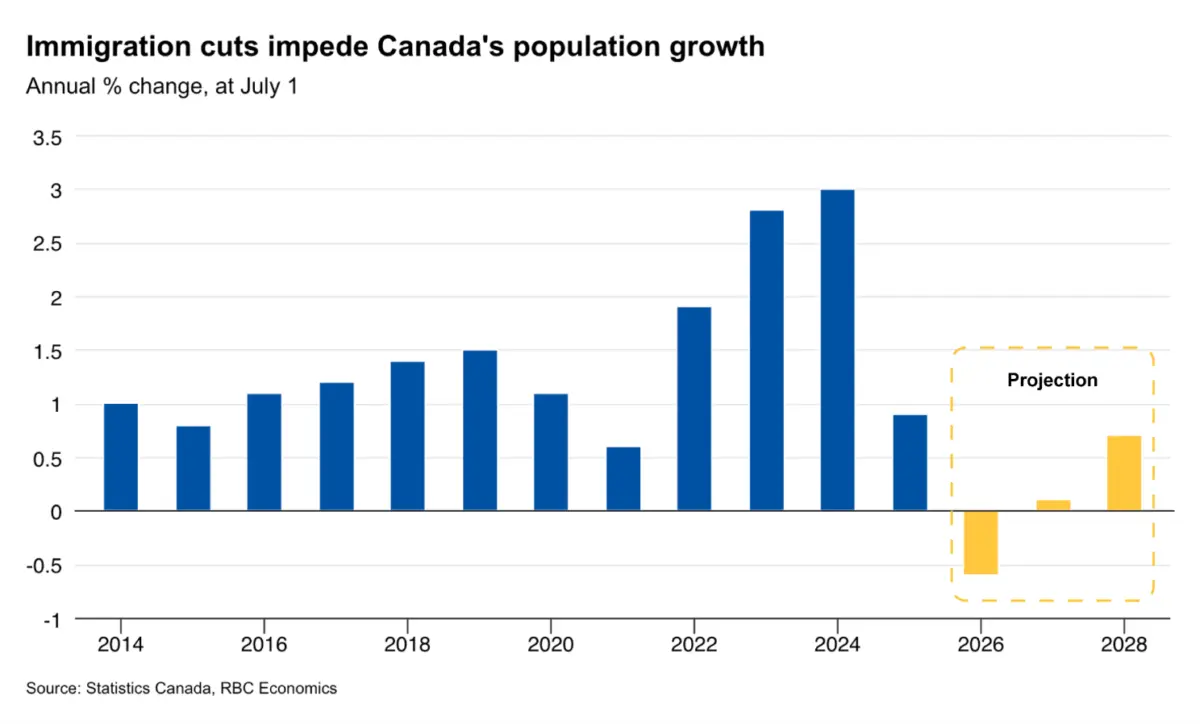
Furthermore, prospective buyers may find themselves in a structurally stronger financial position to act when the time is right. Canadians are currently saving money at a rate sitting near a 25-year high, and employment levels among young adults aged 25 to 34 are currently tracking above historical averages. RBC expects that this powerful reservoir of pent-up domestic demand will ultimately outweigh any downward pressure on homebuying stemming from slower population growth and recent federal cuts to immigration targets.
Interest Rates Have Likely Bottomed
The anticipated improvement in housing affordability across some of Canada’s traditionally most expensive metropolitan markets should naturally serve as a catalyst to draw sidelined buyers back into the fold. However, ownership costs across the country remain elevated, and this persistent financial barrier is a primary reason why the bank does not anticipate a sudden, explosive rebound in market activity.
Further relief from borrowing costs is also widely considered unlikely in the near term. The era of aggressive monetary easing has likely run its course for this economic cycle, altering the financing calculus for prospective purchasers.
“We believe they are as low as they will get this cycle,” Hogue noted regarding current interest rate levels.
Looking ahead, RBC projects that long-term mortgage rates will drift upward modestly through the end of 2027. Meanwhile, the Bank of Canada is expected to hold its overnight policy rate steady through the remainder of 2026 before eventually beginning to incrementally raise interest rates again next year.
Improving Economy Could Rebuild Confidence
Beyond interest rates and baseline affordability, broader economic conditions are expected to play a critical role in shaping market psychology and rebuilding consumer confidence. Persistent low consumer confidence has heavily weighed on prospective buyers in recent years, fueled by a combination of falling home values, acute affordability challenges, a sluggish broader economy, and widespread public anxiety regarding employment security.
Fortunately, RBC anticipates that the macroeconomic backdrop will continue to improve steadily through the end of 2027, with domestic economic growth persisting and current labor market slack expected to largely dissipate by the spring of next year.
The stabilization of home prices is also expected to act as a psychological turning point, encouraging prospective buyers who have remained intensely reluctant to participate in a market where property values were actively falling. As actual transactions increase and available housing inventory is steadily absorbed by the market, RBC projects that buyers will likely begin to feel a renewed sense of urgency to secure properties before market conditions shift further against them.
At the same time, RBC’s analysis includes important caveats, cautioning that the forecast remains vulnerable to several downside risks. These potential disruptions include the escalation of trade tensions with the United States, ongoing geopolitical conflicts abroad, deeper-than-expected economic fallout from federal immigration reductions, and the stubborn persistence of underlying affordability challenges in key regions.
The Canadian housing market has already navigated what RBC describes as four distinct "false starts" since 2023, during which brief periods of market improvement were repeatedly interrupted by external economic shocks and shifting monetary policy announcements.
Ontario and B.C. Expected to Emerge from Slumps
Geographically, the recovery is expected to manifest unevenly across Canada’s provinces. Ontario and British Columbia, which bore the brunt of the recent market corrections, are projected to record some of the strongest sales growth next year as improving regional affordability successfully draws sidelined buyers back into the active pool.
RBC forecasts that home sales in Ontario will rise by 8.2 per cent in 2027, following a modest decline of 0.5 per cent over the course of this year. Similarly, home sales in British Columbia are anticipated to climb 7.8 per cent next year, rebounding from a 4.6 per cent contraction recorded in 2026. Home values in both provinces are forecast to post modest increases of 0.7 per cent in Ontario and 0.5 per cent in B.C. next year.
At the same time, the condominium segment within these major provinces may require significantly more time to fully recover. RBC pointed out that stubbornly high inventory levels in the Toronto and Vancouver metropolitan areas, compounded by subdued investor demand, could easily keep condo prices on a downward trajectory well into 2027.
Price Growth to Cool in Resilient Markets
Conversely, regional markets that demonstrated remarkable resilience and managed to hold up much better throughout the broader downturn are expected to experience a cooling of momentum. As national population growth slows down and local housing inventory gradually increases, these previously hot markets will see moderated gains.
Price growth is forecast to moderate significantly in 2027, slowing to 2.5 per cent in Saskatchewan, 1.9 per cent in Manitoba, 1.2 per cent in Quebec, 0.9 per cent in New Brunswick, and 1.3 per cent in Newfoundland and Labrador. Meanwhile, Nova Scotia and Prince Edward Island are projected to post modest price increases of 1.1 per cent and 0.3 per cent, respectively, successfully returning to positive territory after experiencing declines this year.
Alberta is expected to remain an outlier of relative strength within the national landscape. RBC forecasts that the province will maintain strong momentum, projecting robust sales growth of 7.1 per cent alongside a solid 1.8 per cent increase in local home values through 2027.