
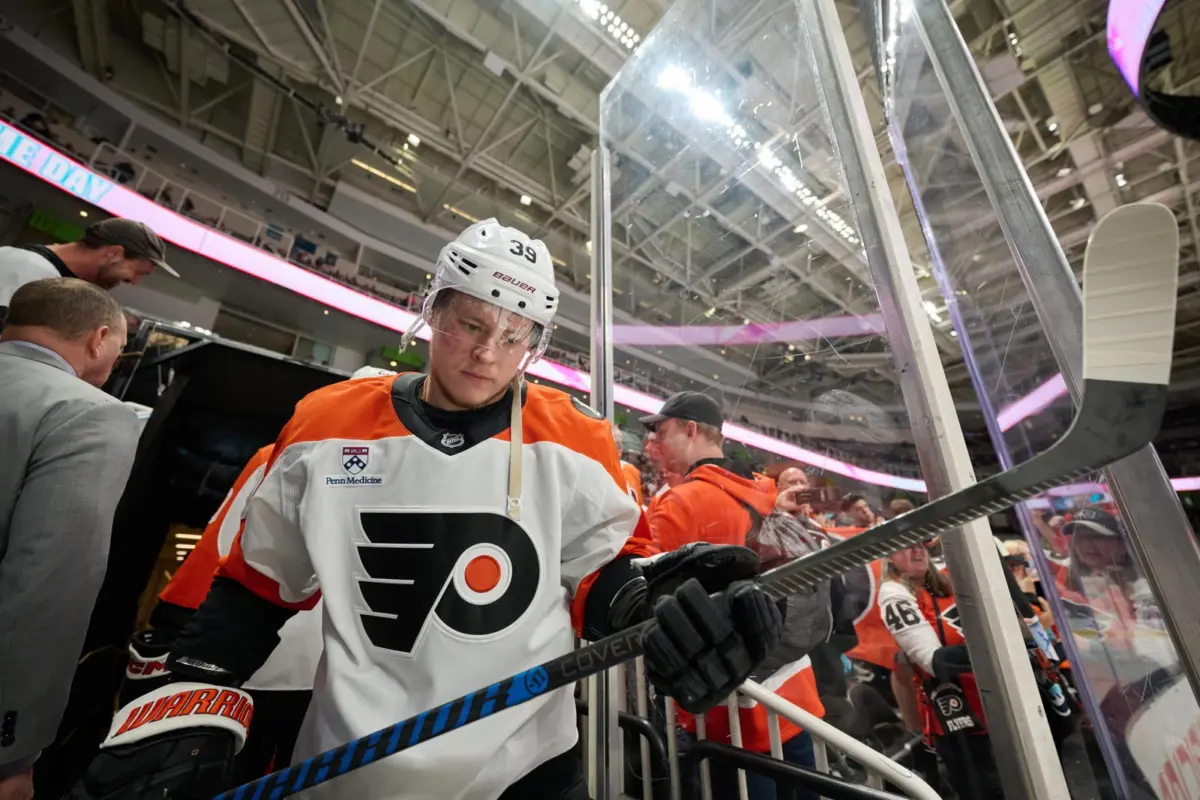
Matvei Michkov arrived at Philadelphia Flyers training camp this autumn looking like a completely different player—not just mentally, but physically. Shedding a staggering 30 pounds over the offseason through an intense regimen of conditioning and dedicated workouts, the young forward has traded the weight and friction that slowed down his sophomore campaign for a streamlined frame and a renewed professional attitude.
Yet, as the Flyers prepare for the rigors of a new NHL season, the fundamental question surrounding the franchise’s prized forward remains: How will this dramatic physical transformation and shifted mindset translate to on-ice success during his third year in the league?
The journey to this juncture has not been without its turbulence. Over his first two seasons in Philadelphia, Michkov endured a complicated relationship with the team’s coaching staff. Depending on the account, questions regarding his baseline motivation, coachability, and physical conditioning coalesced into a frustrating narrative. After a dazzling rookie campaign that established him as one of the most dynamic young talents in the league, Michkov’s sophomore season suffered a noticeable sophomore slump.
The statistical regression was hard to ignore. From his rookie year to last season, Michkov’s average ice time plummeted by nearly two minutes per game. Naturally, his offensive production dipped right along with it, accompanied by a decline in his per-60-minute metrics. He generated fewer goals, fired fewer total shot attempts, and put fewer pucks on the opposing goaltender’s net.
Recognizing that the status quo was unsustainable, Michkov took matters into his own hands during the summer. Working closely with a personal trainer, he attacked a grueling conditioning program. Last season, he reported to training camp tipping the scales north of 200 pounds; today, he is officially listed at a much leaner 172 pounds.
Whether head coach Rick Tocchet tests him early in the schedule or extends his trust immediately based on the grueling labor put in over the summer and the brief pre-season remains to be seen. However, early indications suggest that if Michkov can secure a longer leash from the coaching staff early in the year, it will serve as a strong indicator of a bounce-back campaign.
Last season’s deployment metrics underscore the uphill battle he faced. Michkov averaged a modest 11:50 of ice time per night during the playoffs and even found himself enduring a healthy scratch for one game. At various points throughout the regular season, he was stripped of his spot on the primary power-play unit. Because a player’s statistical production is inextricably linked to how and when they are deployed by the bench boss, the road toward reclaiming a prominent role in the lineup begins with earning that trust back.
Assuming the message delivered by the coaching staff has fully registered, expectations dictate that Michkov will be integrated far more deeply into the Flyers’ offensive schemes moving forward. Being limited to a meager 176 total minutes on the power play, as was the case last year, simply does not suffice for a player of his offensive pedigree and draft billing.

Beyond simply demanding more minutes, however, Michkov must prove that he can act as a reliable catalyst for the offense. Philadelphia’s man advantage struggled mightily last season, finishing dead last in the National Hockey League with an abysmal success rate of 15.7 percent. Consequently, the challenge for the young forward is not merely about accumulating power-play time, but about maximizing those minutes and actively contributing to a turnaround.
The silver lining is that the Flyers’ coaching staff is undoubtedly searching for alternative tactical approaches. Running the majority of the power-play operations through Trevor Zegras clearly yielded subpar results last season. If Michkov can command a more prominent role and help spark a stagnant power play, his offensive totals will inevitably rebound.
The persistent tactical challenge, however, lies in 5-on-5 play. Due to Michkov’s well-documented limitations as a complete 200-foot player, the coaching staff struggled to comfortably commit to deploying him in softer, sheltered minutes. The team went to great lengths to protect him, starting over half of his non-fly shifts in the offensive zone and carefully shielding him from opposing top defensive pairings. Even with these strategic cushions, his overall performance dipped below his rookie standards.
This vulnerability is precisely where his offseason conditioning and weight loss are expected to make their presence felt. In theory, a well-conditioned, finely tuned Michkov who is no longer dragging fatigue behind him at the tail end of a shift will be capable of imposing a much heavier forecheck. By putting his most frequent opponents under sustained pressure, he should be in a far better position to capitalize on the scoring chances he and his linemates generate.
In addition to overall usage and tactical deployment, linemates play a critical role in shaping a player’s offensive output. Throughout the early stages of training camp, Michkov has skated alongside Alex Bump, a promising goal-scorer who earned a 17-game stint with the big club during his age-21 season last year, and defenseman Oliver Bonk, who is fresh off his first professional campaign in which he logged six goals and 19 points across 46 games with the AHL’s Lehigh Valley Phantoms.
While line combinations are fluid and bound to shift as the season progresses, these early configurations suggest the coaching staff is testing the waters with two highly regarded prospects rather than relying entirely on established roster mainstays like Zegras or Travis Konecny, let alone factoring in an anticipated star like Porter Martone.
Michkov faces the clear responsibility of demonstrating to the organization that he warrants a larger, more impactful role. Based on glowing reports emerging from Flyers camp so far—including consistent praise from Tocchet—making that leap does not feel like an unreasonable expectation. Should he lock down a consistent second-line role alongside proven scorers, complemented by steady minutes on the power play, his rookie stat line of 26 goals and 60 points ought to serve as a baseline. Under those optimal conditions, a progression toward 30 goals and 70 points is well within his reach.
Given what has transpired over the first two chapters of his professional career, Michkov may never develop into a defensive stalwart. Nevertheless, evolving into a reliable 30-goal threat who can skate through a full shift without exhausting himself would represent a massive step forward for a player who is only months away from turning 22.
The Flyers have invested a significant amount of capital and faith in Michkov’s ultimate potential. If the talented winger continues to hold up his end of the bargain by maintaining his conditioning and buying into the team’s structural demands, the pieces are finally in place for everything to fall into alignment.