
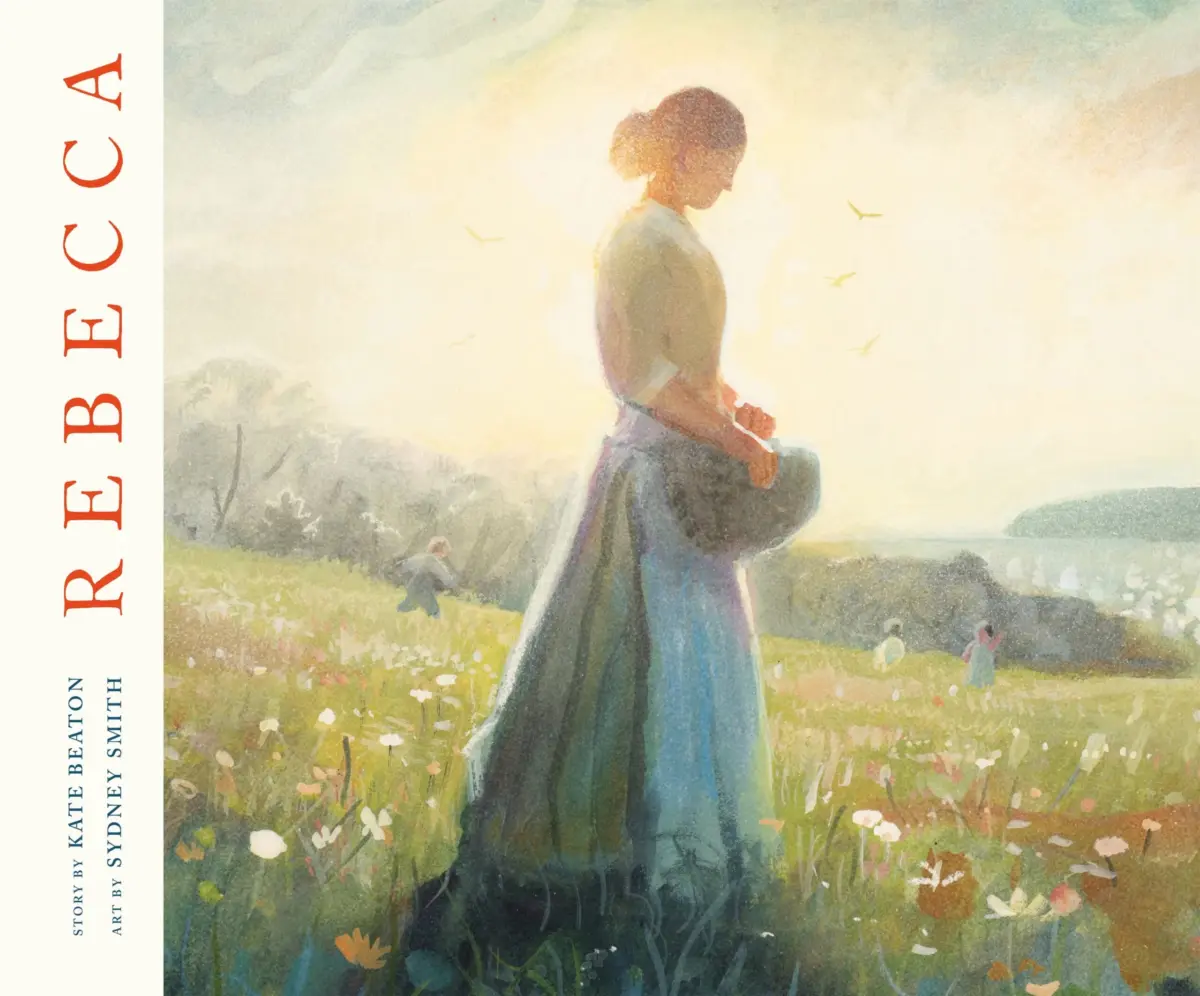
Renowned graphic novelist and author Kate Beaton is releasing her latest work, a children’s picture book titled Rebecca, which draws deeply on personal tragedy, family history, and the enduring nature of grief. Best known for her webcomics under the banner Hark! A Vagrant and her New York Times bestselling graphic novel collections, Beaton’s new project marks a poignant departure into children’s literature, tackling themes of adult loss, mortality, and historical resilience.
Beaton, who was born and raised in Cape Breton, Nova Scotia, where she still lives with her family, has structured the new book around a deeply personal foundation. The origin of the project traces back to her family roots and a shared nomenclature. Beaton and her older sister were both named after their grandmothers—Rebecca and Kathryn, known affectionately as Becky and Katie. Having run out of grandnames after the two sisters, their parents exercised more creativity for their two younger siblings. For Beaton, however, that connection to the name Rebecca remained a treasured tie stretching back through generations of mothers and daughters.
That connection was forever altered on May 14, 2018, when her sister Becky passed away following a grueling three-year battle with aggressive cervical cancer. In a reflective essay detailing the background of her new book, Beaton describes how her existence became bifurcated by the loss. She speaks of a "first life"—the person she was before her sister fell ill—and a "second life," defining who she is now. She characterizes those three years of illness as an intervening horror movie where a loved one slowly vanishes into skin and bone, leaving the survivors to navigate their own distinct types of grief. Anyone who has watched a family member waste away to cancer, she notes, understands the helplessness of watching hope evaporate into a permanent goodbye.
A profound shift occurred a year after Becky’s death, when Beaton became a mother. Expecting her baby in June 2019, her water unexpectedly broke in the middle of the night on Mother’s Day. Racing to the hospital in the dark, she prayed fervently that she would not give birth on May 14th, the anniversary of her sister’s passing, wishing to spare a newborn the heavy weight of that specific grief. Her daughter arrived quickly in what she describes as a mercifully short delivery, born on May 13, 2019. Holding her newborn infant, Beaton experienced a complex convergence of profound joy and enduring sadness.
Becoming a mother in the heavy shadow of her greatest sorrow taught Beaton valuable lessons about human resilience. It demonstrated that grief has no set expiration date; rather, it carves out a permanent space in one’s life, existing side by side with day-to-day survival. Grief, she realized, is neither inherently good nor bad, but rather a reality that one learns to live alongside because life demands continuation.
Following the birth of her daughter, Beaton welcomed a baby boy into the family. During the quiet evening hours, as she and her husband took turns sitting in the dark next to their young children to help them drift off to sleep, the inspiration for her new book began to take shape. The hours spent listening to the soft, rhythmic breathing of her sleeping children—the gentle, musical sighs of Hummmm, hummmm—stirred deep emotions. Feeling overwhelmed by love and the protective aches of parenthood, Beaton began composing Rebecca line by line in her head, polishing the narrative like a precious gem as a way to work through her unresolved grief.

Directly writing about her sister Becky proved too difficult, as the wound remains raw and open. Instead, Beaton looked to the history carried within the name itself. Tracing the lineage back through the centuries, she arrived at an ancestor from the late 18th century: Rebecca Lombard Smith, her great-great-great-great-grandmother.
Historical accounts of the family typically center on Rebecca’s husband, Captain David Smith, a whaling captain who met a devastating end in March 1789 when he fell through the ice near Port Hood Island while his wife was pregnant with their last child. While history books often focus on the tragedy of the captain’s death, Beaton found herself captivated by Rebecca. Left entirely alone on a small island off the shore of Cape Breton, Rebecca raised their six sons and one daughter through sheer fortitude. While descendants branched out along many lines, Beaton’s lineage descends through that lone daughter, preserving the mother’s name and embodying the same fierce maternal strength that Beaton witnessed in her sister during her illness, and later found within herself.
During the period when Becky was sick, Beaton lived in the village of Port Hood, where she could look out her window and see Port Hood Island across the water—a lonely place among the waves, particularly in the winter months when it remains uninhabited. She remained in Port Hood after Becky’s death and through the early days of motherhood, frequently looking out at the island and contemplating the legacy of Rebecca Smith, whose children all survived against the odds. While her sister’s story ended in profound loss, Rebecca’s story ultimately concluded with hope despite enduring immense tragedy.
During her walks with her dog and a baby strapped to her chest—carried until back strain limited her travels—Beaton frequently walked as far as the Old Protestant Graveyard, the final resting place of Rebecca Lombard Smith. The gravestone bears an inscription detailing her birth in Truro, New England, her marriage to Captain David Smith, his loss on the ice in Port Hood in 1789, and her own passing on November 30, 1821, at the age of 76. Uniquely, the stone features the names of her surviving sons—Lewis, Parker, and David—carved directly into the monument, a personal touch that Beaton notes is absent on neighboring stones, reading almost like a direct declaration of love from the children she raised: "This is our mother. We loved her."
These deep historical connections provided an anchor for Beaton as she processed her grief, walking home from the graveyard with her sleeping baby making rhythmic sounds against her chest in time with her footsteps.
The resulting children’s book, Rebecca, explores these heavy themes in a format that challenged standard publishing conventions. Connie Hsu, publishing director of Roaring Brook Press, admitted her initial reaction was one of awe, noting that the project defied the typical unwritten rules of children’s literature by featuring an adult protagonist, addressing the heavy theme of loss, and including the deaths of characters. Nevertheless, Hsu recognized the undeniable power of the work and committed to its publication.
Rebecca arrives on bookshelves nationwide tomorrow, offering readers a unique meditation on ancestry, maternal endurance, and learning to coexist with the profound losses that shape our lives.