
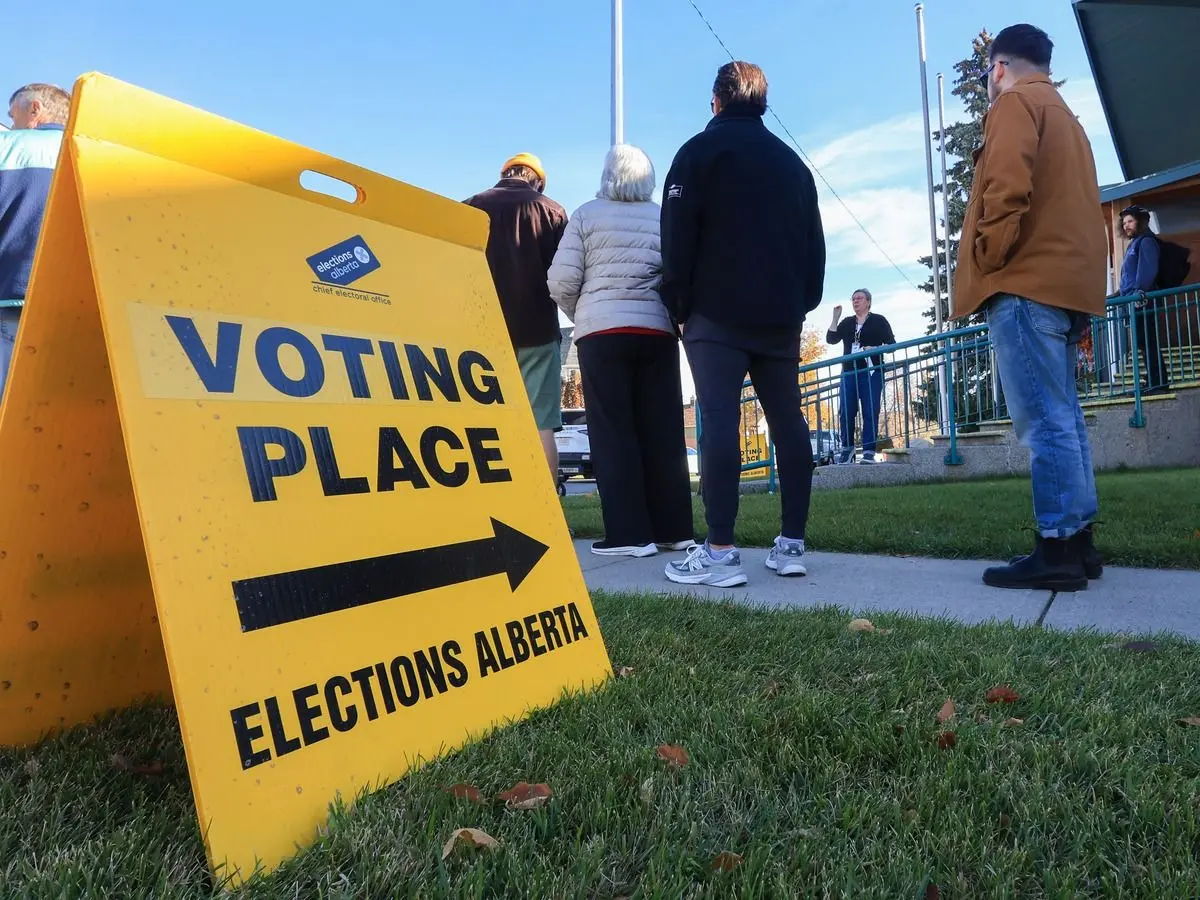
CALGARY — Polling stations across Alberta saw steady lines this week as advance voting began on a historic ballot that could fundamentally reshape the Canadian federation. With the official referendum scheduled for October 19, Albertans are being asked to determine the foundational future of their province: whether to remain within Canada or initiate a formal process toward a subsequent referendum on separation and full independence.
At advance voting locations, including the Scandinavian Centre in Calgary, citizens gathered early to cast their ballots, reflecting the intense public engagement surrounding an issue that has dominated provincial and national discourse. The vote represents one of the most critical constitutional tests Canada has faced in decades, arriving at a time of heightened political friction between Edmonton and Ottawa, and coinciding with complex economic headwinds within Alberta’s signature energy sector.
As the province prepares for the final tally, national political leaders, provincial officials, and energy market analysts are closely watching both the ballot box and the trading desk. The outcome stands to influence not only the constitutional architecture of the country, but also the long-term economic path of a province whose resource wealth remains central to national prosperity.
Alberta leaving Canada? A vote on redrawing the country
The October 19 referendum places a consequential question directly in front of the electorate. Rather than an abrupt unilateral declaration, the vote serves as a critical junction: citizens can choose to remain firmly committed to the Canadian constitutional framework, or they can mandate the provincial government to begin a structured, formal progression toward an eventual binding referendum on outright independence.
The debate over redrawing the country’s political map has exposed deep divisions and profound passions across Alberta. For proponents of the separation process, the referendum is viewed as the culmination of decades of grievances regarding federal policy, resource oversight, jurisdictional encroachment, and the structural balance of power within Canadian institutions. Those supporting the mandate argue that the existing federal system has consistently constrained the province’s economic engine, and that initiating a clear path toward sovereignty is the only definitive way to secure autonomy and ensure local self-determination.
Conversely, the campaign to remain within Confederation underscores the profound institutional, trade, and geopolitical risks associated with fragmentation. Opponents of separation point to the intricate entanglements of federal programs, cross-border commerce, currency stability, and national defence, arguing that dismantling a 159-year-old union would create profound uncertainty for businesses, workers, and international investors.
The scene at Calgary’s Scandinavian Centre, where voters lined up during advance polls, underscored the gravity of the decision before the public. Voters have turned out knowing that this plebiscite carries far more weight than an advisory gesture; it is an explicit gauge of whether Albertans believe the federation can still be reformed from within or whether the time has arrived to prepare for an independent future outside Canada’s borders.
What Carney said about the Alberta Referendum
The impending vote has prompted direct intervention from the highest levels of the federal government. Prime Minister Mark Carney addressed Albertans directly in an online video appeal, making an urgent case for national unity ahead of the October 19 ballot.
Carney’s message sought to connect directly with a provincial population that has long felt sidelined by federal policymaking. Rather than dismissing provincial discontent, the prime minister acknowledged the acute frustrations that have fueled the independence debate, while firmly appealing to Albertans to choose to stay within the Canadian family. He argued that the shared achievements, economic scale, and collective security of a unified country provide a vastly stronger foundation for meeting the challenges of a volatile global landscape than fragmentation ever could.
The direct outreach highlights the federal government’s acute awareness of the stakes. For Ottawa, an Alberta vote endorsing the first step toward sovereignty would trigger unprecedented legal, political, and economic turbulence, destabilizing national institutions and fracturing the domestic economy. Carney’s appeal aimed to persuade uncommitted and moderate voters that their grievances can be answered through partnership and institutional dialogue, framing Alberta’s role as central and indispensable to Canada’s collective economic and social future.
Whether the prime minister’s personal intervention will soften hardened grievances remains an open question. For many in the province, federal pledges of renewed cooperation have historically failed to translate into structural reform. Nonetheless, the message signaled Ottawa’s recognition that the referendum cannot be treated as a routine regional protest, but as an existential moment for the country as a whole.
Danielle Smith on feds and future of Alberta
As voters cast their ballots, Alberta Premier Danielle Smith offered a noteworthy perspective on the ballot question, confirming publicly that she voted against leaving the country.
In an extensive interview with the Financial Post’s Larysa Harapyn, Smith outlined the rationale behind her vote, framing the current moment not as a definitive rupture, but as the dawn of a "new day" in Alberta’s often contentious relationship with the federal government. While Smith has established herself as one of the most vociferous defenders of provincial rights and autonomy in modern Canadian history, she argued that the strategic ground has shifted sufficiently to justify remaining within Canada while aggressively renegotiating the province’s jurisdictional footing.
Smith’s stance illustrates the complex tightrope she must walk. On one side, she leads a governing movement whose grassroots include impassioned supporters of complete sovereignty who are determined to see the separation process formalized. On the other, she is tasked with maintaining economic stability, attracting global capital, and governing a province whose institutional and corporate pillars rely heavily on stability and access to national markets.
In her remarks, Smith articulated a vision where Alberta’s leverage within the federation is stronger than ever. By demonstrating that the province has the political will to entertain a departure, she suggested that Alberta has finally forced Ottawa to confront western concerns seriously. For Smith, casting a vote to stay is not an endorsement of the historical status quo, but an assertion that a renewed framework—one that respects provincial jurisdiction over resources and economic policy—is now achievable from within the Canadian union.
Why Alberta oil is losing value as global prices soar
Compounding the political high-stakes vote is an unsettling economic paradox playing out across Alberta’s oil patch: the province’s heavy crude is selling at a steep and widening discount, even as global energy prices continue to soar.
Historically, wider price differentials for Western Canadian Select (WCS) against global benchmarks like West Texas Intermediate (WTI) have been attributed to physical transport bottlenecks, notably insufficient pipeline export capacity that left barrels stranded and forced producers to rely on costly rail transport. However, market observers point out that the forces driving the current discount are fundamentally different this time around.
Rather than being caused simply by a sudden lack of takeaway pipeline volume, the widening gap reflects an intricate combination of downstream demand dynamics, heavy-oil refinery processing economics, and shifting patterns in the global supply of competing heavy and medium grades. While international benchmark crudes have commanded elevated prices amid global supply tightness and geopolitical uncertainty, heavy, high-sulphur crude like Alberta’s bitumen blend faces unique refining requirements. When specialized refinery capacity encounters shifting feedstock economics, maintenance outages, or regional imbalances, the value of heavy crude can decouple sharply from the broader rally seen in light, sweet global grades.
This discount exacts a direct, measurable toll on the province. Every dollar added to the price differential translates into diminished revenues for energy producers, curtailed provincial royalty collections, and pressure on government fiscal planning. For an economy that relies on robust resource revenues to fund public services and support regional employment, watching the value of provincial barrels erode during a global commodity boom is a source of acute frustration.
The divergence between global price strength and local realization also casts a long shadow over the ongoing political referendum. For sovereignty proponents, the discounted value of Alberta’s primary export serves as another example of an economy constrained by regulatory and geographical limitations that they argue a separate state could better resolve through independent trade and infrastructure diplomacy. For those advocating to stay, the volatile dynamics of global commodity markets illustrate the vulnerability of relying on an export whose value is determined by international refinery dynamics, reinforcing the argument for the broad economic shelter, fiscal risk-sharing, and diversified financial base provided by the Canadian confederation.
As the October 19 deadline nears, Albertans are weighing these interconnected realities. Between the long queues at advance polling stations, the prime minister’s impassioned plea for unity, the premier’s insistence on a renewed federal partnership, and the persistent market challenges facing the province’s energy sector, the upcoming vote represents a defining crossroads for both Alberta and the nation.