
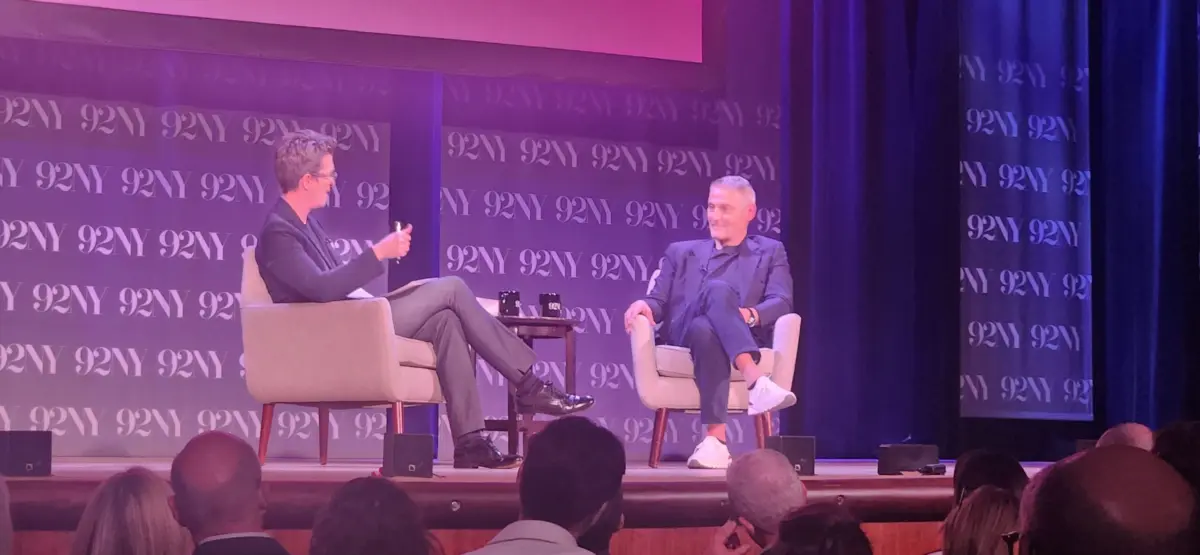
Entertainment and sports executive Ari Emanuel revealed during a live-stage interview in New York City that Donald Trump has indicated he does not intend to remain in the White House past 2028. Speaking with MSNBC anchor Rachel Maddow at New York’s 92Y on Tuesday night, the TKO chief executive officer shared details from a recent phone conversation with the president regarding federal tax credits.
According to Emanuel, the conversation naturally drifted into the political landscape of the future, during which Trump expressed high regard for a potential leadership pairing of Vice President JD Vance and Senator Marco Rubio. When Maddow asked to clarify if Trump envisioned them running on a joint ticket with Vance at the top of the ballot, Emanuel confirmed that was precisely the impression the president conveyed during their call three weeks prior.
The unstreamed conversation served as the marquee event on the publication day of Emanuel’s new memoir, Roll the Calls, which chronicles his grueling rise from an ambitious apprentice in the William Morris Agency mailroom to his current stature atop a conglomerate overseeing the UFC and WWE at age 65. Despite their long-standing personal and professional association, Maddow repeatedly challenged her agent on a range of contentious political and cultural topics. The dynamic between the interviewer and interviewee shifted fluidly from convivial to fiercely combative as Emanuel defended his extensive network of relationships with prominent political figures, the White House, and billionaire tech leaders like Elon Musk, arguing that his engagement serves a greater societal good.
Addressing his controversial association with Musk—whose company X, formerly Twitter, received early investment backing from Emanuel’s Endeavor—the executive pushed back against the notion that his influence is entirely weightless. While acknowledging the limits of his persuasion, Emanuel maintained that he has successfully moderated some of Musk’s impulses, even if those changes have been incremental rather than sweeping.
Throughout the evening, Emanuel balanced his defense of the tech billionaire with commentary on the shifting media landscape, praising entertainment mogul David Ellison. Emanuel had very publicly supported Ellison’s successful and high-profile acquisition of Warner Bros. Discovery. While Emanuel conceded that he disagreed with how Paramount handled the cancelation of Stephen Colbert, he highlighted Ellison’s willingness to grant creative freedom to satirists and creators such as Trey Parker, Matt Stone, and Jon Stewart on programs like South Park and The Daily Show, both of which frequently direct their comedic barbs at the current administration.
Maddow was sharply critical of this defense, drawing an immediate parallel to legal infractions. She likened Emanuel’s defense of Ellison’s broader media strategy to a driver pulled over by law enforcement who attempts to excuse bad behavior by pointing out all the pedestrians they managed not to hit in a crosswalk. Emanuel respectfully disagreed with the metaphor, choosing instead to champion the newly formed media oversight boards intended to safeguard the editorial independence of outlets like CBS News and CNN.
The discussion grew increasingly tense as Maddow challenged Emanuel over Ellison’s stewardship of legacy news programs. She asserted that the changes implemented under Ellison had severely damaged the reputation of the CBS morning show, the nightly news broadcast, and 60 Minutes, labeling the current state of CBS News an embarrassment. Maddow suggested that Emanuel’s public backing of the media mogul was motivated purely by business pragmatism, pointing to the billions of dollars involved in securing UFC broadcast rights. Emanuel corrected her financial figures slightly, clarifying that the transaction totaled $7.4 billion rather than the eight billion suggested, but brushed aside the broader critique of corporate media consolidation by shifting focus toward how modern audiences consume their news primarily through mobile devices and social media platforms.
The dialogue temporarily lightened as the two touched upon Emanuel’s unconventional wellness routines, which include cold plunges and eccentric dietary choices. However, the atmosphere quickly returned to high stakes when Maddow pressed the TKO leader regarding his historical and ongoing diplomatic engagements with controversial foreign leaders. Specifically, she questioned his 2018 meeting with Russian President Vladimir Putin concerning potential UFC initiatives in Moscow, as well as his renewed warmth toward Saudi Crown Prince Mohammed bin Salman following the initial fallout and return of investment funds in the wake of the murder of journalist Jamal Khashoggi.
Pushed on where he draws his ethical boundaries, Emanuel responded bluntly, describing himself as an adult operating in a complex world where diplomatic and business realities are rarely defined by simple binaries. He asserted that he believes the Saudi crown prince has subsequently undertaken significant positive initiatives, a stance that prompted Maddow to note visible signs of frustration in her guest. Emanuel denied being frustrated, though his defensive tone underscored the friction in the room.
Emanuel similarly defended other high-profile spectacles, including the decision to host a UFC event directly on the White House lawn earlier in June, pointing to the educational video packages on American history that accompanied the broadcast. Reverting to his defense of Musk, Emanuel noted that while he fundamentally disagrees with the billionaire on immigration policy, he remains deeply appreciative of Musk’s actions to block Russian capabilities in Ukraine, alongside ongoing technological advancements spearheaded by Neuralink and SpaceX.
Turning his attention back to the corporate entertainment sphere, Emanuel could not resist taking a pointed jab at the leadership of rival agency Creative Artists Agency. Criticizing top executives such as Bryan Lourd, Kevin Huvane, and other long-tenured leaders for failing to orchestrate an orderly succession plan, Emanuel characterized their prolonged grip on power as a failure of leadership.
The conversation eventually circled back to the broader implications of the American political horizon. Emanuel sought to downplay the singular nature of Donald Trump’s political threat by drawing historical parallels to the Nixon administration, asking the audience if contemporaries had not viewed Richard Nixon as similarly dangerous. When Maddow and sections of the audience openly demurred, Emanuel jokingly told the crowd to quiet down with a half-smile, maintaining that Trump is simply a different kind of political figure.
Maddow countered by expressing her firm belief that Trump will attempt to hold onto power beyond his constitutional term limits, arguing that he is not the type of leader to willingly step down in 2028. Emanuel disagreed, pointing directly to his recent conversation regarding the potential joint ticket of JD Vance and Marco Rubio as clear evidence that Trump is actively looking toward a succession plan rather than plotting a permanent stay in the White House. While political analysts note that Rubio has signaled he would not contest Vance in a primary, paving the way for a potential vice presidential slot, any such ticket would require Vance to first secure the Republican nomination in what is expected to be a fiercely contested primary process. Furthermore, political history shows that an outgoing American president has rarely successfully orchestrated the transition of power to a handpicked successor in modern decades.
Compounding the intrigue surrounding the 2028 presidential race is the potential involvement of Emanuel’s own family. Speculation has steadily mounted that Rahm Emanuel, the former White House chief of staff and mayor of Chicago, may position himself as a centrist contender on the Democratic primary ticket. When asked about his brother’s political ambitions, Ari Emanuel did nothing to dampen the rumors, stating unequivocally that he would offer his brother any assistance possible should he choose to run. Praising his brother’s administrative credentials and asking the audience if anyone could point to a more qualified candidate, the executive fueled ongoing chatter about a potential Emanuel campaign.
As the evening drew to a close, Maddow returned to the central ethical dilemma of the interview, pressing Emanuel on whether his cozy relationships with authoritarian figures and controversial oligarchs have ever genuinely mitigated the harm they inflict on society. Emanuel defended his philosophy of engagement, asserting that he prefers to participate actively in society rather than isolate himself. He maintained that through direct conversations and pointed disagreements with the president, Musk, and other prominent figures, he has successfully swayed their perspectives on key issues—even if that explanation ultimately failed to satisfy his interviewer or the skeptical members of the audience.