
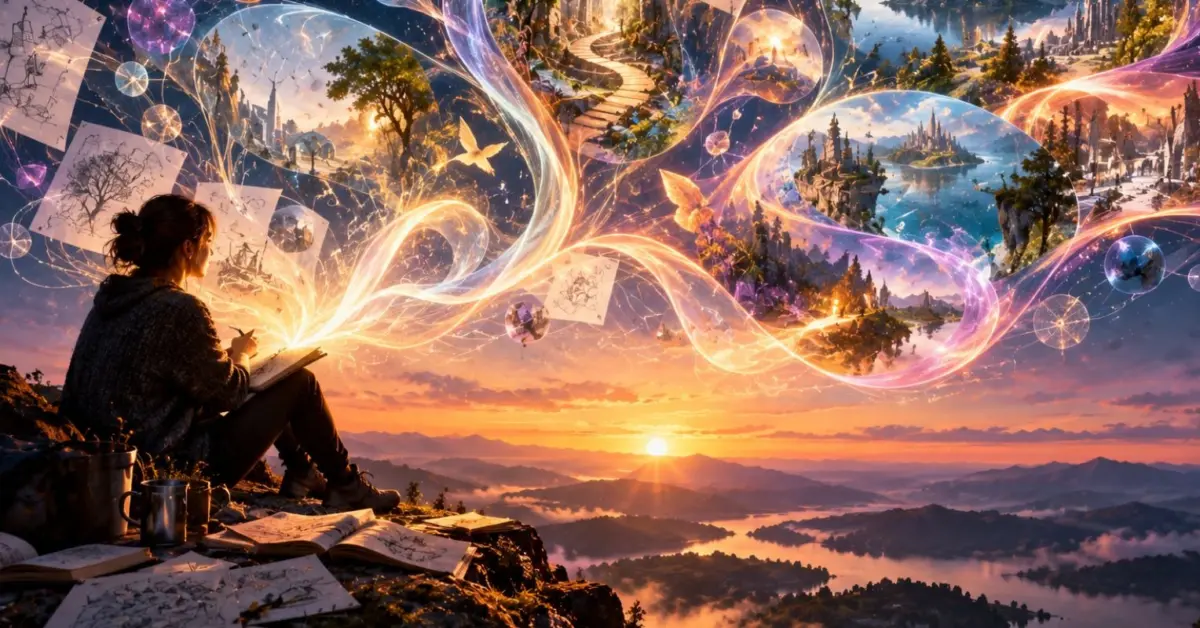
Where do ideas come from? For centuries, this fundamental question has captivated the minds of philosophers, scientists, and artists alike, serving as a central puzzle in understanding human consciousness and expression.
Mathematicians frequently describe their breakthroughs not as constructs of their own making, but as though they were charting a vast, pre-existing landscape that lay waiting for discovery long before they arrived. Similarly, classical composers often speak of enduring melodies that seem to drift down to them from somewhere far beyond the limits of their own individuality. Writers, too, frequently report the uncanny experience of watching their fictional characters take on lives of their own, making choices and behaving in directions that their creators never originally anticipated or planned.
Such compelling experiences appear to give heavy weight to what scholars call the "discovered view." According to this philosophical perspective, a finished creative work exists latently within some abstract realm of universal possibilities, and its human creator gradually uncovers it piece by piece. This concept closely mirrors Platonism—the enduring philosophical idea that mathematical truths, alongside other abstract structures, possess an objective existence entirely independent of human awareness or perception.
Yet, adopting this perspective entirely can feel deeply counterintuitive. It is difficult to reconcile the notion that if William Shakespeare had never lifted a quill to write Hamlet, or if Ludwig van Beethoven had never put pen to paper to compose his monumental Fifth Symphony, these masterpieces would still somehow exist in a metaphysical ether, lingering patiently for someone else to stumble upon them.
Because of these conflicting intuitions, the discovered view is traditionally contrasted with the "invented view." This alternative standpoint posits that the human creator brings the work into absolute existence from nothingness. Under this framework, when an author sits down to write a story, they actively usher it into being with every single narrative decision they make about plot, setting, and what happens next.
However, neither of these traditional extremes precisely captures the intricate reality of the human creative process. To resolve this enduring philosophical puzzle, researchers and thinkers may need to fundamentally reconsider something that is usually taken entirely for granted: the true nature of potentiality.
What Changes as a Work Takes Shape?
To understand how creation actually operates, one might imagine a sculptor standing quietly before a rough, unhewn block of stone. In the earliest stages of contemplation, every single sculpture that could potentially be carved from that stone is technically "possible." The heavy rock could theoretically become a roaring bear, a graceful human figure, or a piece of sweeping abstract art. In this broad sense, each of the endless possibilities lying dormant within the stone could be said to "exist" as a latent form.
Yet, these myriad possibilities are far from equally probable. Furthermore, their relative probabilities shift dramatically as the physical process of sculpting moves forward. The sculptor brings a unique set of personal interests, technical skills, and psychological tendencies to the task, including an innate predilection to pay attention to and draw inspiration from certain unique aspects of the stone.
Perhaps a smooth bump on the surface suggests the delicate curve of a human shoulder, prompting the artist to begin envisioning an angel or a ballerina. But as the heavy chisel continues to chip away at the material, the sculptor notices that the middle of the region designated for the face contains a streak of red mineral. The artist becomes increasingly excited by the sudden, spontaneous idea that this natural red region would make a brilliant clown nose. Features such as an exaggerated, painted smile and a cap adorned with a flower—which were initially wildly unlikely—suddenly become increasingly probable outcomes. Over time, the clown concept grows more and more likely, while the removal of surrounding stone simultaneously makes other physical possibilities impossible.
At each individual step of this artistic journey, the sculptor’s next action is guided and influenced by two interacting forces: first, the artist’s developing mental model or internal conception of the sculpture, and second, the unfolding physical state of the unfinished work itself. The continuous interplay between these internal and external factors results in a precise sequence of physical actions by which, out of endless initial possibilities, eventually just one remains standing.
In short, it is in some sense true that the final sculpture, complete with all its idiosyncratic details, existed as a raw possibility for that specific stone from the very beginning. This reality seems to firmly support the discovered view. However, it is equally true that the final clown sculpture did not exist inside the sculptor’s conscious mind as a well-defined option that was carefully chosen from a lineup of other distinct possibilities. And that undeniable fact appears to support the invented view.
How can these two seemingly contradictory truths be reconciled?
Possibility Versus Potentiality
A potential resolution to this persistent paradox can be found by shifting the focus away from mere possibility and turning instead toward the concept of potentiality. This theoretical resolution aligns closely with the broader proposition that reality itself is fundamentally rooted in potentiality, though it does not strictly depend on that larger metaphysical framework to hold true.
The stone certainly possessed the latent potential to become the specific clown sculpture that eventually emerged, but in the beginning, that particular outcome was exceedingly improbable. As the physical sculpting process proceeded, the probability of that outcome steadily increased, remaining strictly conditional on the evolving, dynamic state of both the sculptor’s mind and the stone itself.
New possibilities do not necessarily need to spring into existence out of nowhere for potentiality to change. Potentiality concerns itself not just with what is theoretically possible, but with the relative probabilities of different outcomes. These probabilities shift fluidly as the creative process unfolds over time. Moreover, an initially vague and formless idea does not need to consist of a neatly organized set of well-defined possibilities; these options frequently become differentiated only as the idea gradually takes tangible shape.
For example, when an individual sits down to write a story, devise a new scientific explanation, or compose a piece of music, the initial spark often begins as a vague intuition. It is little more than a persistent sense that there is something worthwhile pursuing, even if the creator does not yet quite know what it is. As they turn the concept over in their minds from different perspectives, certain aspects finally come into sharp focus, suggesting new possibilities that had not previously occurred to them.
These emerging possibilities may rise up from the depths of the unconscious mind, remaining entirely out of reach until the exact moment the creator finds themselves in a situation where those elements have suddenly become relevant. They may have existed in principle all along, but the actual probability of their realization was formerly negligible.
Honing New Possibilities Into Existence
To better understand this dynamic, scholars point to honing theory, an account of creativity developed through extensive research and detailed in academic literature. This framework proposes that creative ideas take shape through successive steps of interaction. These steps consist of a continuous dialogue between the creator’s current internal conception of an idea and the fresh perspectives or ways of thinking about it that naturally bubble to the surface.
This ongoing mental interaction is frequently influenced and accelerated by a tangible, external expression of the idea, such as the physical sculpture itself or words written on a page. Each individual step alters the creator’s overarching conception of the project, rendering some potential outcomes significantly more probable while pushing others out of reach.
Crucially, these interactions are continually guided by the creator’s world-model—their deeply integrated, comprehensive understanding of themselves and the surrounding world, including aspects they do not yet fully understand, accept, or are actively wrestling with. A personal world-model encompasses far more than just conscious elements that an individual can access voluntarily. It includes deeply buried elements brewing below the threshold of daily awareness, such as a painful memory, a forbidden desire, or a subtle pattern that the person perceived at some level long ago but never had a reason to bring to the forefront of their mind.
For instance, the sculptor may harbor an unresolved fear of or fascination with clowns. The immersive experience of creating a clown from raw stone helps them slowly come to terms with that underlying fear or discover their own psychological "inner clown." Consequently, each new iteration of the creative idea alters the creator’s internal world-model in return, which explains why artists frequently speak of achieving a greater sense of personal wholeness, psychological integration, and self-understanding as they complete their works.
This nuanced resolution to the old debate over invention versus discovery does not definitively settle the grand metaphysical question of whether every conceivable idea exists in some timeless, abstract realm. However, it successfully offers a practical way to reconcile two traditionally opposed answers.
Creative works are undeniably invented to the extent that human decisions and physical actions actively shape what comes into existence, continuously altering the relative probabilities of subsequent outcomes. At the same time, they are discovered to the extent that novel possibilities emerge unexpectedly, arising naturally from the ongoing interaction between our evolving conception of a project and new perspectives that bubble up into consciousness, sometimes without our direct awareness.
Individuals who follow a rigidly preconceived path to the completion of their creative projects—often referred to by writers as "planners"—may find that they resonate much more strongly with the invented view. Conversely, those who prefer to remain open to the spontaneous possibilities that emerge organically as the creative process unfolds—colloquially known as "pantsers," working by the seat of their pants—will likely find that the discovered view speaks more accurately to their personal experience.
Ultimately, this perspective suggests that each traditional answer misses something essential about the true nature of creativity. The discovered view overlooks the reality that whether an idea gets successfully created depends heavily on whether it becomes sufficiently probable within the creator’s mind to influence the process, either consciously or unconsciously. On the other side, the invented view misses the profound truth that creators are rarely fully aware of the contents of their own minds, particularly when dealing with possibilities that depend on conditions which have not yet arisen.