
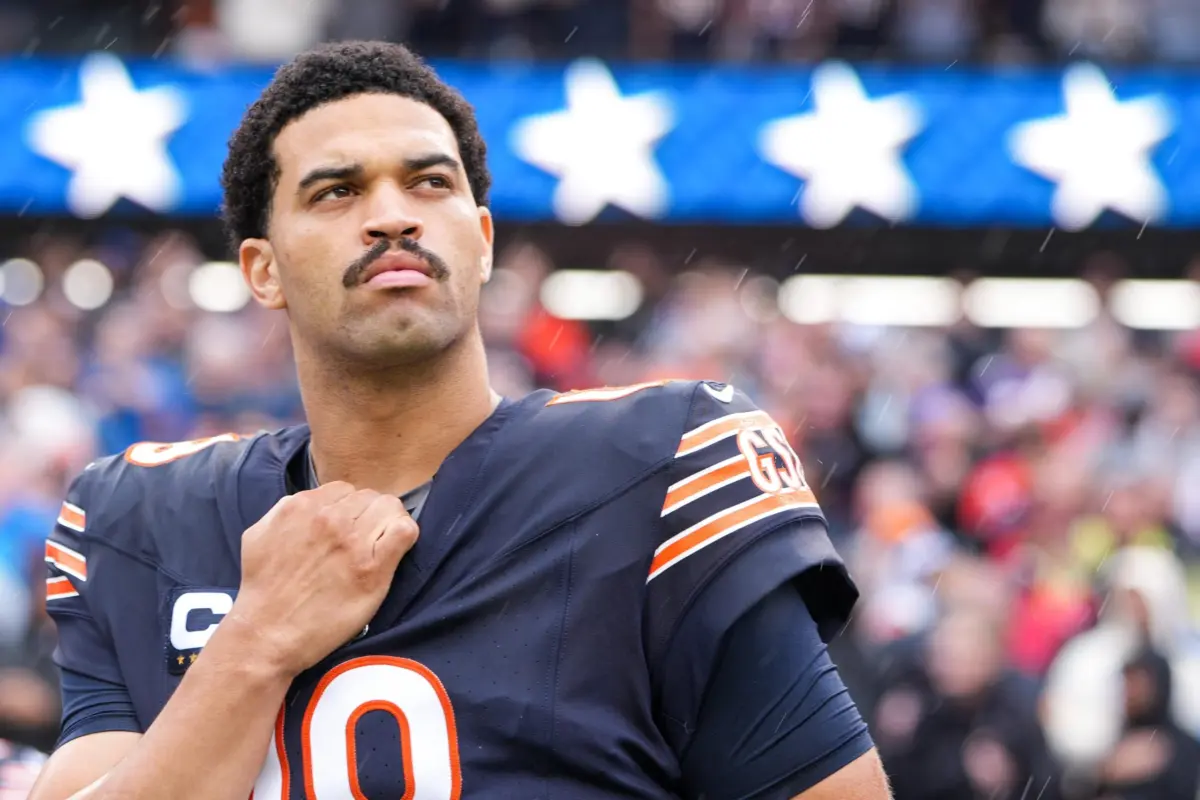
The promising momentum of the Chicago Bears’ season has hit a major roadblock. Following an anxious wait over the initial days of the week, official medical evaluations have confirmed that star quarterback Caleb Williams suffered a Grade 2 hamstring strain during Sunday’s contest against the Minnesota Vikings. According to reports from ESPN’s Adam Schefter, the injury is expected to sideline the second-year signal-caller for three to four weeks, delivering a substantial blow to the team’s offensive rhythm just as they were finding their footing.
The timeline means Williams is officially ruled out for Chicago’s upcoming high-profile Monday Night Football matchup against the Philadelphia Eagles. Looking further ahead, the dynamic quarterback is also slated to miss subsequent divisional and conference games against the New York Jets and the fierce rival Green Bay Packers. Depending on his rehabilitation progress and how the muscle responds to treatment, the earliest potential windows for Williams’ return point toward a Week 6 clash with the Atlanta Falcons or a short-turnaround Thursday Night Football showdown against the New England Patriots in Week 7.
The injury update provides definitive clarity following a tense 48 hours for the franchise and its fan base. Initially, after Williams went down in the fourth quarter of Sunday’s game, early optimism circulated through the organization. NFL insider Tom Pelissero reported on Monday afternoon that Williams had seemingly "avoided any major injury to his hamstring," leaving open the possibility that he might avoid missing game action entirely and giving head coach Ben Johnson room to describe the injury simply as "week to week."
However, mandatory follow-up diagnostic testing told a more severe story. Per Adam Schefter’s initial reporting, Williams underwent a scheduled MRI on Monday morning, which ultimately revealed the Grade 2 strain requiring a multi-week recovery period rather than a minor day-to-day tweak.
The concern surrounding Williams’ health stands in stark contrast to the sheer euphoria that defined just a week prior. Entering Week 2, the hype surrounding the Chicago Bears offense was reaching a fever pitch. Williams looked every bit the part of a potential Most Valuable Player candidate during a sensational Week 1 performance. In that opening-week explosion, he orchestrated a masterclass of an offensive showcase, leading the Bears to an eye-popping 59 points against the Carolina Panthers. Fans and analysts alike were ready to anoint the young quarterback as the transformative face of the franchise, capable of turning Chicago into an instant offensive powerhouse.
Yet, professional football rarely follows a predictable script. The atmospheric conditions at Soldier Field shifted dramatically for Week 2, bringing a combination of inclement weather to the lakefront. More importantly, the Bears ran squarely into a defensive mastermind in Brian Flores, whose complex schemes and relentless pressure packages made for significantly tougher sledding. The smooth execution that defined the season opener bogged down into a gritty, hard-fought defensive battle, putting a heavy burden on every possession.
As the physical game wore on into the final frame, disaster struck for the Bears. Midway through the fourth quarter, following a routine short scramble, Williams immediately pulled up and had to be helped off the field. The sequence instantly silenced the capacity crowd at Soldier Field. The only sound audible over the stadium’s broadcast microphones after the play was Williams crying out in pain, leaving the heavily partisan home crowd stunned into absolute silence. Teammates and training staff rushed to his side, and the young quarterback was ultimately helped off the turf, signaling the immediate end of his afternoon and bringing backup quarterback Tyson Bagent into the fray under the most difficult of circumstances.
The compounding misfortunes of that single sequence proved disastrous for Chicago’s immediate game-day prospects. Making an already bleak situation exponentially worse, the Bears’ possession completely stalled in the wake of the injury. To top off the sequence, a potential game-tying field goal attempt was blocked just as Williams was being carted down the stadium tunnel toward the locker room for initial evaluations. The double-whammy of losing their star playmaker and squandering a crucial scoring opportunity left the Bears scrambling for answers both on the field and in the injury room.
As the team navigates the immediate aftermath of the medical diagnosis, the coaching staff faces an additional layer of complexity regarding the quarterback depth chart. Chicago’s primary backup quarterback, Tyson Bagent, has himself been managing a recovery process within the league’s mandatory concussion protocol. With both Williams sidelined for multiple weeks and Bagent’s exact availability subject to clearance, the team’s preparation for the upcoming Monday Night Football matchup against the Philadelphia Eagles has taken on an emergency feel. If Bagent is unable to clear protocol in time for kickoff, veteran quarterback Case Keenum stands ready to take the reins of the offense and make the start under the bright lights of prime-time television.
For now, the franchise enters a critical phase of the season without its most important offensive weapon. The coaching staff will have to adjust their game plans to protect and maximize whatever combination of quarterbacks is available, relying on the running game and defensive resilience to weather the storm. As the rehabilitation clock begins for Williams, the entire organization will be watching closely, hoping for a seamless recovery that can place their franchise quarterback back on the field by early October.