
Despite navigating one of the most challenging housing landscapes in modern Canadian history, a significant majority of the nation’s renters have not abandoned their dreams of achieving homeownership or securing more living space. According to comprehensive new data from the Canada Mortgage and Housing Corporation (CMHC), a striking 60 per cent of current renters consider buying a home to be an important or somewhat important personal goal.
However, this enduring optimism stands in stark contrast to the daily reality on the ground. Millions of tenants are grappling with severe spatial deficits, persistent affordability hurdles, and troubling levels of systemic discrimination. The findings stem from the 2024 Canadian Housing Survey, released on September 21, a biennial report conducted jointly by the CMHC and Statistics Canada. The research provides an exhaustive look at the current housing circumstances of Canadians, alongside a forward-looking examination of what citizens desire from their living spaces over the next five to ten years.
Renters Want More Room
The survey highlights a dramatic disparity between the living conditions renters currently endure and the space they genuinely desire. On average, Canadian renters occupy apartments or houses featuring 1.9 bedrooms. Yet, when asked about their spatial aspirations, these same respondents reported wanting an average of 2.6 bedrooms—representing an immediate desire for roughly 37 per cent more space than they currently have.
This gap is notably wide when compared to homeowners. By comparison, Canadian homeowners currently possess an average of 3.2 bedrooms and aspire to virtually the same number, indicating a baseline level of spatial satisfaction that renters rarely experience.
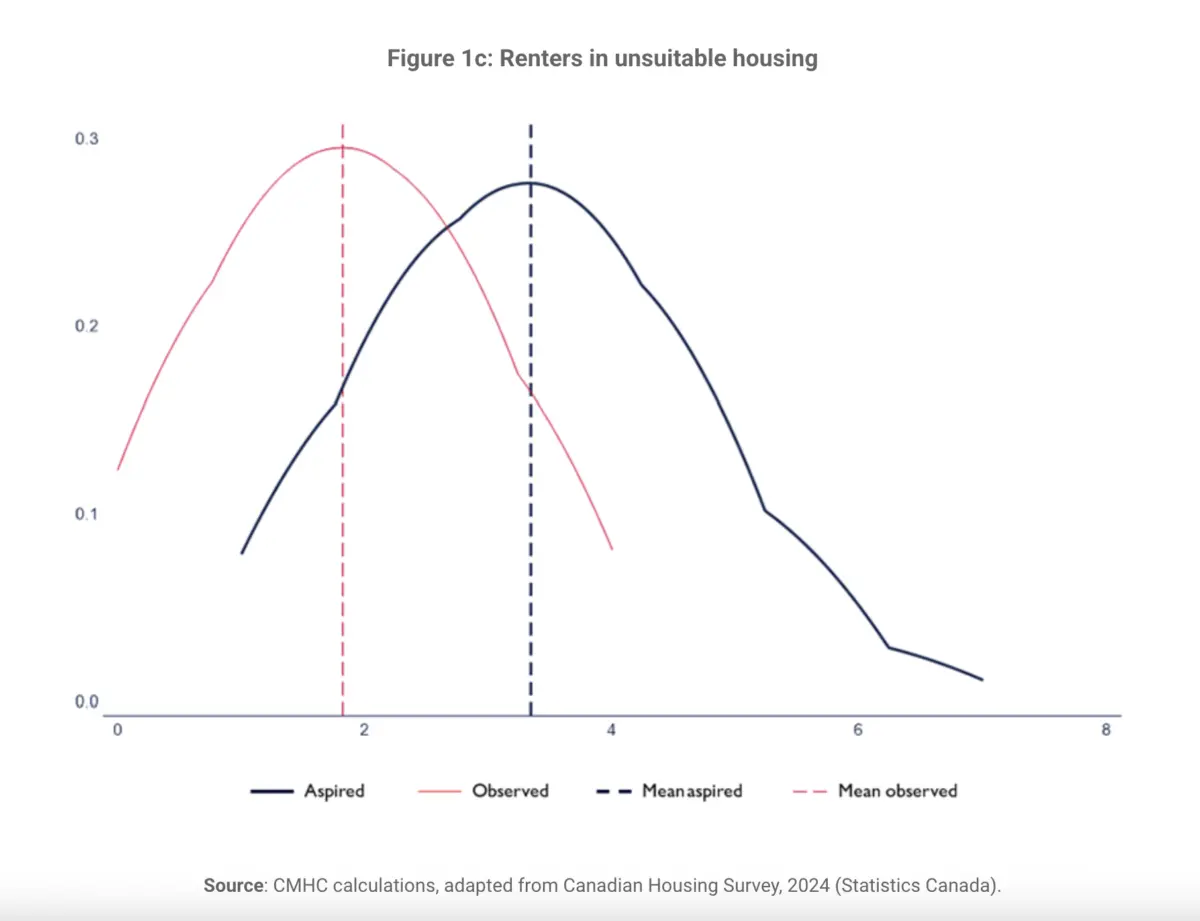
The division becomes even more pronounced among renters who are already living in visibly unsuitable housing arrangements. Households classified as living in unsuitable conditions currently navigate an average of just 1.8 bedrooms, yet they aspire to an average of 3.3 bedrooms. This represents an astonishing 84 per cent jump in the amount of space they feel they need to live comfortably.
“This gap shows how far existing housing falls short of meeting their bedroom needs,” the CMHC states in the report, emphasizing that the finding also points directly toward worsening overcrowding, particularly within high-cost metropolitan hubs like Toronto and Vancouver where rental inventories remain tight and exceptionally expensive.
Despite these physical and financial constraints, the aspiration to transition from renting to owning remains robust. When polled on long-term financial milestones, 47 per cent of renters stated that beginning the process of purchasing their own home was an important goal, while another 13 per cent labeled it somewhat important. Only 28 per cent dismissed homeownership entirely, indicating that the traditional American and Canadian dream of owning property remains deeply rooted.
Across all surveyed households, regardless of their current tenure type, 96 per cent considered having a safe and secure place to call home to be important or somewhat important. Furthermore, 72 per cent emphasized the importance of building generational or personal wealth through housing, while 73 per cent noted that owning a tangible asset to help fund their eventual retirement was an important or somewhat important milestone.
One in Five Renters in Core Housing Need
While Canadians continue to adapt to shifting market dynamics, the systemic struggles of the population remain deeply entrenched. Notably, the overall rate of what the CMHC defines as "core housing need" remained completely unchanged between the 2022 and 2024 survey cycles.
In 2024, approximately 11.6 per cent of all Canadian households found themselves trapped in core housing need, mirroring the exact proportion recorded two years prior. A household is officially categorized in core housing need when its current accommodation fails to meet basic standards of affordability, safety, or physical size, and its total household income is simultaneously insufficient to rent alternative housing within its local community that meets those mandatory standards.
While the national rate held steady, the burden was distributed unevenly, falling disproportionately on those who rent rather than own. Renters were vastly more likely to be affected, registering a core housing need rate of 22.1 per cent. This contrasts sharply with the homeowner community, where just 5.7 per cent experienced similar distress.
Vulnerability within the rental market itself also varied by sector. Renters living in social and affordable housing experienced the highest rate of core housing need in the country, climbing to a staggering 33.4 per cent. Meanwhile, market renters faced a rate of 20.5 per cent.
When dissecting the underlying causes of this distress, the CMHC noted that affordability remains the primary pressure point. Across the country, financial strain accounted for 71 per cent of all core housing need cases.
“While adequacy and suitability matter, affordability is the main driver of core housing need across Canada,” the agency observed.
For the very first time, the 2024 survey separated data to distinguish between renters operating within the primary rental market and those participating in the secondary rental market—such as individuals renting single-detached homes, condos, or basement apartments from individual landlords. The findings revealed that core housing need affected 22.9 per cent of households in the primary market, compared to 18.4 per cent in the secondary market.
Income levels help provide a clearer picture of this divergence. The average renter household income in the primary market hovered at $77,900, compared to approximately $90,000 in the secondary market, demonstrating that even slight income advantages can influence housing security.
Housing Challenges Vary by Household
The 2024 data further underscores that housing vulnerability does not impact all demographic groups equally, with rates of core housing need fluctuating substantially depending on family structure and cultural background.
One-person households endured the highest rate among all reported domestic configurations, with 20.4 per cent falling into core housing need. They were closely followed by single-parent families, who registered a rate of 19.1 per cent. By contrast, traditional multi-person family units faced significantly lower risks: just 6.7 per cent of couples with children and 5.1 per cent of couples without children experienced core housing need.
Systemic divides were also glaringly apparent along cultural and ethnic lines. Indigenous households across Canada reported a core housing need rate of 20.1 per cent, while racialized households faced a rate of 13.7 per cent. This stands above the 10.6 per cent rate recorded among non-racialized, non-Indigenous households, highlighting persistent socioeconomic disparities within the national housing ecosystem.
Headwinds Faced by Racialized Groups
Adding a critical new dimension to the biennial research, the 2024 survey introduced targeted questions designed to capture Canadians’ direct experiences and subjective perceptions of discrimination within the housing system.
These findings are based entirely on respondents’ self-reported encounters. The CMHC notes that discrimination in the housing sector can manifest in various ways—appearing during the frantic search for a new rental apartment or home to purchase, while attempting to secure mortgage financing from lending institutions, or even after a tenant is already stably housed. Post-occupancy discrimination often surfaces when residents formally request routine property repairs, ongoing maintenance, or necessary physical accessibility accommodations from landlords or property managers.
The survey results reveal a troubling landscape of inequality. Overall, 18.2 per cent of racialized respondents reported experiencing housing discrimination at some point during their lives. This figure is roughly three times higher than the six per cent reported by non-racialized respondents.
When broken down further, the data reveals that Black respondents reported the highest lifetime prevalence of housing discrimination, sitting at 30.2 per cent. Similarly, respondents who identified as Indigenous frequently self-reported experiencing housing discrimination over their lifetimes, registering a rate of 16 per cent.
As the CMHC continues to track these metrics biennially, the comprehensive 2024 survey paints a complex picture of a Canadian housing market where the fundamental desire for a secure, spacious, and affordable home remains strong, yet out of reach for a significant portion of the population.