
The Large Hadron Collider, the world’s largest and most powerful particle accelerator, has officially entered a transformative new chapter in its scientific lifespan. Stretching 27 kilometers in an underground ring beneath the Franco-Swiss border, the massive machine relies on thousands of specialized magnets to steer, shape, and control its high-energy particle beams. Among these vital components are dipoles, quadrupoles, sextupoles, octupoles, and decapoles, with each specific type performing a specialized task to ensure the machine operates with pinpoint accuracy. Now, as part of a multi-year modernization effort, engineers and technicians at the European Organization for Nuclear Research are undertaking one of the most complex hardware replacements in the history of the facility.
Some of the most critical components within this vast magnetic ecosystem are known as inner triplets. These specialized groups of three quadrupole magnets—hence the descriptive name—sit strategically positioned on both sides of the LHC’s four main experimental caverns. Their primary responsibility is to focus the particle beams as tightly as possible just before the subatomic particles smash into one another inside the massive detectors. The mechanics governing these collisions are straightforward in principle yet challenging in execution: the tighter the particle beams are compressed, the greater the statistical probability that the particles will physically cross paths and collide.
This beam squeezing makes the inner triplets absolutely essential for increasing the overall luminosity of the LHC, a technical term that refers to the number of particle collisions occurring in a given period of time. Higher luminosity directly translates to a larger volume of collisions, which in turn yields vastly more data for researchers to analyze in their quest to understand the fundamental laws of physics. By generating more data, scientists can probe deeper into rare phenomena, search for undiscovered particles, and test the limits of the Standard Model with unprecedented precision.
Preparing the LHC for a New Era
To unlock these higher levels of performance, a major component of the future High-Luminosity LHC, commonly referred to as the HiLumi LHC project, involves removing the existing inner triplets and replacing them with a substantially more powerful generation of magnets. This ambitious engineering feat is currently taking place during the facility’s scheduled third long shutdown, a prolonged operational pause dedicated to major maintenance, technical upgrades, and infrastructure improvements across the entire accelerator complex.
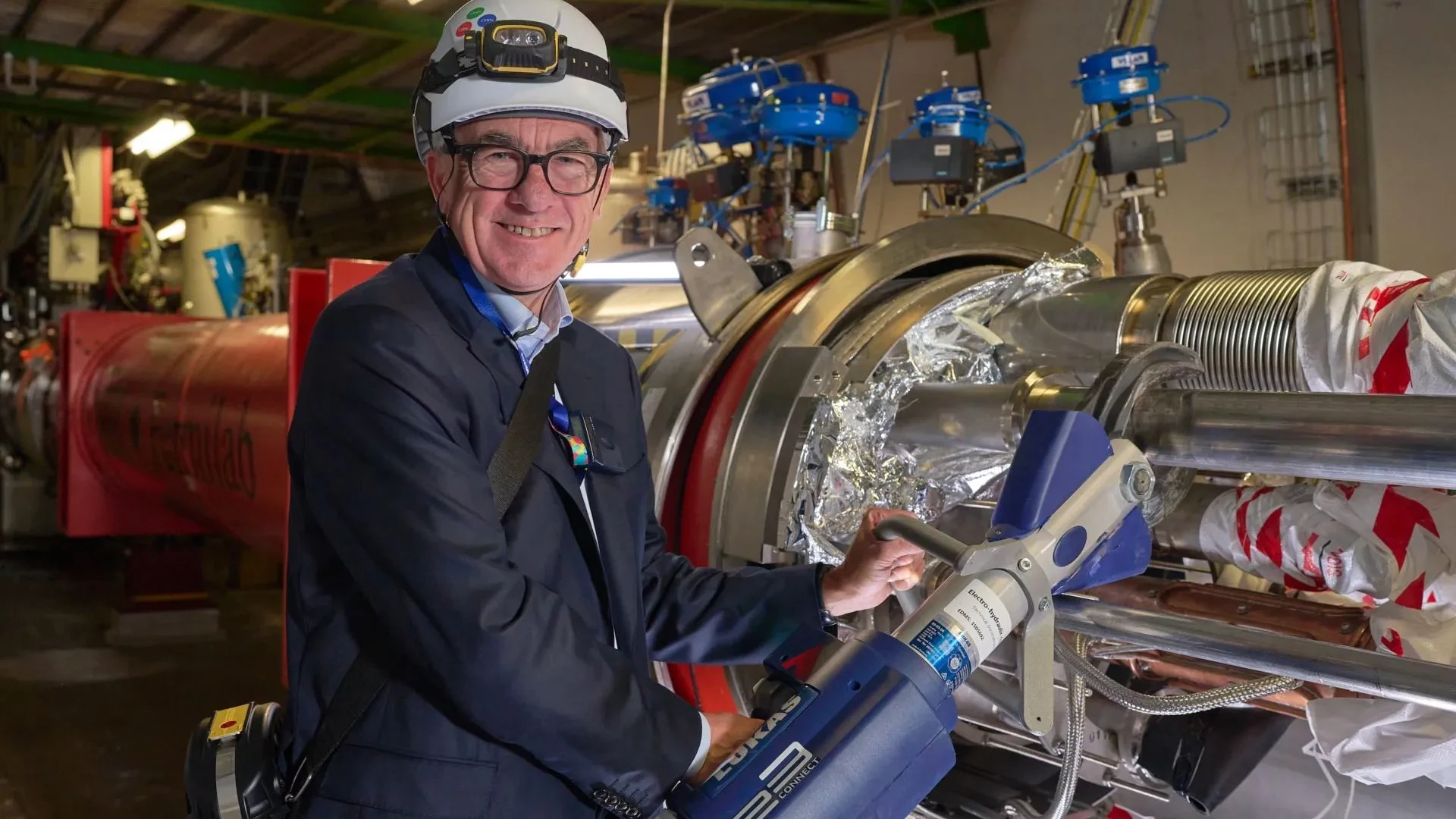
Recently, engineering crews achieved a major operational milestone by cutting the first magnet interconnection, formally and symbolically beginning the intensive replacement operation. To mark this significant occasion, CERN Director-General Mark Thomson visited LHC Point 1, the surface and underground site housing the ATLAS experiment, to observe the start of the dismantling work firsthand.
The replacement of these magnets with the new HiLumi LHC inner triplets is crucial for the coming high-luminosity years. The first quadrupole of the new system should arrive in the accelerator tunnel at the start of 2029, setting off a sequence of precise installations. In total, 16 cryostats and 28 cryo-assemblies will be installed throughout the designated zones, marking a major undertaking that requires meticulous planning, specialized transport systems, and close international collaboration among hundreds of engineers and technicians, as explained by Jean-Philippe Tock, Head of the LS3 Coordination Team.
Magnets About 40% Stronger
The development of the new inner triplets is the culmination of many years of intensive research, advanced materials science, and engineering development. They represent a monumental technological leap forward over the niobium-titanium magnets that have successfully operated inside the LHC tunnel since the machine first came online.
Instead of relying on conventional niobium-titanium alloy, the newly designed and upgraded magnets utilize advanced niobium-tin superconducting coils. This sophisticated superconducting material allows the magnets to generate staggering magnetic fields reaching 11.3 tesla. To put this into perspective, these fields are about 40 percent stronger than the fields produced by the current generation of magnets. This massive increase in magnetic strength is precisely what will allow physicists to compress the particle beams to a much tighter focus than ever before, directly driving the surge in collision rates.
This cutting-edge equipment will be installed specifically around the ATLAS and CMS experiments, where the dramatically increased collision rate will be exceptionally important for their ongoing physics programs. These two general-purpose detectors are designed to search for a wide variety of new physics, including dark matter candidates and further details regarding the Higgs boson, making maximum luminosity a top priority for their research teams.
Meanwhile, the ALICE and LHCb experiments operate under entirely different physical configurations and pursue distinct scientific programs, meaning they do not require the same massive increase in instantaneous luminosity. Because of these operational differences, their existing inner triplets can remain in place without needing a complete replacement. However, those magnets will still undergo targeted upgrades and maintenance so that both experiments can fully benefit from the overall infrastructure improvements and the general increase in luminosity across the wider accelerator complex.
Removing 28 Superconducting Magnets
The physical transformation of the collider began in earnest when CERN teams commenced the dismantling of large sections of the accelerator on either side of the ATLAS and CMS interaction points. The primary objective of this initial phase is to safely disconnect, extract, and remove 28 large superconducting magnets, including the critical inner triplets, which have reached the end of their operational lifespan and are scheduled to be entirely replaced.
This sweeping extraction operation marks the definitive end of an era for hardware that has been an integral part of the LHC since its initial construction and commissioning phases. These components have endured nearly two decades of exposure to high radiation environments and intense electromagnetic forces, reliably guiding particle beams at nearly the speed of light.
Markus Zerlauth, the HiLumi LHC Project Leader, reflected on the historical significance of the undertaking as the heavy machinery began the extraction process. Today’s event is a major milestone for CERN, especially for the HiLumi LHC project team, he noted. The current inner triplets date back to the original LHC construction phase and were installed in the machine between 2005 and 2007. After nearly twenty years of reliable operation, they will give way to a new generation of even more powerful magnets. It is truly remarkable to witness such a seamless handover from one generation of scientific innovation to the next as the facility prepares for its next decades of discovery.