
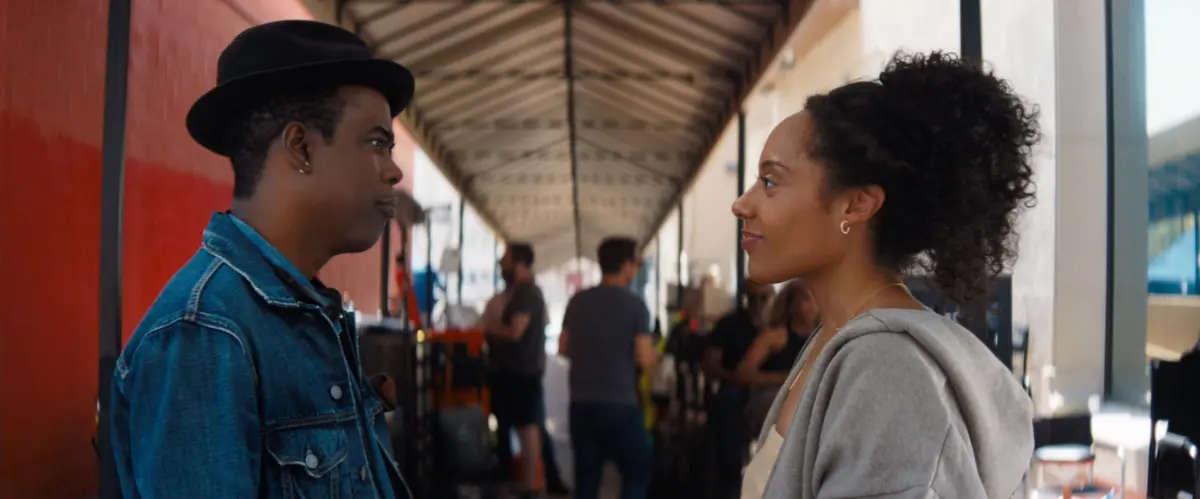
Comedian and filmmaker Chris Rock is delivering something entirely unexpected with his fourth feature as a writer and director, Misty Green. The film functions as a slice-of-life drama that doubles as a bitter, unsparing kiss-off to Los Angeles, taking audiences on a harrowing ride through the hellscape of working in modern Hollywood. The story is seen through the eyes of the titular actress, played by Rosalind Eleazar, as her once-promising career flickers out and eventually plummets toward total ruin.
Yet, the primary surprise of the film is not the harshness of Rock’s perspective on contemporary Los Angeles, nor is it the fact that the beloved comic—who built his legendary career on incisive, real talk about race, culture, and politics—would choose to center his narrative entirely on a troubled, self-destructive woman. Instead, the true revelation of the project is the stunning, multifaceted performance Rock draws from British actor Rosalind Eleazar as the salty, abrasive, and deeply self-sabotaging washed-up starlet.
Before making this starmaking transition to the forefront of American cinema, Eleazar built a formidable profile stateside through her work on Apple TV’s critically acclaimed espionage drama Slow Horses, starring alongside industry heavyweights Gary Oldman and Kristin Scott Thomas. Over four seasons on that critics’ darling series, she portrayed Louisa Guy, a disgraced and mourning MI5 agent trying to navigate the murky waters of British intelligence. Prior to that breakthrough television role, she appeared in the BBC adaptation of Howards End as Jacky Bast. Between these prestigious television engagements, Eleazar honed her craft extensively on English stages, having formally trained at the prestigious London Academy of Music and Dramatic Art.
That varied and demanding résumé proved to be a fitting prelude to Misty Green, a chaotic cinematic drama that remains messy, complicated, and entirely unapologetic—much like the one-time starlet it follows for a tumultuous week as she wanders through Los Angeles watching her professional and personal life unravel at an alarming speed.
"She’s so incredibly complicated and contradictory, and you know she’s difficult to get on board with, because she’s so self-destructive," Eleazar told the audience at this year’s New York Film Festival, where the feature made its high-profile premiere. "But I have a lot of compassion for people that sort of go out into the world with so many layers of protection. Because they’ve experienced so much hurt and so much pain that they’re constantly fighting, and it’s not necessarily pleasant to be around. But those are the sort of characters that make you want to unpack and figure out what, like, what is it? What makes her go out into the world with such a fierce exterior."
Over the course of just under two hours, Rock relentlessly searches for what lies behind Misty’s relentless destructive streak. As the character stands on the absolute cusp of losing her housing, she systematically escalates the damage she inflicts upon herself and her remaining relationships. In one sequence, she viciously berates her agent before abruptly attempting to seduce him. Later, she runs into industry acquaintances she still bitterly resents and engages in raw, frank conversations with a fellow has-been starlet, played with sharp precision by Anna Kendrick. Things take an even darker turn during a reckless, cocaine-fueled night of impulsive sex in a restaurant bathroom with a longtime "friend" played delightfully against type by Adam Driver—though the film makes it painfully clear to the audience that they are not real friends at all. This descent ultimately launches Misty down her darkest and most irreversible path yet.
The desperate decision that Misty makes as the film enters its third act is partly precipitated by her bipolar, surrogate brother figure, who serves as her lone touchstone to a troubled childhood that the script keeps frustratingly vague. As portrayed by acclaimed actor Daniel Kaluuya, the character initially offers hope that Rock is about to deliver a cutting, nuanced portrait of the severe mental health crisis plaguing many Black Americans. Unfortunately, much like the plundering of his heroine’s fractured psyche, this promising narrative thread eventually falls by the wayside, and the brother’s story gets awkwardly shoehorned into an unnecessary serial killer subplot that dampens the film’s thematic focus.
Interspersed with occasional photo montages suggesting the perpetual, systemic problems of modern Los Angeles, the movie is teeming with supporting characters who fit the most blasé, cynical perceptions of Angelenos. It is abundantly clear that Chris Rock has something deeply personal to say about the City of Angels, and his message is far from flattering. Speaking to the crowd at Lincoln Center during the New York Film Festival, the comedy icon took the opportunity to clarify the root of his cinematic beef with the sprawling metropolis.
"L.A. is America in a way," Rock told the attentive audience. "It’s the best of times. It’s the worst of times. It’s the weather and the palm trees and homeless people everywhere, man. Just like Magnolia. It’s like wow—Skid Row and Rodeo Drive are seven miles apart. So I try to capture all of that."
Rock, who also drifts in and out of the margins of the film as a filmmaker, serving as both a phantom from Misty’s distant past and a potential lifeline to a functional Hollywood future, has been a fixture of the entertainment industry for more than three decades. His astute stand-up comedy and withering, spot-on cultural insights into race, romantic relationships, and the absurdities of celebrity culture have profoundly influenced countless comedians, screenwriters, and social commentators over the years.
As a feature film director, however, Rock has been remarkably selective, having helmed just four projects across his career: the early political comedy Head of State, the romantic comedy I Think I Love My Wife, the widely praised critical hit Top Five, and now the starkly different Misty Green. He has frequently described his newest cinematic endeavor as a deep dive into the inherently "soul-sucking" nature of the Hollywood machine and the elusive question of who truly deserves or manages to find redemption. Redemption, in various forms, is precisely what Misty is relentlessly seeking throughout the narrative, whether she manages to realize it consciously or not.
"I always felt that acting isn’t the right profession for Misty; even though you’re talented at something, it doesn’t necessarily mean that that is the right profession for you," Eleazar reflected during the festival discussions. "And I think for someone who has her own mental health issues and is also a functioning addict, she actually needs a job that provides a routine, and she needs a slightly smaller life, and a life that’s going to give her a bit of peace."
At the very same premiere event, Rock offered a related philosophical thought that underscores the underlying melancholy of his directorial effort.
"It’s important to live in the now," Rock noted to the crowd. "It’s that weird thing when you get success at something, especially the way show business is set up right now. You can talk about something you did 30 years ago for a long time. You can do that, but some people have worked, and some people need to live now."