
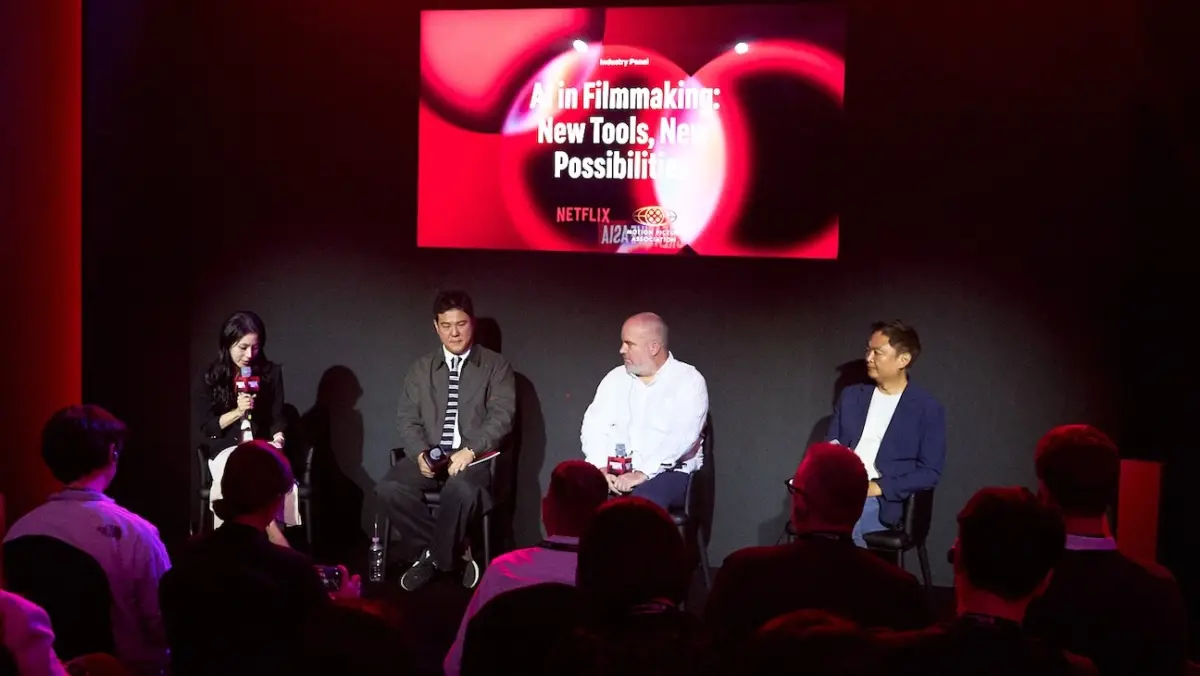
Speaking at the streaming giant’s annual Creative Asia event, Sung Q Lee, Netflix’s senior director of production for Asia-Pacific, detailed how the technology is currently deployed throughout various stages of the filmmaking process. However, he firmly emphasized the necessity of preserving human oversight and artistic judgment amidst rapidly evolving technological capabilities.
The panel, co-hosted by Netflix in partnership with the Busan International Film Festival and the Motion Picture Association, brought together key figures from across the entertainment industry to debate the expanding footprint of artificial intelligence in visual storytelling. Alongside Lee, the discussion featured Korean filmmaker Kang Yun-sung, known for directing The Outlaws and recognized as an enthusiastic adopter of generative AI tools, and Kimball Thurston, the chief technology officer at visual effects powerhouse Wētā FX.
The dialogue offered a clear window into how artificial intelligence is being tested and normalized within modern production pipelines, while also underscoring a striking cultural divide. Observers note that the Hollywood creative community has frequently approached generative artificial intelligence with profound caution, driven by anxieties over copyright, job displacement, and creative integrity. Conversely, many sectors of the Asian content industry view the technology primarily through the lens of opportunity—a powerful tool capable of overcoming traditional financial hurdles and expanding creative boundaries.
Exploring the Boundaries of AI in Production
During the panel discussion, Lee outlined the practical applications of artificial intelligence within Netflix’s current production ecosystem, noting that the technology has touched roughly 300 titles in various capacities. Rather than focusing on maximum technological saturation, he framed the implementation around enhancement and capability.
"AI is being used in previsualization, production design, working out set-dressing concepts ahead of time, in editing, and of course in VFX," Lee told the audience in Busan. "But the question that matters to me isn’t, ‘How much AI can we put into this title?’ but, ‘What more can this title do with AI’s help?’"
Lee placed the current wave of technological innovation within the broader historical context of the film industry, comparing it to previous paradigm shifts that redefined how movies are made without altering their fundamental purpose. He argued that while technological advancements consistently improve the "how" of filmmaking, they can never replace the human element that determines the "why."
"Technological changes and new tools have helped a great deal with the ‘how,’ or how we make what we make better," Lee explained. "But they never decided the ‘why’ — why we have to tell this story."
He added a definitive caveat regarding emotional resonance in storytelling, asserting that automated systems cannot replicate lived human experience. "When it comes to conveying emotion, ultimately, a human has to touch it. AI can get many jobs done, but does it touch human emotion? The human touch is critical and necessary."
Echoing this sentiment from a visual effects perspective, Wētā FX chief technology officer Kimball Thurston described his company’s approach as strictly "assistive." He stressed that the technology is not permitted to dictate or alter creative choices made by directors and artists.
"It provides us — very fast — with the visual images and visualization. So from the director’s perspective or the cinematographer’s perspective, it’s very easy to identify the errors and correct them," Thurston said, noting that the primary operational objective at Wētā FX remains the reduction of simple, repetitive tasks rather than the replacement of artistic decision-making.
Financial Liberation and Budgetary Realities
Much of the festival conversation centered on the unique economic opportunities that artificial intelligence presents for filmmakers working within restrictive budgets. For regions with historically lower production budgets compared to major Hollywood studios, generative tools are increasingly seen as a viable mechanism to level the playing field and bring ambitious concepts to life.
This economic argument was championed by Korean director Kang Yun-sung, who has leaned heavily into experimental AI integration. Last year, Kang partnered with self-described AI filmmaker Kwon Han-seul to co-direct Run to the West, widely publicized as Korea’s first fully AI-assisted feature film.
The project encountered significant hurdles upon its release. Amid vocal public pushback and harsh online criticism directed at its unconventional AI-generated visuals, the film struggled at the box office, grossing roughly $100,000. Reflecting on the project, Kang acknowledged that the lightning-fast pace of technological advancement meant the film already appeared dated by the time it reached audiences. Nevertheless, his enthusiasm for the storytelling potential of AI remained entirely undeterred.
Kang is currently deep in production on a new action film titled The Gulf of Aden, which extensively utilizes advanced generative AI tools developed by China’s Kling AI. According to the director, the software has unlocked the ability to execute complex, large-scale sequences that would have been utterly unattainable under standard financial frameworks.
"What has been buried due to budgetary issues was able to be put back on the table," Kang said, pointing to financial constraints that he believes have historically restricted the full growth and international reach of the Korean film industry.
By streamlining the physical shoot and integrating generative digital assets, Kang estimated that the production will slash its overall budget by approximately 40 percent.
"When we calculated how much we’d save on The Gulf of Aden for financing, it came to a reduction of around 40 percent," Kang stated. "That’s not just from replacing CG and VFX. The shoot itself was streamlined, and that cut down our production time to some extent."
As the entertainment industry continues to grapple with the commercial, ethical, and artistic implications of artificial intelligence, panels at major international gatherings like Busan demonstrate that adoption is no longer a theoretical debate for the distant future. Instead, major platforms like Netflix, top-tier visual effects houses like Wētā FX, and independent directors alike are actively forging the protocols that will govern screen storytelling for years to come.