
For generations, college football fans from below the Mason-Dixon line have proudly proclaimed that "It matters more in the SEC." While that mantra certainly holds water when measuring the unbridled passion, financial investments, and regional obsession surrounding Saturdays in the South, a deeper examination reveals a troubling discrepancy in how wins and losses are evaluated on a national scale. In the eyes of the College Football Playoff selection committee, while impressive victories continue to matter deeply, the traditional weight of a loss has been drastically diminished—so long as that loss happens to wear the right conference patch.
This favoritism has created a bizarre ecosystem within the first installment of the College Football Playoff Top 25. Every single Southeastern Conference team with a winning record has successfully secured a spot inside the initial rankings, a sweeping inclusion that notably covers programs carrying three losses. Across the entire landscape of major college football, Oregon stands as the lone outlier outside of the southern footprint to sneak into the top 25 with a three-loss resume.
At this stage in the season, logic and historical precedent suggest that any team burdened with three losses ought to find themselves on the outside looking in. The stark differentiation in scheduling strength, roster depth, and competitive variance within a single conference makes it far too early, and frankly unjustifiable, to grant these three-loss programs a safety net in the national rankings. While marquee victories should rightfully outweigh uninspired performances or bad losses, college football has reached a tipping point where losses must carry genuine consequences. Otherwise, the regular season loses its competitive urgency.
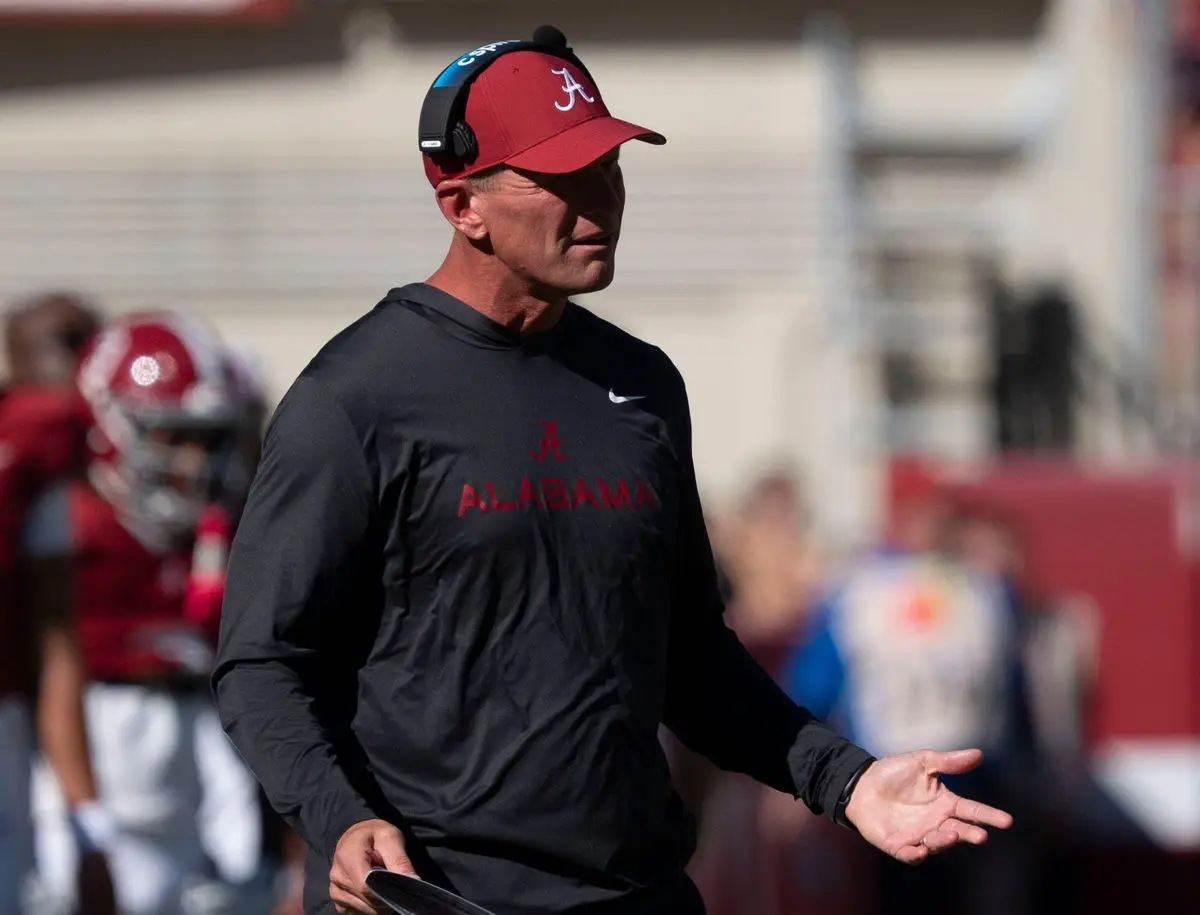
The most egregious example of this modern committee bias is vividly illustrated by where they ultimately chose to rank Alabama under head coach Kalen DeBoer. The Crimson Tide certainly boast one of the more impressive singular wins on their resume this season, courtesy of a hard-fought victory over Kentucky. However, that high-water mark exists alongside a pair of blemishes that, under traditional scrutiny, would usually anchor a team further down the board. Instead, Alabama finds itself situated comfortably among the nation’s elite, defying conventional standards of evaluation.
To fully understand the absurdity of the current ranking, one only has to look at the surrounding teams. Alabama sits a staggering eight spots above a Tennessee program that they previously crushed head-to-head, yet they are also positioned three places above a UCLA squad that has not lost a single game all year. Furthermore, the Crimson Tide are currently ranked ahead of both two-loss Ohio State and two-loss Texas, two traditional powerhouses that boast substantially better and more complete victories on their resumes than anything Alabama has managed to put together thus far.
UCLA might not boast the flashiest or most exhaustive list of signature wins on its resume, but the Bruins possess something far more valuable in a crowded race: one fewer ranked win than Alabama and, more importantly, two fewer losses. Every college football season features a unique scheduling dynamic where the cards occasionally break in a program’s favor, and that fortunate alignment is precisely what is happening in Westwood. Nobody is currently lobbying for Miami to be ranked lower in the polls despite the Hurricanes holding the exact same number of ranked victories as UCLA. The discrepancy lies entirely in perception, bias, and the letters stamped onto the uniform.
The selection committee continues to place an exaggerated level of importance on historic brand names, with their absolute favorite brand being the SEC as an overarching entity. Within this closed loop of logic, defeating virtually any team residing within the SEC footprint is automatically categorized as a quality win. Alabama was catapulted into the top five largely because the committee chose to count a victory over Mississippi State as a significant resume-builder. Yet, a closer inspection reveals that Mississippi State running back Kamario Taylor was forced to play through a lingering injury during that exact matchup, and even at full strength, Mississippi State features a horrific defensive unit that the rest of the conference has successfully exploited week after week.
Conversely, when an SEC powerhouse suffers a defeat, the narrative crafted by the committee is rarely that the team simply was not good enough on that given Saturday. Instead, the setback is excused away as just another casualty of the brutal "SEC grind," and a beaten team might not even drop a single spot in the following week’s rankings. The committee has carefully structured the parameters of the postseason race in such a way that marquee programs like Alabama, Texas, and Ole Miss can absorb a third loss down the stretch and still comfortably coast into the expanded playoffs.
This protective favoritism represents a stark pivot from previous years. Texas, for instance, found itself left out of the playoff picture after accumulating three losses in a prior campaign, but the CFP committee appears determined to ensure that high-profile SEC programs never face that same exclusionary fate again, fundamentally altering the competitive standards of college football.