
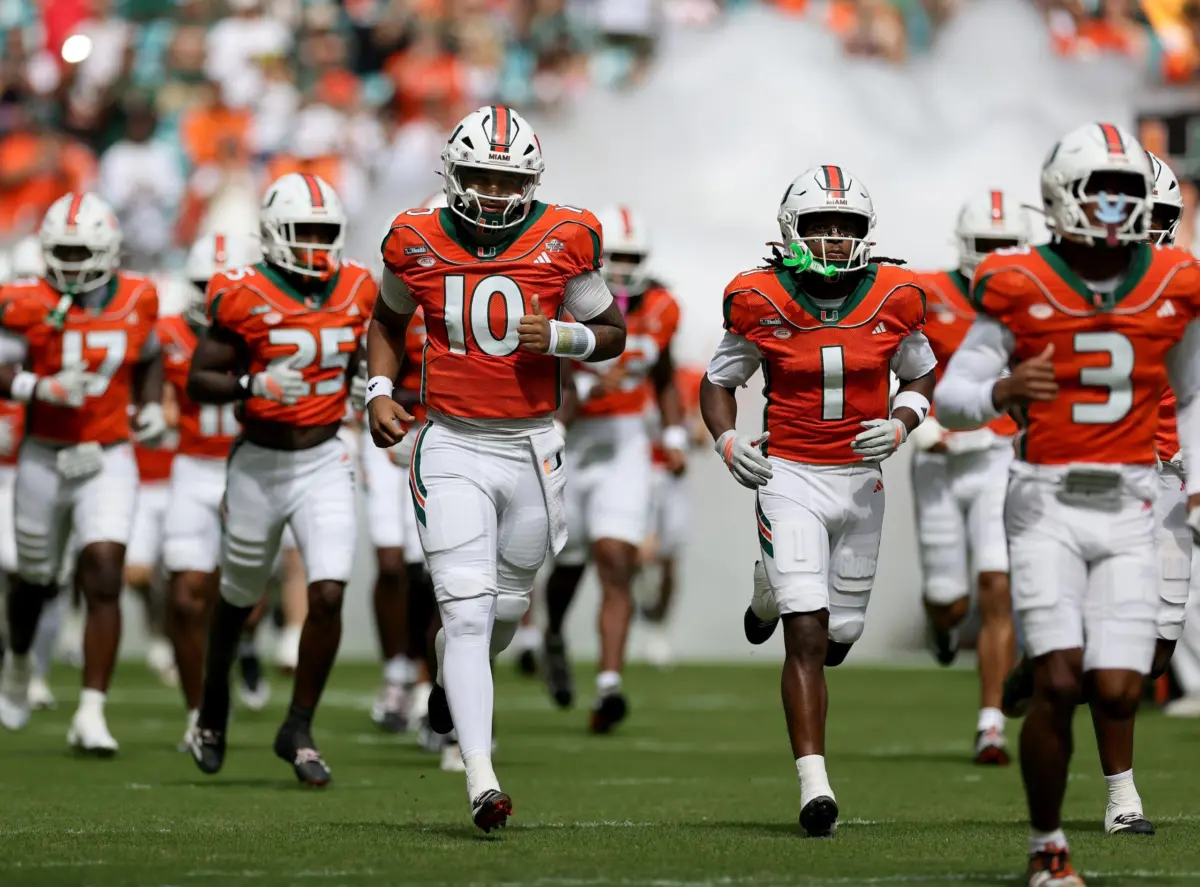
The results are officially in. On Tuesday, as millions of voters across the United States headed to the polls for the midterm elections, the College Football Playoff selection committee delivered its own resounding message to the nation about the current landscape of college football. When the dust settled on the committee’s very first batch of rankings, one program stood head and shoulders above the rest as the undisputed leader of the sport.
Miami has officially been crowned the top college football team in the nation in the initial College Football Playoff rankings. While the timing of the release coincided neatly with Election Day—prompting plenty of quick-witted election jokes across sports media and social platforms—the committee’s selection of the Hurricanes at number one was hardly a surprise to anyone following the sport closely. However, the exact placement of nearly every other team throughout the rest of the top 25 certainly raised eyebrows, sparked intense national debate, and set the stage for what promises to be a chaotic and unpredictable finish to the regular season.
As analysts and fans alike digest the initial committee board, several major takeaways have emerged from the first official CFP rankings of the season, shining a light on the criteria, double standards, and high-stakes matchups that will define the weeks leading up to the postseason.
A Message Sent to Notre Dame
Few programs entered Tuesday night with more scrutiny surrounding their playoff resume than the Notre Dame Fighting Irish. Just a year ago, the program found itself agonizingly left out of the College Football Playoff picture despite finishing a stellar 10-2 campaign. Those two lone blemishes came early in the year against Miami and Texas A&M, and the team’s impressive ten-game winning streak to close out the regular season ultimately proved insufficient to earn them a coveted playoff berth.
That heartbreak triggered widespread consternation throughout South Bend, leading to a temporary withdrawal from bowl game consideration and sparking intense conversations regarding the overall fairness and transparency of the College Football Playoff selection process. In response to those widespread concerns, a significant structural adjustment was introduced. Starting this season, Notre Dame is guaranteed an automatic bid to the expanded playoff field if the Fighting Irish finish the regular season ranked inside the top 12 of the final selection committee rankings.
On Tuesday, the Fighting Irish debuted at No. 11, walking a precarious tightrope right on the edge of the postseason cutoff line. With that ranking came an unmistakable, crystal-clear directive from the selection committee: win out.
This coming weekend, Notre Dame will host No. 1 Miami in a high-profile showdown in South Bend. A victory against the top-ranked Hurricanes would undoubtedly propel the Fighting Irish surging up the selection committee’s rankings, validating their spot among the nation’s elite. Conversely, a defeat would saddle the team with its second loss of the season, effectively slamming the door on their playoff aspirations and dooming Notre Dame to yet another agonizing year on the outside looking in.
While numerous college football analysts and fans have openly questioned Notre Dame’s debut at No. 11—pointing out that their only loss came on the road at BYU in a game that ended under controversial circumstances—selection committee chairman Hunter Yurachek offered some clarity during his media availability on Tuesday night. Yurachek noted that while the committee remains deeply "impressed" with the overall body of work and trajectory of the Fighting Irish, the team ultimately lacks a true "signature win" on its current resume. A victory this Saturday against the top-ranked Hurricanes, it seems, would more than qualify.
So Signature Wins Matter, Until They Don’t
Notre Dame fans were far from alone on Tuesday night in scratching their heads over what specific criteria constitutes a "signature win" in the eyes of the committee members. The confusion and frustration quickly boiled over when critics of the initial rankings immediately directed their attention toward the Indiana Hoosiers, who comfortably checked in at No. 4 in the selection committee’s very first top 25. If the College Football Playoff were to begin today, those same Hoosiers would secure a coveted first-round bye.
Yet, while Notre Dame was penalized by the committee for a perceived lack of high-profile victories against elite competition, Indiana seemed to be entirely excused from that exact same requirement. The Hoosiers currently boast an impressive 8-1 overall record, including a 5-1 mark in the fiercely competitive Big Ten. Their victories this season have come against North Texas, Howard, Western Kentucky, Northwestern, Rutgers, Nebraska, Michigan, and Minnesota. Notably, the last two victories on that list—against traditional conference powers Michigan and Minnesota—both required hard-fought overtime sessions to secure. Meanwhile, Indiana’s lone defeat came at the hands of Ohio State, a powerhouse program that checked in at No. 12 in the initial rankings, leaving them as the very first team out of the hypothetical playoff bracket, while Boise State currently occupies the No. 25 spot as the designated Group of 6 representative.
When pressed by reporters to explain the stark discrepancy between how the committee evaluated Notre Dame and how it viewed Indiana, committee chairman Hunter Yurachek quickly pivoted to a detailed strength of schedule argument. However, that explanation did little to quell the brewing controversy surrounding how the committee weighs strength of schedule versus marquee wins, especially as observers turned their gaze toward the Southeastern Conference.
It Apparently Does Mean More in the SEC
"It just means more" is a phrase that has long existed as a popular internet meme and rallying cry regarding the cultural and athletic dominance of the Southeastern Conference. But following the release of Tuesday’s initial top 25, it is a philosophy the selection committee seemingly took entirely to heart.
The committee heavily populated its initial top 25 with SEC programs, ranking an astounding ten teams from the conference. That massive total included two separate teams that currently carry three losses on their respective records: South Carolina and Florida. Furthermore, traditional heavyweights Alabama, Texas, and Ole Miss found themselves securely positioned inside the playoff bracket despite each carrying two losses already this season. Meanwhile, Georgia checked in at No. 2 overall—climbing ahead of an unbeaten Utah squad—despite also carrying a blemish on its resume.
An analysis of the rankings revealed that of the ten SEC teams included in the top 25, eight of them—Alabama, Kentucky, Texas, Ole Miss, Tennessee, LSU, Missouri, and South Carolina—were slotted noticeably higher by the committee than they were in the contemporaneous Associated Press Top 25 media poll.
There were also peculiar anomalies regarding the committee’s evaluation of individual SEC resumes, particularly concerning the Alabama Crimson Tide. Beyond earning a lofty No. 5 national ranking despite possessing a pair of losses, the committee appeared to grant the Crimson Tide immense credit for a victory over a one-loss Kentucky squad. At the same time, Alabama seemingly escaped any severe punishment for a resounding three-score loss to Tennessee—a Volunteers team that itself sits comfortably among the two-loss SEC contingent in the rankings. The message sent by the committee’s ballots suggested that within the borders of the SEC, impressive wins are magnified, but damaging losses are easily forgiven.
The Big 12 Is Fascinating
While the SEC dominated the volume of ranked teams, the Big 12 presented one of the most compelling and fluid storylines in the initial selection committee release, placing five distinct programs within the top 25: Arizona at No. 22, Houston at No. 17, Texas Tech at No. 15, BYU at No. 9, and Utah at No. 3.
This strong representation positions the conference favorably to secure multiple bids into the expanded playoff field when the regular season concludes. If the postseason bracket were to kick off today, both BYU and Utah would secure their places in the field, while conference rivals Texas Tech and Houston would be knocking directly on the door.
The immediate challenge facing the top tier of the Big 12, however, is an unforgiving upcoming schedule over the next two weeks. BYU and Utah are set to square off against one another in a massive conference clash this weekend, and the surging Utes will subsequently travel to Tucson the following week to take on Arizona. How these high-stakes head-to-head matchups unfold on the gridiron will go a long way toward reshaping the power balance and conference pecking order in the selection committee’s subsequent rankings.
Remember, These Are a First Draft
All of these early debates, controversies, and projections lead directly to the final and perhaps most important takeaway regarding the initial College Football Playoff rankings: these lists are merely a starting point.
Beginning this weekend, college football fans can fully expect a tremendous amount of volatility and movement within the playoff rankings. Week 10 looms large on the calendar as a massive "moving day" across the sport, highlighted by a staggering slate of seven games featuring direct matchups between teams currently sitting inside the committee’s initial top 25.
A high-profile clash between Oregon and Ohio State certainly carries the weight and atmosphere of an elimination game, given the precise positioning of both powerhouses in the opening rankings. Similarly, the precarious situation facing Notre Dame highlights a weekend where multiple traditional contenders are fighting for their playoff lives. Meanwhile, Kentucky finds itself in a commendable position with just one loss, but the Wildcats face a grueling gauntlet that requires them to play opponents inside the CFP Top 25 in each of their next three consecutive weeks—traveling to face No. 13 Tennessee, hosting No. 24 Florida, and visiting No. 18 Missouri. This weekend officially marks the beginning of a pivotal, season-defining stretch for the program.
So while college football analysts, coaches, and passionate fans alike will undoubtedly continue to debate the controversial nuances of Tuesday night’s initial rankings, the games played on the field this weekend will go a long way toward answering those burning questions—and, perhaps, ensuring no new ones take their place.