
The new college hockey season officially gets underway on Oct. 2, and the sport enters a new campaign with more intrigue, talent, and cultural dominance than ever before. As the NCAA increasingly cements its place firmly atop the development pyramid of amateur and junior hockey, the landscape of the collegiate game continues to evolve rapidly. With more than 60 teams spread across six major conferences—alongside a handful of independent clubs—there is no shortage of compelling storylines heading into the opening puck drop.
From the perennial powerhouses projected to make a deep run to the Frozen Four and the elite NHL prospects who will guide them, to programs navigating heartbreaking tragedies and massive coaching overhauls, the upcoming season promises drama both on and off the ice.
Western Power Continues
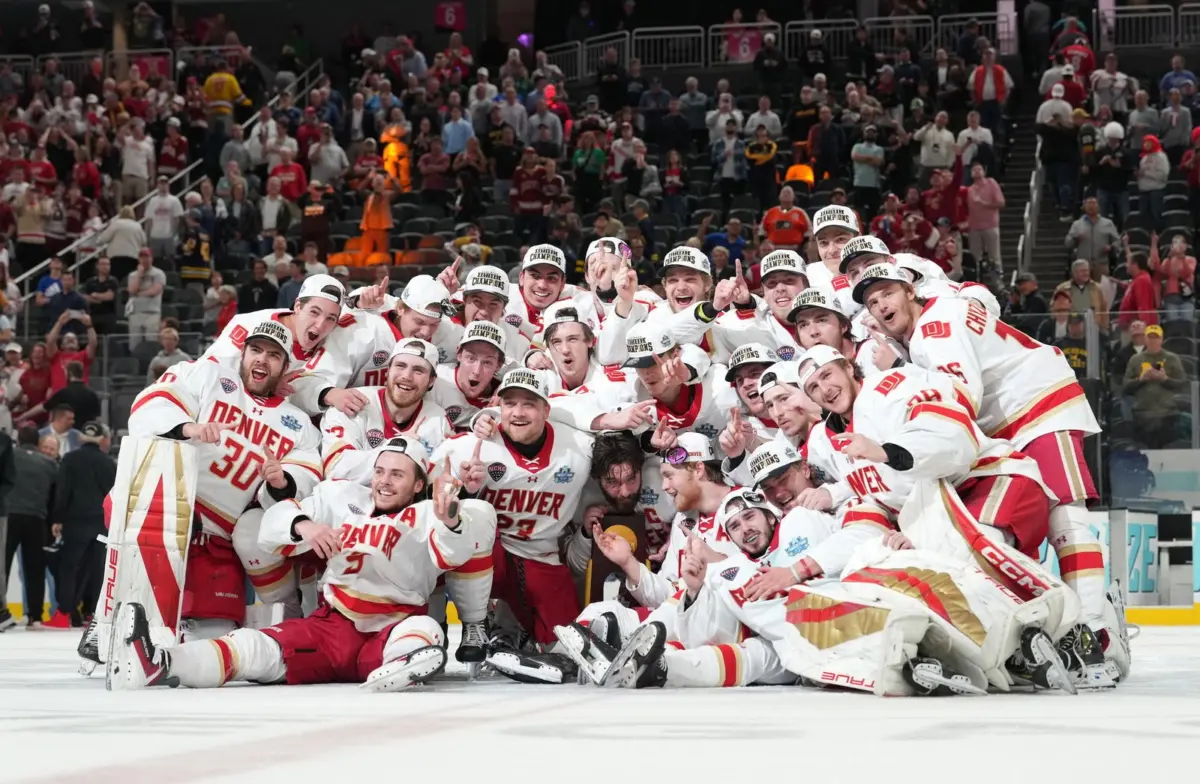
Last spring, the University of Denver captured its NCAA-record 11th national championship, putting even more distance between the storied program and the next-closest team, Michigan, which has nine titles. It was the Pioneers’ third national championship since 2022, but more significantly, it extended an undeniable era of dominance from Western teams, who have now claimed eight of the last 10 national titles.
There is little reason, at least at this early stage of the season, to believe that trend will shift. The top six teams in the preseason U.S. College Hockey Online poll are all located in the West, accompanied by 11 of the top 20 and an overwhelming 19 of the 37 teams that received any votes at all.
Denver sits comfortably at No. 1, but they are closely followed by traditional heavyweights. Michigan checks in at No. 2 with six first-place votes, Michigan State occupies the third spot with seven first-place votes, and North Dakota rounds out the top four with two first-place votes.
The first Eastern program to crack the poll is Quinnipiac at No. 7. Other traditional Eastern contenders like Providence, Massachusetts, Dartmouth, Boston College, Cornell, UConn, and Boston University populate the rest of the top 16. While these rankings suggest that voters believe these Eastern squads will be very good, they stop short of viewing them as true national championship favorites out of the gate.
It is, of course, entirely possible for Eastern teams to prove the doubters wrong and use those preseason projections as bulletin-board material. However, they will face a demanding gauntlet of hurdles between now and the Frozen Four in April.
Top Prospects Choosing College
Part of the reason Western schools are perceived as holding such a commanding advantage is that they have grown increasingly effective at attracting and retaining elite prospects away from traditional junior routes like the Ontario Hockey League (OHL) and the Western Hockey League (WHL).
The shifting landscape of player development is starkly illustrated by the numbers. In total, 14 players selected in the first round of the 2026 NHL Draft—including nine of the top 15 selections overall—are currently slated to skate on college rosters this fall. This influx includes four high-end prospects at Michigan State, alongside two each at Denver, North Dakota, and Boston University.
Looking deeper at the rosters, a total of 29 past first-round picks and 30 second-round selections will play NCAA hockey this season. Furthermore, the collegiate ranks will feature a pair of likely top picks for the 2027 draft, headlined by presumptive No. 1 overall prospect Landon DuPont at Michigan, and potential top-10 selection Sammy Nelson at Notre Dame.
The driving force behind this shift is relatively straightforward. National Hockey League talent evaluators increasingly favor the college model because it allows young prospects—many of whom spent their mid-teens playing in the Canadian Hockey League—to log heavy minutes and high-level repetitions against physically mature opponents who can be as old as 25 or 26.

While major junior hockey has historically offered a proven path, the modern landscape makes the choice clear for many elite players. The prospect of enduring long bus rides across Saskatchewan in February pales in comparison to playing a structured, two-game weekend schedule on expansive university campuses, where student-athletes can also benefit from substantial Name, Image, and Likeness (NIL) financial opportunities. Most importantly, the collegiate environment is viewed by many as a more direct and effective springboard to professional hockey within a year or two.
Arizona State’s Season Comes Second After Tragedy
While the on-ice product generates excitement, the biggest and most sobering story of the off-season involves Arizona State University. On Aug. 20, 21-year-old Sun Devils defenseman and St. Louis Blues prospect Matthew Mayich collapsed during an outdoor team workout. He has remained in a coma ever since.
The program has attempted to maintain a sense of normal operations while administrative reviews and external investigations swirl around the athletic department. However, the tragedy has deeply overshadowed preparations for the new campaign, particularly given the ongoing institutional response from the university.
The situation reached a critical juncture with the revelation that a number of Arizona State players submitted an anonymous letter to the university’s president. Fearing professional reprisal from the coaching staff, the players detailed numerous concerns regarding the administration’s initial review of the events surrounding Mayich’s medical emergency. The troubling details laid bare in the letter placed school officials under intense public scrutiny.
In the wake of these developments, head coach Greg Powers was placed on administrative leave. The timing—occurring just weeks after widespread speculation regarding whether the Sun Devils would even field a team this season, and less than a week before their scheduled season opener on the road against Lindenwood—leaves the program facing a mountain of questions and very few answers as competitive play begins.
Rebuilding Years and New Coaches Abound
Coaching turnover has become a defining characteristic of modern college hockey, with programs frequently hitting the reset button in search of immediate improvement or a fresh cultural identity.
Last season saw a staggering 10 Division I programs appoint new head coaches, and another six bench bosses step into new roles for the current campaign. This wave of leadership changes includes Eric Rud at Alaska-Anchorage, Top Upton at Brown, Rob Rassey at Harvard, Brett Larson at Minnesota, Nick Oliver at St. Cloud State, and Jeff Hamilton at Yale.
Unlike transitions of the past, where legendary coaches handed the reins of fully optimized programs to their hand-picked successors—such as Casey Jones at Cornell or Dane Jackson at North Dakota taking over established cultures—today’s new hires are frequently inheriting major rebuilding projects.
With 34 out of the 64 NCAA Division I programs having changed head coaches since the 2021-22 season, high turnover is now the baseline reality of the sport. Because successful program turnarounds rarely follow a linear path and often require four to five years of foundation-building, the opening year under these new coaches will provide an intriguing look at early progress.
A New Team Emerges
As the broader Division I landscape settles into its familiar rivalries, a new competitor is stepping into the spotlight. St. Lawrence opens its season with a pair of games as part of an unconventional schedule that blends Division III opponents, club teams, the U.S. National Team Development Program, and 18 exhibition and non-conference matchups against established Division I foes like Bowling Green, Quinnipiac, Yale, Princeton, Holy Cross, and Lindenwood.
The university has designated this campaign as an official transition season, which will pave the way for a full Division I schedule commencing in the 2027-28 academic year. While expectations regarding the team’s immediate win-loss record remain modest, the primary objective for the program is to establish positive momentum and lay the groundwork for future competitiveness at the highest level of collegiate hockey.