
It was billed as a marquee heavyweight fight under the primetime lights in South Bend, and No. 11 Notre Dame and No. 1 Miami certainly delivered what many are already calling the college football game of the year. For the Fighting Irish, Saturday night’s showdown offered a desperate opportunity to secure a signature victory that could drastically alter their standing with the College Football Playoff Committee. Beyond the national playoff implications, it carried the heavy weight of redemption following a bitter season-opening loss to the Hurricanes last year—a defeat that ultimately kept Notre Dame out of the postseason field entirely.
When the dust finally settled on a frantic, high-stakes battle, Notre Dame emerged victorious with a hard-fought 31-24 win, handing Miami its first defeat of the season and dramatically shaking up the national championship landscape. Yet, despite the impressive performance from the Fighting Irish—who built a commanding early lead only to weather a furious second-half storm—the game will be remembered just as much for a razor-thin, highly controversial officiating decision in the final minutes that effectively snatched a potential game-tying touchdown away from the Hurricanes.
The contest began with Notre Dame dictating the tempo and imposing its will on both sides of the ball. The Fighting Irish faithful packed into the stadium witnessed a dominant opening surge as the home team raced out to a commanding 24-7 lead. Notre Dame’s game plan clearly caught the top-ranked Hurricanes off guard, as the offense executed with precision and the defense repeatedly harassed Miami’s backfield, forcing uncharacteristic mistakes from a team that had looked invincible through the first half of the season.
However, a top-ranked team like Miami does not reach the summit of the AP poll without resilience. Slowly but surely, the Hurricanes began to chip away at the deficit, adjusting their schemes and leaning on the immense talent of their roster. At the center of the comeback was dynamic Heisman Trophy candidate Darian Mensah. The star quarterback engineered a brilliant second-half rally, utilizing his arm and legs to breathe life back into the Miami offense and systematically dismantle the cushion Notre Dame had spent the first two quarters building.
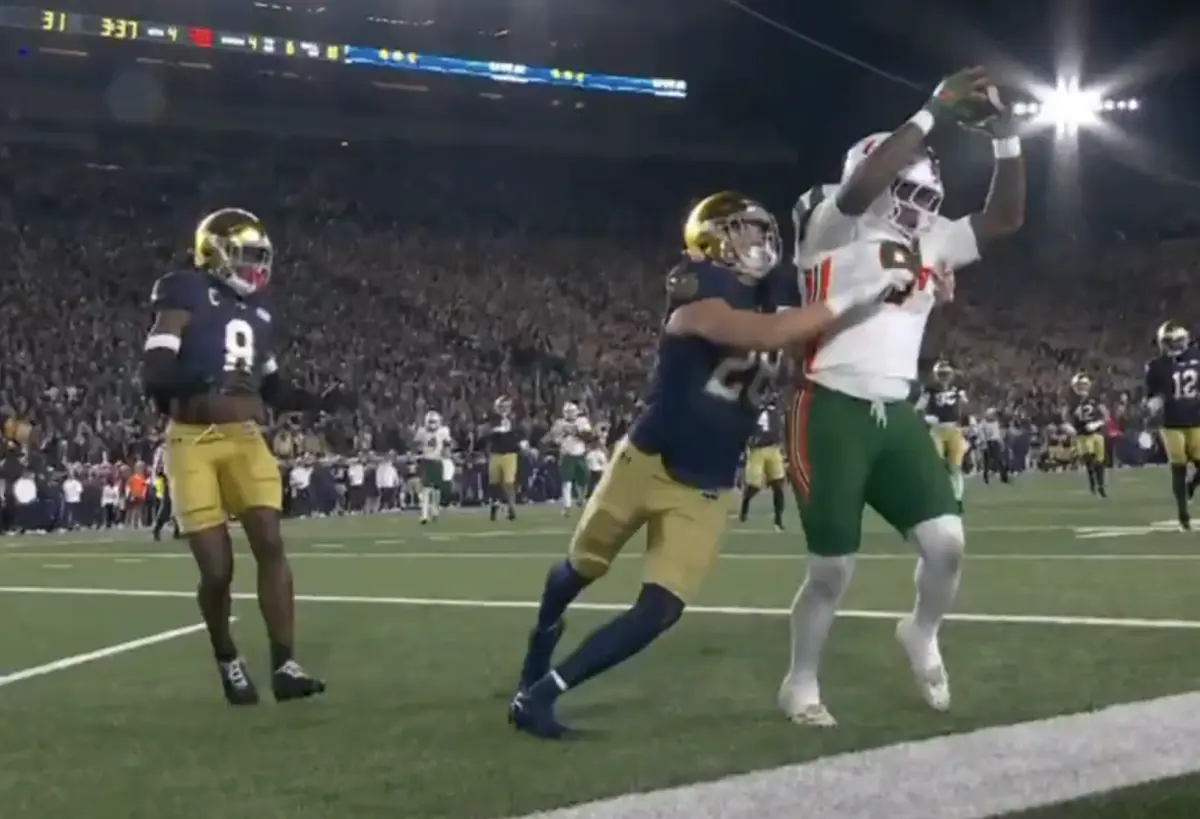
As the fourth quarter ticked down, Mensah put the Hurricanes in position to pull off a dramatic, game-tying drive. With under four minutes remaining on the game clock and facing a crucial fourth-down conversion deep in Notre Dame territory, Mensah dropped back and fired a precise pass toward tight end Elija Lofton, who was running a precise route into the corner of the end zone.
For a fleeting moment, it appeared Miami had pulled off the improbable. Lofton hauled in the pass, seemingly securing the ball and getting both of his feet firmly down in-bounds before tumbling toward the turf. The visiting sideline erupted, and Miami players celebrated what looked like a touchdown that would tie the game at 31-apiece and leave the door open for a potential game-winning extra point or a dramatic overtime period.

Instead, the officiating crew immediately huddled, and after a tense delay, waved their arms to signal incomplete. The referees ruled that while Lofton caught the ball and established feet in-bounds, he did not complete the reception according to college football’s strict standards for a completed catch. Specifically, the officials judged that Lofton failed to perform an "act common to the game"—meaning he did not maintain control long enough after the initial contact to satisfy the completion requirement before Notre Dame defensive back Luke Talich arrived to strip the ball away. The ruling on the field stood as a turnover on downs, giving possession back to the Fighting Irish with the score still at 31-24.
The decision immediately ignited a firestorm of debate, both inside the packed stadium and across the college football landscape on social media. Replays showed Lofton securing the reception and stepping down in bounds, leading many analysts, fans, and former players to argue that the step itself should have constituted a common football act before the ball was jarred loose.
Under current college football rules, a catch requires three distinct elements: firm control of the football, at least one body part down in bounds (or two feet, as in this case near the sideline), and control long enough to enable a player to perform an act common to the game, such as tucking the ball, turning upfield, or taking an additional step. Because the officials determined that the strip happened virtually simultaneously with or during the process of going to the ground without a definitive secondary football act, the review booth ultimately affirmed the initial ruling on the field of no catch.
With the lifeline granted by the officials, Notre Dame’s offense managed to run out crucial clock and secure the remaining yardage needed to seal the 31-24 victory. The emotional win provides the Fighting Irish with the exact resume-boosting triumph they needed to strengthen their standing in the playoff race, turning a disappointing season narrative into a triumphant redemption story.
For Miami, the bitter pill of a first defeat is compounded by the manner in which it concluded, leaving lingering questions about the consistency of catch reviews in high-stakes moments. As the college football world dissects the final minutes of Saturday night’s thriller, the debate over what constitutes a completed catch in the heat of competition is sure to continue in living rooms, sports talk shows, and online forums across the country.