
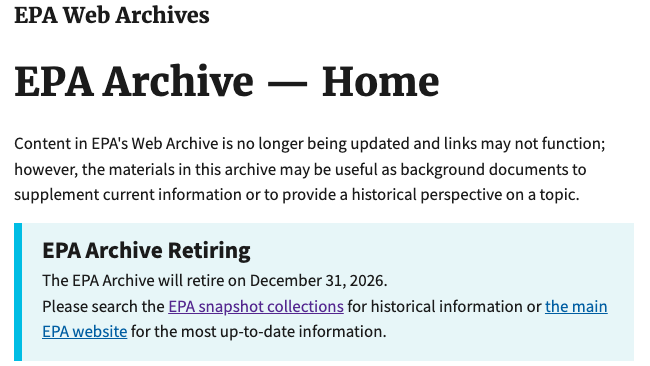
In a discreetly updated webpage notice that has largely flown under the radar, the Environmental Protection Agency has announced a definitive plan to shutter its online web archive by the end of the year. The move threatens to permanently wipe tens of thousands of publicly accessible historical environmental resources from the internet, drawing swift condemnation from data governance advocates, historians, and transparency watchdogs.
This quiet administrative maneuver stands in stark contrast to the high-profile public actions of EPA Administrator Lee Zeldin. In recent months, Zeldin has made headlines for aggressively targeting and dismantling major federal environmental policies, including public takedowns of the agency’s power plant pollution standards and sweeping rollbacks of the federal methane regulatory system for the oil and gas sector. While those policy shifts played out in the spotlight, the decision to eliminate the digital archive was tucked away in a banner notice on the agency’s website, setting a termination date of December 31, 2026.
For academics, policy analysts, legislators, and everyday citizens, the EPA’s online repository has served for decades as an invaluable window into the federal government’s environmental decision-making.
“The EPA’s online archive makes information about a wide variety of environmental issues and past policies available to the public, dating back at least 20 years,” said Gretchen Gehrke, co-founder of the Environmental Data and Governance Initiative, or EDGI. “This information is irreplaceable, and if the archive is decommissioned, that information will be lost forever.”
Gehrke, who has spent a decade tracking and documenting alterations to vulnerable federal environmental data, emphasizes that the repository has long acted as a vital tool for democratic oversight. The archive houses a sprawling collection of documentation, ranging from routine fact sheets and technical environmental reports to major agency policy shifts and landmark regulatory actions. Without it, tracking the evolution of federal environmental policy becomes significantly more difficult.
This upcoming closure is not the first time the agency has attempted to dismantle the digital repository. In late January 2022, during the Biden administration, the EPA first announced plans to discontinue the online archive. At the time, officials cited the burdensome financial upkeep of the site as the primary justification. Subsequent Freedom of Information Act requests filed by Gehrke revealed that the agency estimated the archive cost roughly $2 million a year to maintain.
That initial announcement triggered immediate and widespread backlash. A broad coalition of environmentalists, academic historians, and professional librarians swiftly condemned the decision. Groups like EDGI and the American Society for Environmental History labeled the move alarming, warning that it would create a tremendous and lasting gap in the national historical record.
Faced with mounting pressure and five months of intense public criticism, the EPA relented. The agency announced a one-year delay, pushing the scheduled retirement of the web archive to July 2023. At the time, observers noted that a mere postponement did little to address the fundamental threat to government transparency. Merely delaying the inevitable failed to resolve concerns about the permanent loss of historical record-keeping, leaving advocacy groups unsatisfied with a temporary reprieve.
By March 2023, the agency adjusted its approach once again, modifying the banner announcement to state simply that the online web archive was “retiring,” while conspicuously omitting a hard end date. For the next three and a half years, the digital repository soldiered on quietly. Though it was no longer actively updated with fresh content, the existing trove of historical pages remained accessible to the public—that is, until a few weeks ago, when the EPA updated the expiration notice to explicitly target the end of 2026.
Throughout its existence, the usability of the archive has faced criticism. Researchers frequently encountered dead links, fragmented pages, and frustratingly limited search capabilities. Despite these technical shortcomings, the repository remained a treasure trove containing tens of thousands of federal documents dating back to the 1990s that were simply not available anywhere else on the public internet.
The archive has functioned as a chronological roadmap for major political and environmental inflection points in modern American history. Observers could track the trajectory of sweeping regulatory shifts, such as President George W. Bush’s 2003 Clear Skies Initiative or President Barack Obama’s 2015 Clean Power Plan, both of which sought to fundamentally transform power plant pollution standards. Furthermore, during President Trump’s first term in office, when the administration systematically deleted the majority of the EPA’s active climate change web resources, the online archive played a crucial role by preserving those defunct pages and keeping them accessible to the public.
Beyond broad policy tracking, the repository has served as an essential instrument for environmental enforcement, community accountability, and public health investigations. A prominent example involves Marine Corps Base Camp Lejeune and the Marine Corps Air Station in North Carolina. In 1989, following comprehensive investigations that uncovered severe contamination of soil, sediment, surface water, and groundwater due to decades of military operations, the EPA placed the base on its prestigious National Priorities List.
Documentation detailing the EPA’s decades-long investigation was meticulously preserved within the agency’s online archive. For nearby residents, veterans, and military families who lived and worked on the base, these preserved records proved instrumental in overcoming institutional doubts, evaluating chemical exposures, and understanding the scope of the contamination. The historical availability of these files carried renewed public resonance recently when political discussions turned toward the compensation of service members and their families affected by the toxic water at Camp Lejeune.
The decision to eliminate the archive arrives at a delicate moment, coinciding with historic lows in public trust toward the federal government. Transparency advocates warn that destroying historical access will only deepen public skepticism.
“The EPA’s insistence on decommissioning its web archive will only continue to erode public trust—at the exact time the public and lawmakers need agency information the most,” wrote Lauren Harper, the inaugural Daniel Ellsberg chair on government secrecy for the Freedom of the Press Foundation, in an email statement. “Killing easy access to records forces researchers and lawmakers to flood an already underwater FOIA office just to see once-public records.”
In its recently updated webpage notice, the EPA suggests that users looking for historical information can still consult the agency’s designated “snapshot collections.” However, given the broader policy environment of the second Trump administration—characterized by continuous reductions in federal data accessibility and significant financial and personnel cuts across environmental programs—researchers remain deeply skeptical about whether these snapshots will preserve a comprehensive record. Observers question whether these alternative collections will capture more than a fraction of the archive’s original contents.
“EPA should expand and systematize the archive, not throw it away and expect that three discrete snapshots will suffice,” Gehrke noted.
The EPA did not respond to requests for comment regarding the impending closure of the archive or the future accessibility of its historical contents.