
For years, the Canadian real estate industry relied on informal channels to share properties quietly coming down the pipeline. Real estate agents routinely swapped details about upcoming listings during morning office meetings, or hurried to post property teasers in private WhatsApp chats and localized Facebook groups. While these grassroots methods allowed agents to test the waters before a public launch, they remained fragmented, exclusive to small inner circles, and entirely divorced from modern consumer search habits.
Derek Hooper, an Ottawa-based third-generation real estate agent, knew there had to be a more efficient, transparent way to handle the pre-marketing phase. That realization led him to establish FirstList in 2023 alongside Andrew Paliga, a former Shopify product leader. Designed as a dedicated real estate technology platform, FirstList set out to modernize how agents collaborate on upcoming properties, taking pre-marketing well beyond the physical confines of individual brokerage offices and closed digital networks.
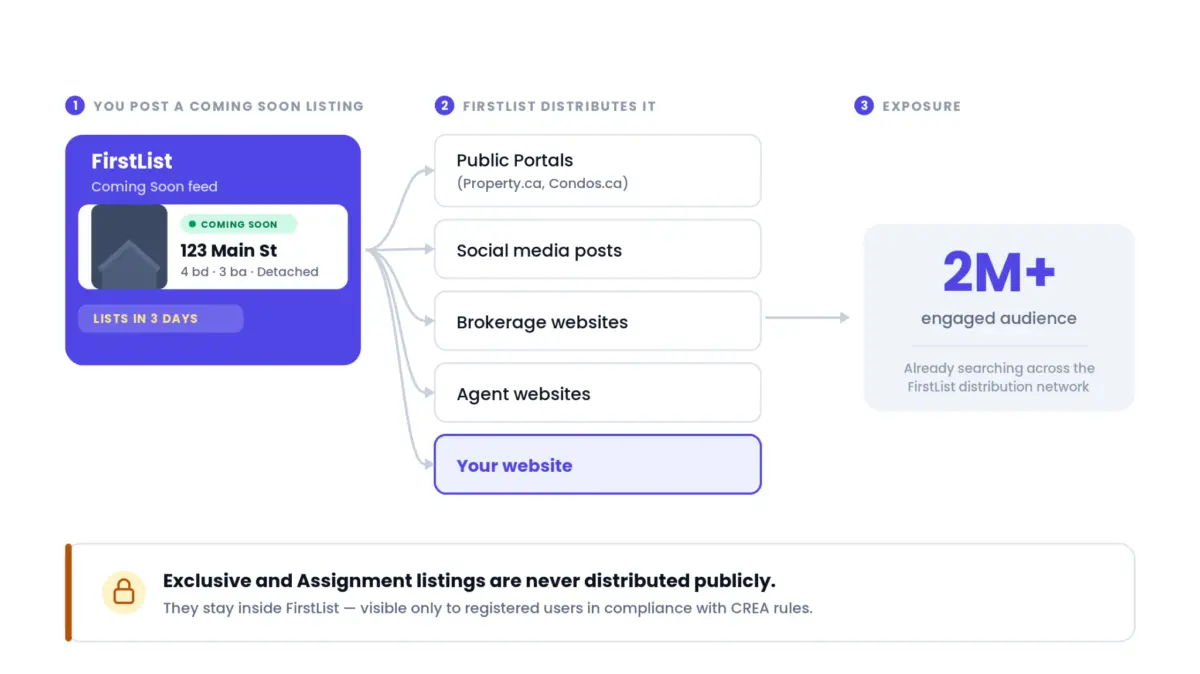
Following its acquisition by myAbode last November, FirstList has taken its most ambitious step yet. The company has officially launched a broad coming-soon distribution network that enables agents from any brokerage to advertise qualifying properties across participating public-facing websites. Already, the network includes prominent brands owned by MyAbode, such as Property.ca and Condos.ca. This evolution transforms pre-marketing from an invisible, word-of-mouth exercise into a structured, outward-facing strategy, allowing properties to secure early buyer interest before they officially hit the market.
How the Network Works for Agents and Buyers
Under the newly expanded system, agents are granted the ability to publicly market coming-soon listings for up to three days ahead of their official launch. This brief window gives sellers an early opportunity to test market responsiveness and build momentum.
From a consumer perspective, prospective buyers browsing participating websites can view essential property details, including general neighborhood information and high-level specifications. However, to access sensitive information such as the exact property address and the asking price, interested users must register their contact details. Those registrations are then funneled directly back to the listing agent, generating valuable, qualified leads while protecting homeowner privacy during the initial pre-market phase.
The technology is equally built to support real estate professionals on their own digital properties. Agents and brokerages can seamlessly embed the FirstList feed directly into their personal or corporate websites, allowing visitors to browse upcoming listings sourced from across the entire network. Throughout these digital touchpoints, Hooper emphasizes that transparency remains paramount: the listing brokerage is clearly identified wherever its properties appear, ensuring that brand recognition and accountability stay intact.
From Office Conversations to a National Network
Hooper’s drive to build FirstList was born directly out of the daily frustrations he experienced in the field. Real estate professionals frequently begin working alongside home sellers months before a property is physically ready to make a public debut. Some homeowners require extended periods to complete necessary home repairs, professional staging, or decluttering, while others navigate personal, family, or financial circumstances that complicate the precise timing of a market launch.
During that pre-listing window, agents naturally want to gauge interest or share information about upcoming opportunities without immediately triggering a full-scale public marketing campaign. Historically, that meant standing up at weekly office meetings to announce incoming inventory, or typing hurried updates into smartphone messaging apps. Hooper quickly noticed a glaring disconnect: while consumer-facing property search platforms had advanced by leaps and bounds over the past two decades, the operational tools agents used to communicate with one another remained outdated.
Teaming up with Paliga, Hooper designed FirstList to bridge that gap. The platform facilitates cross-brokerage collaboration while preserving strict control for brokerages over who can view their sensitive listings. Following myAbode’s acquisition of the company in November 2025, Hooper realized the venture was evolving past pure software development into a fully fledged marketplace. The core mission expanded to actively connecting agents with properties while engineering wider distribution channels.
This movement toward structured pre-marketing is not isolated to Canada. Similar trends have gained significant traction south of the border, most notably championed by Compass and its CEO, Robert Reffkin, through the promotion of private exclusive listings. Hooper notes that the growing prominence of structured pre-marketing in the United States helped shine a helpful spotlight on the urgent need for comparable, modernized services within the Canadian real estate landscape. With thousands of agents already utilizing FirstList across Ontario, the company recognized a clear mandate to scale its infrastructure and distribute coming-soon listings through broader public-facing channels.
Navigating Canada’s Evolving Listing Rules
This strategic expansion arrives at a critical regulatory juncture for Canadian real estate professionals. Agents across the country currently operate under the strict parameters of the Canadian Real Estate Association’s Realtor Co-operation Policy, which was initially introduced in January 2024 and later refined through subsequent amendments.
The policy draws a sharp regulatory line between private exclusive listings and properties intended for public marketing. It dictates that any property marketed publicly must be submitted to the local Multiple Listing Service within the specific real estate board’s strict timeline, which cannot exceed three days. Hooper openly acknowledges that the policy was introduced to address legitimate, widespread concerns regarding how certain segments of the industry handled coming-soon and off-market inventory.
Recalling past market practices, Hooper points out that some properties were previously advertised as coming-soon for weeks or even months without ever transitioning to the Multiple Listing Service. In certain instances, home sellers may not have fully understood the nuances of the marketing strategies their agents were employing on their behalf. However, Hooper firmly believes those questionable practices represented a relatively small fraction of the broader industry, whereas the vast majority of real estate professionals were simply searching for lawful, effective ways to better serve their clients’ unique timelines.
To ensure strict regulatory compliance, FirstList embedded CREA’s requirements directly into the core logic of its technology platform. The system is engineered to help agents navigate the rules effortlessly, allowing them to share listings privately within restricted networks or distribute eligible coming-soon properties publicly within the permitted three-day window. Crucially, true exclusive listings and assignment sales remain safely confined within the platform’s restricted network and are entirely excluded from the public feed.
Building Beyond Ontario
FirstList soft-launched its innovative distribution network in Ottawa on October 13 and is actively scaling its footprint into the Greater Toronto Area. The platform has already achieved significant adoption, with more than 10,000 agents actively utilizing its infrastructure. The user base includes professionals from several prominent real estate brokerages, such as REVEL Realty and Harvey Kalles Real Estate.
Operating on a predictable subscription business model, FirstList charges individual agents a flat fee of $49 per month, while offering discounted tiered pricing structures for brokerages scaled to their total agent count. Participating brokerages benefit from private internal listing-sharing networks designed for their own teams, while individual agents maintain the flexibility to distribute eligible listings outward through the broader collaborative network.
Looking ahead, Hooper confirmed that the company has set its sights on full national expansion. He views the platform’s proprietary technology as a competitive moat that individual brokerages would find cost-prohibitive and structurally difficult to replicate on their own. By combining software development with marketplace dynamics, FirstList aims to cement its role as an essential pillar of modern Canadian real estate operations.