
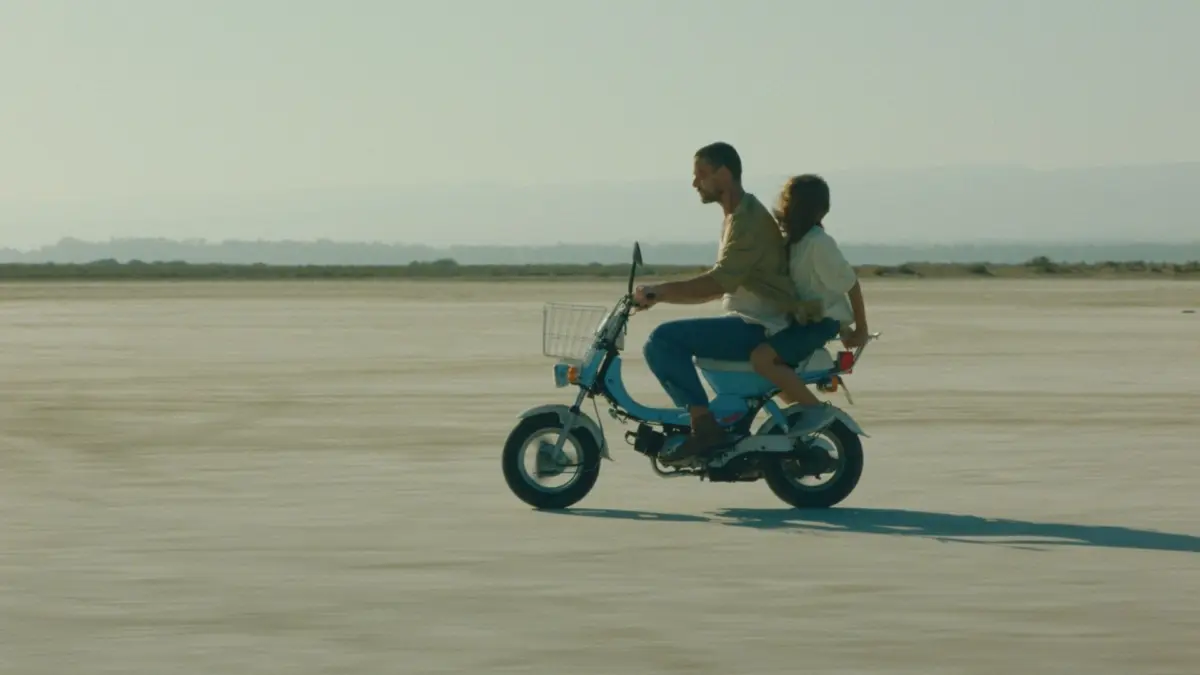
It is summertime in Cyprus, a season traditionally associated with sun-drenched leisure, youthful exploration, and endless Mediterranean days. For 11-year-old Iris, the days are spent in the company of her older best friend, Danae. However, the carefree rhythm of her youth is abruptly disrupted when she receives the news that her grandfather has passed away. Returning to her hometown for the funeral is a figure she has never known: her father, Aris.
This poignant premise serves as the starting point for Hold Onto Me, the feature-length directorial debut of writer-director Myrsini Aristidou. The narrative asks a compelling central question: Can Iris and Aris find a way to forge a connection, even though he is a petty criminal who consistently avoids taking personal responsibility? Refusing to accept his emotional distance, Iris remains stubborn in her pursuit of a relationship, eventually getting entangled in his various illicit schemes despite explicit warnings from both her mother and her older brother. What begins as a stubborn, almost desperate attempt by a child to reconnect with an absent parent slowly unfolds into a fragile, complex bond. But just as a tentative bridge is built between them, Aris’s dark past catches up, plunging them both into serious trouble.
Starring newcomer Maria Petrova alongside Christos Passalis, widely recognized for his memorable role in Yorgos Lanthimos’s acclaimed feature Dogtooth, Hold Onto Me first made waves internationally when it premiered at the Sundance Film Festival. There, the Cyprus-Denmark-Greece co-production captured the prestigious World Cinema Dramatic Audience Award. Following its critical reception in Utah, the film achieved a historic milestone for the Mediterranean island nation by becoming Cyprus’s first-ever international feature film submission for the Academy Awards.
Continuing its impressive festival run, the film is now screening in the Just Film youth and children’s competitive section at the 30th edition of the Tallinn Black Nights Film Festival (PÖFF) in Estonia, with international sales handled by Cercamon.
Behind the camera, the production brought together a talented international crew. Lasse Ulvedal Tolbøll served as the cinematographer, capturing the sun-bleached landscapes of Cyprus, while the editing duties were shared by Jenna Mangulad and the director herself. Aristidou produced the film alongside Monica Nicolaidou, with Thomas J. Mangan IV and Mark Hollinger attached as executive producers. Anders N.U. Berg, Konstantina Stavrianou, and Rena Vougioukalou rounded out the creative team as co-producers.
In interviews discussing her bittersweet first feature, Aristidou has opened up about the deliberate choices behind casting an untrained young newcomer opposite an established arthouse actor like Passalis, her desire to subvert expectations within a familiar narrative framework, and the surreal experience of steering Cyprus’s debut Oscar submission.
The exploration of father-daughter dynamics is not new to Aristidou; rather, it is a thematic well she has drawn from across her burgeoning cinematic career. Speaking about the evolution of her filmography, the director notes that her past short films and current feature form a cohesive thematic body of work.

"I feel like this is like a triptych," Aristidou explains. "My first short film called Semele in 2015 is also a father and daughter story and was the first time that I began exploring this theme. Then I did my second short film, Aria, which has a father-daughter dynamic again, but with an older daughter—she’s a teenager. They were short, and I wanted to go deeper in this subject matter."
Transitioning to a feature film allowed Aristidou the necessary canvas to explore the theme thoroughly, though she was determined to subvert conventional tropes associated with familial reconciliation dramas. She aimed to frame the central relationship through an unexpected lens.
"I wanted to use the archetypical relationship of father and daughter within a love story," she elaborates. "It’s kind of a love story. It’s about two people who don’t know how to be together. They are sort of strangers in the beginning. They meet, then slowly come together, and they end up accepting each other or even loving each other in their own way. And when you set this up within the framework of a father, daughter and their family, it creates a different energy."
That unique energy is largely fueled by the invisible social pressures and implicit contracts that govern family life. Aristidou highlights how societal expectations complicate relationships where emotional foundations are entirely absent. When someone is a family member, society dictates an automatic baseline of love and affection, generating far heavier expectations than one would place on a total stranger. Yet, in the case of Iris and Aris, they are essentially strangers who share no prior history or collected memories. Navigating that contradiction became a central point of fascination for the filmmaker.
To maintain narrative momentum, Aristidou maintained a rigorous approach to her screenplay. Aware of the common pitfalls that first-time feature directors encounter, she held herself to strict standards regarding pacing and character development.
"On a first feature, it’s very easy to get very obsessed with what you want to do, so I was very tough on myself," she admits. "When it comes to narrative structure and characters, I like to move the story forward in every scene. When I was writing, I was really thinking about that."
The emotional resonance of Hold Onto Me is deeply rooted in Aristidou’s own biography. Like her young protagonist, the director experienced a childhood shaped by parental divorce and a father who was physically and emotionally distant.
"It’s very personal in many ways," she shares, drawing parallels between her life and the film’s narrative. "My parents divorced when I was very young, and I was not really growing up with my dad. He wasn’t entirely gone like this character, but he was not that present. And he’s not a criminal, but a writer. It was only when I turned 12 or 13 that we started having more of a relationship. And when I was 15, 16, we really bonded. We reached a point where we started talking about everything and we really forgave each other. We reconnected, and there was really an understanding and acceptance."

The geographic setting was equally personal. Shooting in Cyprus allowed Aristidou to draw directly from her memories of growing up by the coast, incorporating specific visual and environmental references into the mise-en-scène. From her childhood memories of her father’s small boat to the companionship of older peers, the filmmaker infused the fictional narrative with authentic personal truths.
Achieving the palpable on-screen chemistry between Iris and Aris required a meticulous and unconventional casting process. While Christos Passalis was locked in by April ahead of a July shoot, the search for the right young actress involved numerous auditions, primarily conducted in Athens. Eventually, Passalis traveled to Cyprus to test with local girls, leading him to Maria Petrova.
"I saw Christos with Maria, and they felt family in a strange way," Aristidou recalls. "They physically have things in common and look a bit like family. But Maria had zero experience. She had never done anything in acting. But I felt that there was something with them."
Plans for extensive pre-production rehearsals between the veteran actor and the novice youngster were ultimately derailed by logistical hurdles, including scheduling conflicts and a timely bout of COVID-19 that left Passalis arriving on set just a day before filming commenced.
"We only read the script once, and then I just started shooting with both of them," Aristidou notes. "So I just threw Maria into the wild with him. But I think it worked out perfectly because they didn’t know each other really—just like their characters."
Looking back at the whirlwind journey from an independent production to an unprecedented international milestone for her home country, the director acknowledges the immense weight and honor of representing Cypriot cinema on the global stage.
"It’s a big honor," Aristidou says. "I suddenly felt very responsible for my whole country. But in many ways, this film and I are carving this path for Cyprus. There was no film from Cyprus in Sundance before, and then we won an audience award. And then the Oscars. I guess it’s a new thing for everyone here and for me. So I’m learning a lot in the process. I know we’re a bit of the underdogs, but I’m trying to enjoy the ride."
As for her future creative endeavors, Aristidou intends to continue exploring narratives centered on unexpected connections between strangers, though she plans to step away from father-daughter dynamics for her next project. While developing a crime and spy thriller television series, she is also reviewing scripts sent by her representation in the United States, keeping her options open as she weighs her next directorial step.