
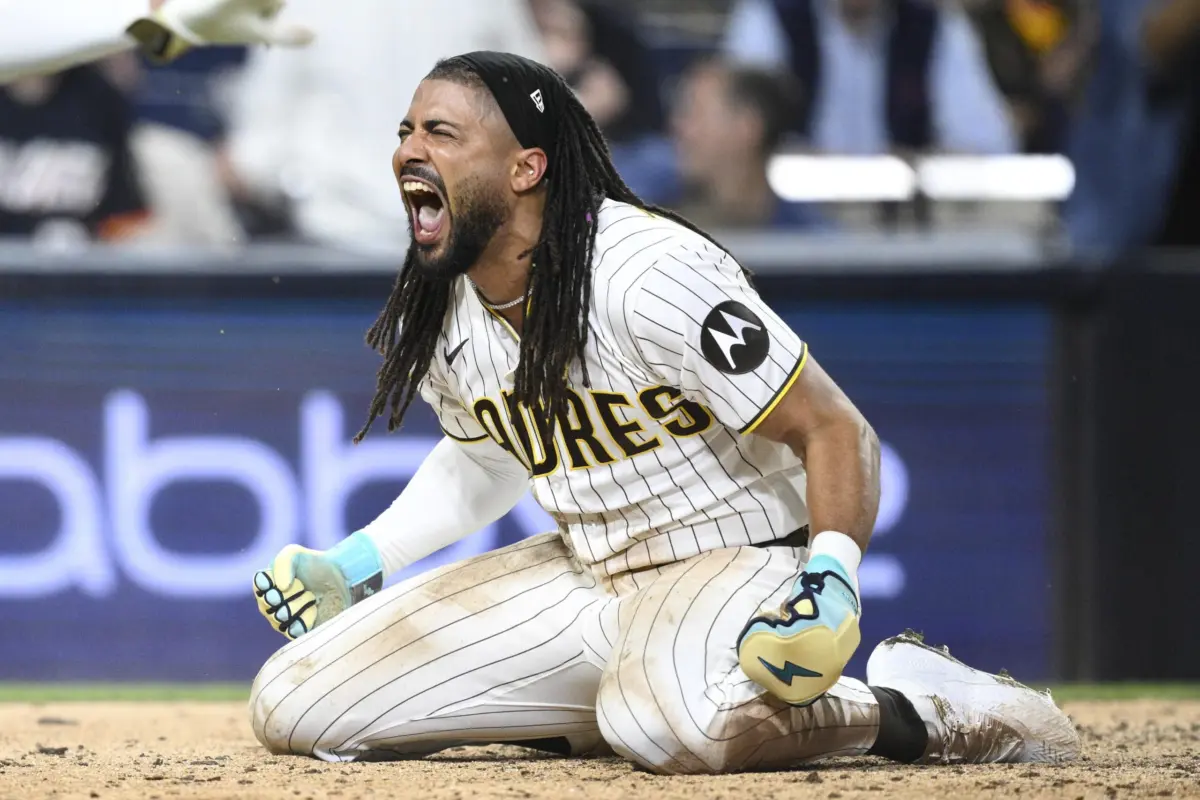
The San Diego Padres are set to face the league’s winningest team in the Division Series, but anyone expecting them to step into the role of wide-eyed, grateful underdogs might want to look a little closer at how they got here.
It seemed entirely unlikely the Padres would ever make it this far. They closed out June with a dismal eight-game losing streak and limped into the All-Star break sitting at a thoroughly mediocre .500 record. In the ruthless National League West, where the juggernaut Los Angeles Dodgers demand absolute perfection just to keep pace at the top, a .500 mark by midsummer is something of a death sentence. By the final week of July, San Diego’s postseason odds had plummeted to a desolate 7.4 percent. At that point, the only conversations swirling around the organization in October were expected to center on who should be fired and how deep the front-office purge needed to go.
Fast forward to Wednesday, however, and the narrative has completely flipped. Not only did the Padres pull off a convincing, decisive sweep of the Chicago Cubs in the Wild Card round, but they entered that series as the betting favorites to do so. Their 41-18 record over the final ten weeks of the regular season stood as the absolute best mark in the majors. In fact, their furious late-season surge was two and a half games better than the next best team in baseball—the Milwaukee Brewers, the very opponent awaiting them in the Division Series on Saturday.
This remarkable transformation goes far beyond a simple hot streak in the standings. When measured by WAR, the advanced statistical metric used as a proxy for true underlying talent, no team in baseball was better in the second half than the Padres. They accumulated an astonishing 21.9 WAR after the break, narrowly edging out the Cubs at 21.8, the Dodgers at 21.5, the Boston Red Sox at 21.4, and the Brewers at 20.2. It stands proudly as one of the great team-level turnarounds of this century.

The mechanics behind the surge in San Diego are not overly complicated when looking at the numbers. During the first half of the season, the Padres scored the fewest runs in all of Major League Baseball and posted a meager 90 wRC+. In the second half, they unlocked their potential, scoring the third-most runs in the league and surging to a 119 wRC+. With the Cubs now eliminated from the playoff picture, the Padres arguably boast the most dangerous and potent lineup remaining in the entire postseason field.
The offensive renaissance starts firmly with the team’s marquee stars. Fernando Tatis Jr. has operated on a torrid, MVP-caliber pace ever since he emerged from a bizarre, prolonged slump at the beginning of the season. Tatis struggled through a frustrating May, hitting just .268/.345/.307 with zero home runs across his first 268 plate appearances. Yet beneath the surface, he was actually striking the ball with immense authority, maintaining a hard-hit rate that soared as high as 60 percent. The issue was never the quality of contact he was making, but rather its trajectory—his scorching line drives were constantly pounded directly into the ground or pushed harmlessly toward the opposite field.
On May 29, Tatis finally connected for his first home run of the year. He proceeded to slug 24 more before the regular season concluded, putting up a stellar slash line of .303/.368/.549 and a 153 wRC+. His 5.0 fWAR accumulated from that first homer onward ranked as the second-best mark in the entire major leagues, trailing only Pete Crow-Armstrong. Just as the Padres may hold the best remaining lineup in the playoffs, Tatis looks every bit the part of the best individual player left standing.
The catalyst for his sudden power explosion can be traced directly to a mechanical adjustment in the batter’s box. Early in the season, Tatis utilized a closed-and-wide stance, but he subsequently transitioned to a more open-and-upright posture for the remainder of the year. While he was already generating plenty of hard contact, the shift allowed his batted balls to travel consistently into the air and toward the pull side. Hitting home runs becomes a much more achievable task when a hitter actively targets the shallowest parts of the park, and that subtle shift proved to be the defining difference for Tatis over the summer months.

Meanwhile, Jackson Merrill’s offensive struggles were even more pronounced early in the 2026 campaign. Through the month of June, Merrill stumbled to a .213/.271/.343 line with a 72 wRC+. Since that time, however, he has rebounded dramatically, hitting .299/.338/.544 good for a 141 wRC+. Unlike Tatis, there is no clean, singular narrative explaining the sudden turnaround. Merrill’s hard-hit rate remained strong throughout the entirety of the year, his strikeout numbers stayed relatively stable, and he has actually drawn slightly fewer walks during his hot streak. It is entirely possible that he was simply the victim of poor batted-ball luck early on, and the cyclical nature of baseball eventually swung back in his favor. Regardless of the underlying cause, Merrill and Tatis now combine to form one of the most formidable one-two punches in the major leagues, particularly when factoring in that both players offer exceptional defense and elite base-running capabilities.
Yet the offensive potency extends far beyond a dynamic duo. Ty France delivered the best season of his career out of nowhere, posting a 141 wRC+ after bouncing around the waiver wire over the previous two seasons. Manny Machado may not have enjoyed a universally dominant year at the plate, but he still supplied 30 home runs while playing stellar, Gold Glove-caliber defense at third base. Even the team’s internal platoons have clicked seamlessly into gear, with contributors like Samad Taylor, Austin Hays, and Dustin Harris performing admirably in limited, specialized roles. From top to bottom, everything has aligned offensively for the Padres lineup.
On the mound, the situation is decidedly more complex—and underscores why having an elite offense is so vital for San Diego’s championship aspirations. The pitching staff lacks significant depth, meaning the Padres are likely better served playing in these shorter postseason series. Michael King has flashed dominant stretches throughout his career, including one of the absolute finest outings of his life against the Cubs earlier in the week, but he functions less as a traditional true ace and more as simply the most reliable starter in San Diego. Beyond King, Nick Pivetta was genuinely impressive this year, albeit across a mere eight starts—none of which exceeded five innings—after missing the bulk of the season recovering from elbow surgery. Then there is Walker Buhler, whom the Padres desperately hope can rediscover his former postseason dominance, even as he has largely struggled to find consistency since undergoing elbow surgery in 2022. While other starters may receive a nod in the National League Division Series, those three represent the absolute best arms the Padres have to offer at the moment, making the starting rotation a clear area of vulnerability rather than a strength.
Fortunately for San Diego, a lockdown bullpen waits behind the rotation, standing unequivocally as the best relief corps in Major League Baseball. Mason Miller anchors the unit after completing one of the most statistically dominant reliever seasons in baseball history. His fastball averages a blistering 101.4 miles per hour, his slider is virtually unhittable, and he routinely strikes out half of all opposing batters he faces. Adrian Morejon effectively serves as a co-closer of sorts, starring as the premier left-handed reliever in the majors by generating endless ground balls with a heavy sinker and an invisible changeup. Bradley Rodriguez functions effectively as a third high-leverage weapon, standing out as a rare changeup-first pitcher who baffles hitters. In truth, the entire Padres bullpen merits mentioning: they are deep, stylistically varied, and suffocatingly effective from the first reliever to the last.

That relief depth will be tested to its absolute limits against the Milwaukee Brewers in the NLDS. Milwaukee secured 103 victories this year, capturing the title of winningest team in the majors for the second consecutive season and marking the first time in franchise history that the organization has crossed the triple-digit win threshold. Much like the Padres, the Brewers boast a potent offense and a lockdown bullpen. Unlike the Padres, however, they also feature a deep, formidable starting rotation anchored by the league’s premier ace, Jacob Misiorowski. The Brewers enter the series as legitimate favorites—not just for this matchup, but perhaps for the entire postseason—for good reason. Through their epic second-half surge, the Padres have successfully elevated their performance to match the level of a Brewers club that has played at an elite standard all year long.
Even so, this is far from a standard mismatch between a 103-win powerhouse and a standard 91-win wild card team where the former is expected to easily roll over the latter. The Padres of today are a remarkably dangerous ballclub, playing baseball at a level vastly superior to what their full-season record implies. At the very least, whichever team emerges from this clash will present a formidable, battle-tested opponent for the Dodgers in the National League Championship Series, assuming Los Angeles successfully navigates its own path past Atlanta.