
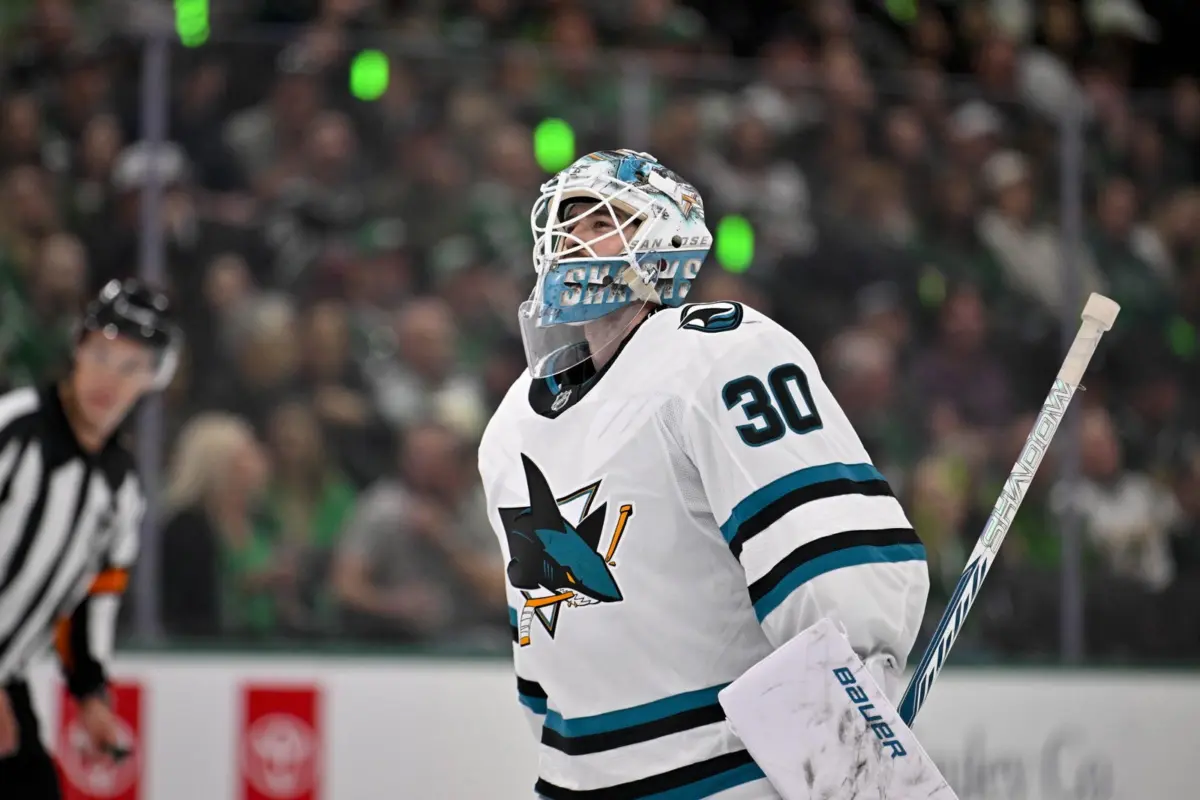
The San Jose Sharks enter the new NHL campaign boasting one of the most exciting and dynamic groups of young talent in professional hockey, anchored by generational superstar Macklin Celebrini. Yet, as the early weeks of the season unfold, the team’s uneven start serves as a stark reminder that even the most celebrated up-and-coming elite prospects require time to mature, adapt, and find consistency at the game’s highest level. What is fair to expect of San Jose as they navigate this delicate transitional phase?
Navigating an Uneven Start
The Sharks hold a decent 4-3-0 record, but a closer look beneath the surface reveals some cause for concern. Following a stretch of early promise, San Jose dropped two out of three games, suffering defeats against the high-octane Edmonton Oilers and the resilient Boston Bruins. More telling than the losses themselves is the manner in which the Sharks have secured their victories. To date, San Jose has failed to win a single game in regulation, grinding out three wins in overtime and another in a shootout.
This narrow margin of error highlights a team still searching for its identity. Statistical indicators further underscore these struggles. San Jose currently boasts the sixth-worst offense in the league, averaging a meager 2.57 goals for per game. Concurrently, their defensive struggles have left them with the eighth-worst defense in the NHL, surrendering an average of 3.57 goals against per contest. This combination of offensive anemia and defensive leakage points directly to a roster caught between the old guard and the new wave, still working out the kinks of a comprehensive team identity.
The Trust Deficit and Veteran Reliance
Equally revealing is how head-coach Ryan Warsofsky is deploying his personnel. While coaches across the NHL are under intense, daily pressure to win immediately, Warsofsky’s early-season deployment suggests he does not yet possess full trust in many of his young pieces.
Macklin Celebrini is the obvious exception. The superstar forward commands Warsofsky’s ultimate confidence, leading the team with a heavy average of 22:02 of ice time per game. But behind Celebrini, the deployment of the team’s touted youth drops off significantly. Ivar Stenberg, selected second overall in the 2026 NHL Draft, averages just 15:37 of ice time. Young star center Michael Misa sees an even more modest 13:31 per night, while 20-year-old winger Igor Chernyshov logs an average of only 13:57.
Instead of turning the keys entirely over to the future, Warsofsky is leaning heavily on his veteran core to carry the bulk of the workload. Five of San Jose’s top nine players in time on ice are established veterans. On the blue line, Jacob Trouba anchors the defense with an average of 21:46 of ice time, closely supported by Darnell Nurse at 20:35, Michael Kesselring at 19:26, and Dmitry Orlov at 18:36. Among the forwards, Alexander Wennberg logs a robust 20:05 per game.

This reliance on veterans is a natural byproduct of the NHL landscape. The grueling 84-game season is more punishing than ever, presenting a formidable physical and mental challenge for teenagers and early-twenty-somethings who are still adapting to the daily grind of professional hockey. Only the truly exceptional, cream-of-the-crop players transition seamlessly to the top of the professional food chain. Celebrini has shown he is capable of that rare feat, producing at a blistering 1.60 points-per-game pace with six assists and eight points through his first five contests. But even a generational talent like Celebrini cannot single-handedly drag the Sharks to victory night in and night out.
Finding Balance Between Youth and Experience
San Jose’s core remains undeniably one of the most exciting in the league. However, that young core still requires time to find its footing and graduate to the next tier of competitiveness. For Celebrini to succeed long-term, he will need meaningful support from a supporting cast that includes Will Smith, Sam Dickinson, Stenberg, Misa, and Chernyshov. On certain nights, that requisite consistency from the supporting cast will inevitably be lacking.
The natural acclimation process means that fans and management must brace for growing pains. Someday—perhaps a couple of seasons from now—Misa will have fully settled into a high-leverage, key role for the franchise. The same trajectory is expected for Smith, Stenberg, and Chernyshov as they build strength, hockey IQ, and familiarity with professional defensive structures.
Yet, Warsofsky’s primary mandate is to push this San Jose team into the Stanley Cup playoffs in the present. Because the immediate goal is competitive viability, it is entirely reasonable to expect the coaching staff to continue leaning heavily on veterans who can stabilize the floor on a nightly basis.
Internal expectations within the organization should rightfully point toward contention and a playoff berth this season. At the same time, the road forward for the franchise will inevitably encounter bumps along the way. Experiencing occasional lateral steps, developmental regressions, or inconsistent performances is simply the cost of doing business as a franchise evolves away from a prolonged playoff drought and toward legitimate, long-term aspirations of championship contention.