
For those who find themselves irritated by the premature arrival of pumpkin spice displays and Halloween decorations during an 85-degree week in September, there is a quiet comfort in resisting the seasonal shift. While retail windows and marketing campaigns aggressively beckon the colder months—pushing wool coats and longing for hearty stews long before autumn truly arrives—many home cooks prefer to hold their ground. For anyone caught gritting their teeth while shouting at a screen displaying ads for heavy winter garments, insisting that there is still another week of summer left to enjoy, the kitchen remains a sanctuary of seasonal defiance.
Embracing summer cooking for as long as fresh summer produce lasts is more than a culinary preference; it is a deliberate act of preservation. Tomatoes, in particular, occupy a sacred space in late-summer kitchens. The thought of abandoning fresh tomatoes the moment the first autumn apple hits grocery store shelves feels entirely premature, especially for those who spend the long winter months missing their bright, vibrant flavor.

Of course, this fierce loyalty to dwindling summer produce often coincides with other seasonal transitions. The emotional complexities of August and September—such as watching children navigate milestones like starting middle school or entering their senior year of high school—can sometimes find a mirrored reflection in the changing garden. Yet, in the kitchen, the focus remains firmly on the ingredients at hand.
The inspiration for a late-season dish often stems from classic favorites. Take, for instance, traditional rice-stuffed tomatoes, where short-grain rice absorbs a pure, clear-noted tomato sauce. That specific flavor profile—clean, bright, and intensely tomato-forward—can serve as a foundation for a standalone recipe. To achieve a tomato risotto as simple and uncluttered as possible, a minimalist approach works best. Rather than relying on heavy canned purees or complex broths, fresh tomatoes can be grated against the large holes of a box grater, pressing the flesh and juices through while discarding the outer skins. Combined with a bit of onion, garlic, a glug of wine, and surprisingly, plain water instead of broth, the resulting dish tastes intensely and authentically of the fresh fruit itself.

This method also challenges conventional wisdom surrounding risotto preparation. For years, culinary dogma has dictated strict rules: mandatory broths, constant and obsessive stirring, and mountains of butter and cheese. Yet, much like oven-baked risotto techniques have proven, many of these rigid requirements turn out to be entirely optional. By utilizing a simplified baking method—bringing the mixture to a simmer on the stovetop, covering it tightly, and transferring it to a 350-degree oven—the rice cooks evenly and absorbs the liquid without requiring a cook to stand over the stove for half an hour.
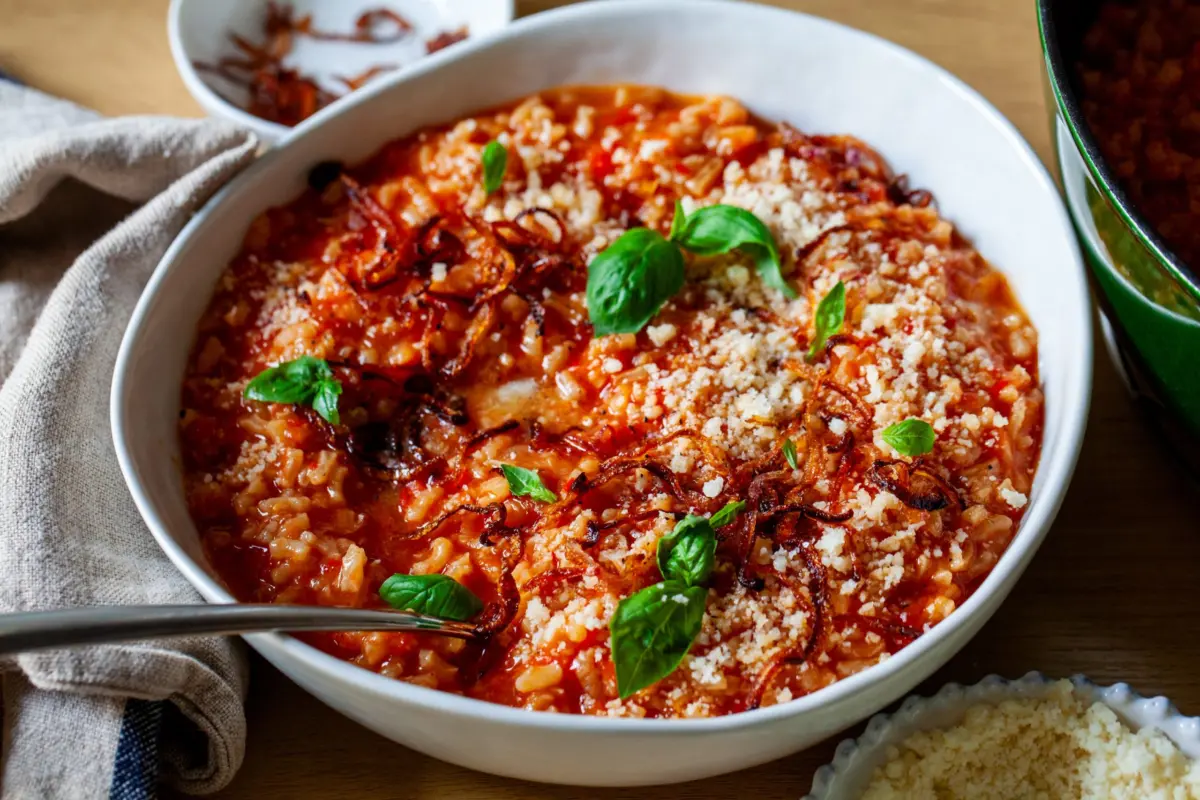
To elevate the dish without falling back on predictable garnishes like pan-crisped prosciutto, salami, or bacon, cooks can turn to an unexpected textural element: thinly sliced red onions, "frizzled" early in the cooking process. By cooking the onions in olive oil until they soften and transform into deeply golden, mostly crisp pieces, they develop a profound depth and fragrance. Half of these crispy onions can be folded directly into the baked risotto, while the remainder are reserved to be sprinkled on top just before serving. This technique introduces a gentle balance of rich and savory notes that complements the late-summer flavor profile.

The final touches can be customized to personal preference or dietary needs. Finishing the dish with a knob of butter or a drizzle of olive oil, alongside torn basil leaves and freshly grated parmesan, rounds out the textures. Alternatively, the recipe can be kept entirely vegan by relying solely on olive oil, fresh basil, and the frizzled onions. Because the foundational flavors are so robust, nothing is missed, proving that sophisticated and comforting meals do not require complicated techniques or heavy, out-of-season ingredients.
Tomato Risotto with Frizzled Red Onions
To prepare the dish, the oven should be preheated to 350 degrees Fahrenheit. The process begins by preparing the tomatoes: halved tomatoes are pressed cut-side against the large holes of a box grater, extracting the flesh and juices while reserving the outer skins to be discarded, yielding roughly two and a half to three cups of tomato pulp.

In a four-quart Dutch oven or a deep, oven-safe saucepan with a lid, three to four tablespoons of olive oil are heated over medium-high heat. Red onion is added and cooked, stirring initially until softened, and then continued until the pieces become deeply golden brown and mostly crisp, taking about eight to ten minutes. Half of the onions are transferred to a paper towel-lined plate, seasoned with salt, and set aside.
Garlic is then added to the onions remaining in the pan and cooked, stirring, for one minute, seasoned with salt, freshly ground black pepper, and a pinch or two of red pepper flakes. Uncooked rice is added to gently toast in the onion and garlic mixture for three minutes. Wine is poured in and cooked, stirring, until it evaporates. The grated tomato pulp follows, alongside two cups of water. The mixture is well-seasoned—typically starting with two teaspoons of kosher salt, adjusted to taste, along with generous grinds of black pepper—brought to a simmer, and then removed from the heat source.

The pot is covered with a tight-fitting lid and transferred to the oven to bake for 25 to 30 minutes, or until most of the liquid is absorbed while retaining a slightly watery appearance. Checking the pot halfway through ensures the liquid is not depleted too quickly; if it appears dry, an additional half-cup of water can be added.
To finish, the pan is removed from the oven and placed on a counter trivet or cooling rack. After removing the lid, the mixture is stirred for two minutes until it achieves a creamy, traditional risotto-like consistency. Seasonings are adjusted with additional salt and pepper as needed. Two to three tablespoons of butter or olive oil are stirred in to enrich the texture. Finally, the dish is garnished with the reserved frizzled onions, parmesan cheese, and torn basil leaves before serving.