
The quiet coastal community of Bowen Island has once again become the focal point of a grueling, decades-long search for answers. This week, the Integrated Homicide Investigation Team quietly returned to the island, reigniting a search that has haunted British Columbia for nearly twenty years. The disappearance of 17-year-old Jodi Henrickson remains one of the province’s most enduring and painful unsolved mysteries, a cold case that continues to cast a long shadow over her family, her friends, and the communities she touched. For the Henrickson family, every mobilization of police resources, every search dog deployed, and every forensic team sent to the island represents a fragile sliver of hope—and a painful reminder of the summer night in June 2009 when the teenager vanished without a trace.
Jodi Henrickson was a bright teenager from Squamish, a scenic town nestled along the Sea-to-Sky Highway. In June 2009, she traveled to Bowen Island, a short ferry ride from West Vancouver, to attend a weekend house party with friends. It was a typical gathering of young people, but for Jodi, it would be the last place she was ever seen alive. Following the party, she disappeared, leaving behind no clues, no digital footprint, and no indication of her whereabouts. What began as a desperate missing persons search quickly escalated into a complex homicide investigation. Despite extensive searches of the island’s dense forests, rugged coastlines, and residential properties over the years, no sign of the teenager was ever found, and the case eventually grew cold.

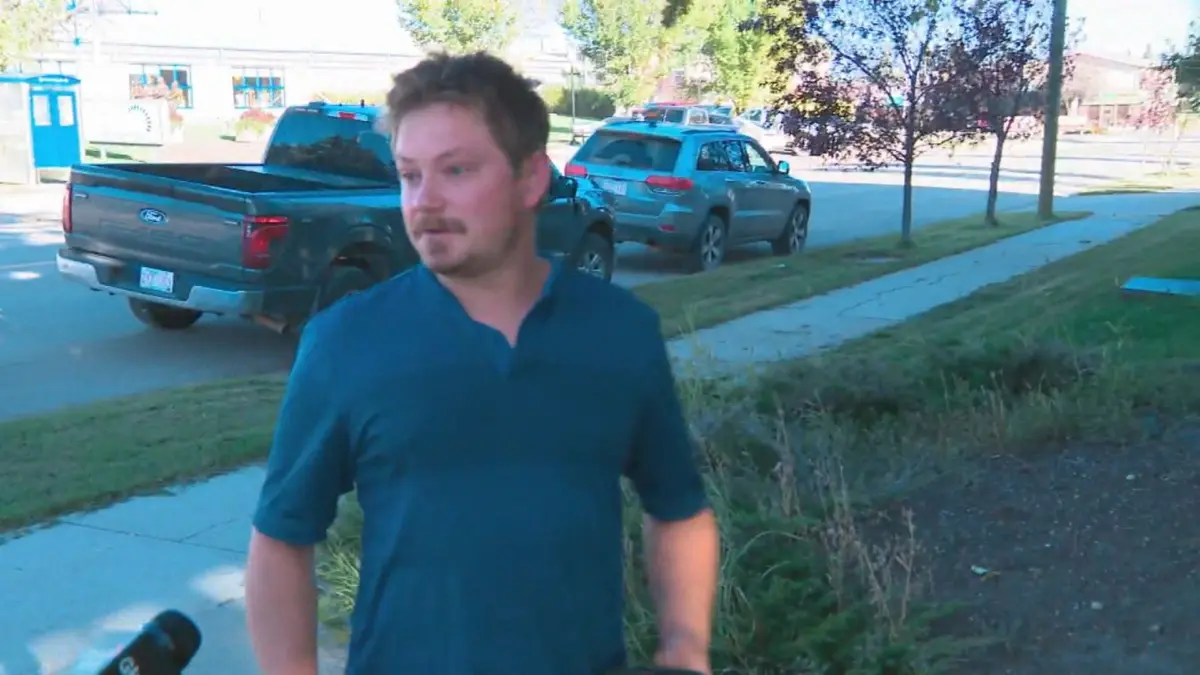
The silence surrounding the case was broken this week when members of the Integrated Homicide Investigation Team’s cold case unit descended on Bowen Island to conduct a targeted search. As investigators combed through the terrain, another key figure in the case was located hundreds of kilometers away in Alberta. Gavin Arnott, Henrickson’s ex-boyfriend, was approached by reporters outside an Alberta courtroom where he was appearing on an unrelated legal matter. When questioned about the renewed police activity near his family’s property on Bowen Island, Arnott appeared entirely dismissive of the ongoing efforts to locate his former girlfriend.
Arnott, who has lived under the cloud of the investigation for nearly two decades, downplayed the significance of the police’s return to the island. He expressed complete confidence that the search would yield no evidence linking him to Henrickson’s disappearance. He suggested that the passage of time was proof enough that nothing would be uncovered, pointing to the lack of results over the last twenty years as evidence of his innocence.
"They’re not going to find anything just because they haven’t for the last 20 years," Arnott told reporters. He maintained that there was no physical or circumstantial evidence connecting him to the crime, asserting that the renewed police presence did not concern him. "There’s nothing to implicate me, the circumstances surrounding my involvement. I know that there’s nothing that’s going to tie me to it, so it’s not really anything to bother me."

Arnott’s comments stand in stark contrast to the gravity of the police investigation and the enduring grief of the Henrickson family. To understand why authorities continue to focus on Arnott, one must look back to the volatile dynamics of his relationship with Jodi in the spring of 2009. Arnott, who was 19 years old at the time of Jodi’s disappearance, had a documented history of violence toward the 17-year-old. Just two weeks before the fateful house party on Bowen Island, Arnott had been convicted of assaulting Henrickson.
The legal system’s response to the assault resulted in a conditional discharge for the 19-year-old, accompanied by a strict probation order. Under the terms of his probation, Arnott was legally prohibited from having any contact with Henrickson. Despite this judicial mandate, both individuals were present on Bowen Island during the weekend she went missing. The proximity of an individual with a prior conviction for assaulting the victim, violating a court-ordered ban on contact just weeks after it was issued, immediately placed Arnott at the center of the police’s investigative efforts. Early in the case, homicide detectives formally identified him as a "person of interest," a designation that has remained attached to him ever since.
Despite the challenges of a case that has spanned nearly twenty years, the Integrated Homicide Investigation Team has refused to let Jodi Henrickson’s file fade into obscurity. The recent mobilization of detectives on Bowen Island is a testament to the persistence of the unit’s cold case team, which is tasked with reviewing unresolved homicides and pursuing new leads as they arise. When asked about the specific motivations behind the latest search and whether any breakthroughs had occurred, IHIT officials provided a measured but firm response.

Sgt. Freda Fong, speaking on behalf of the Integrated Homicide Investigation Team, confirmed that the latest physical search of the island had concluded without the discovery they had hoped for. She stated that investigators did not locate Jodi Henrickson’s remains during their latest operation. However, Sgt. Fong emphasized that the lack of immediate results does not mean the investigation is slowing down. She affirmed that a dedicated team of investigators on IHIT’s cold case team remains deeply committed to exhausting every single lead in their pursuit of the truth.
Furthermore, Sgt. Fong made it clear that the passage of time has not altered the direction of the police’s suspicions. She confirmed that the person of interest identified early in the investigation remains unchanged, reinforcing that the focus of the homicide team continues to center on the same individuals and circumstances that defined the case in 2009.
This week’s search was not the first time in recent years that Bowen Island has seen a sudden influx of homicide detectives. In November 2024, the island became the focus of intense police activity following an unexpected development involving an independent documentary film crew. The crew, which was working on a project related to Henrickson’s disappearance, had brought specialized cadaver dogs to the island to assist in their research. During their exploration of a specific area, the dogs alerted their handlers to a potential site, indicating the possible presence of human remains.

Recognizing the potential significance of the dogs’ reaction, the film crew immediately contacted authorities. Homicide detectives quickly took control of the scene, launching a thorough search of the area where the dogs had alerted. At the time, police remained tight-lipped, releasing no details regarding what, if anything, was uncovered during the November 2024 operation. This previous search, however, served to reactivate public interest in the case and demonstrated that even decades later, new information and unconventional sources can still drive the physical search for Jodi.
For the Henrickson family, the cyclical nature of the investigation—long periods of silence punctuated by sudden bursts of police activity—is an emotionally exhausting ordeal. Yet, each new search also represents a vital opportunity to find the answers that have eluded them for so long. Rob Henrickson, Jodi’s brother, spoke candidly about the profound impact the ongoing mystery has had on his family. For them, the concept of justice has evolved beyond simple legal retribution; it has become a fundamental quest for the truth.
Rob explained that justice for his family is centered on understanding exactly what happened to Jodi on the night she vanished. The lack of closure remains a heavy, daily burden, leaving the family suspended in a state of perpetual grief. He noted that right now, they have absolutely no idea what transpired that night, making it impossible to find peace. The latest round of police activity on the island has once again stirred those deep emotions, offering a tiny, fragile glimmer of hope that the silence might finally be broken.

Rob issued a direct, heartfelt appeal to anyone who might hold the key to resolving the mystery, urging them to put an end to the family’s decades-long nightmare. He pleaded for anyone with information, no matter how small or seemingly insignificant, to finally step forward and let them know what happened to Jodi.
Unsolved disappearances like Jodi Henrickson’s cast a long shadow over small communities. Bowen Island, known for its tranquil landscapes and close-knit population, has lived with the dark cloud of this mystery for nearly two decades. The recurring presence of IHIT investigators serves as a physical reminder of a tragedy that remains unresolved in their backyard. For cold case investigators, the challenges of a nearly twenty-year-old case are monumental. Physical evidence degrades over time, landscapes shift, and memories fade. However, as demonstrated by IHIT’s return to the island, cold case units operate on the premise that no case is truly closed until answers are found.
As the latest search concludes without the recovery of Jodi Henrickson’s remains, the case returns to a state of quiet determination. The Integrated Homicide Investigation Team continues to review the evidence, analyze the results of their recent efforts, and prepare for the next lead. For the Henrickson family, the wait continues. The small spark of hope ignited by this week’s search remains, burning quietly alongside their decades-long grief. They remain steadfast in their belief that someone, somewhere, holds the key to unlocking the truth of what happened to a 17-year-old girl who went to a party in June 2009 and never came home. Until that truth is revealed, the mystery of Bowen Island remains open, and the search for Jodi Henrickson goes on.