
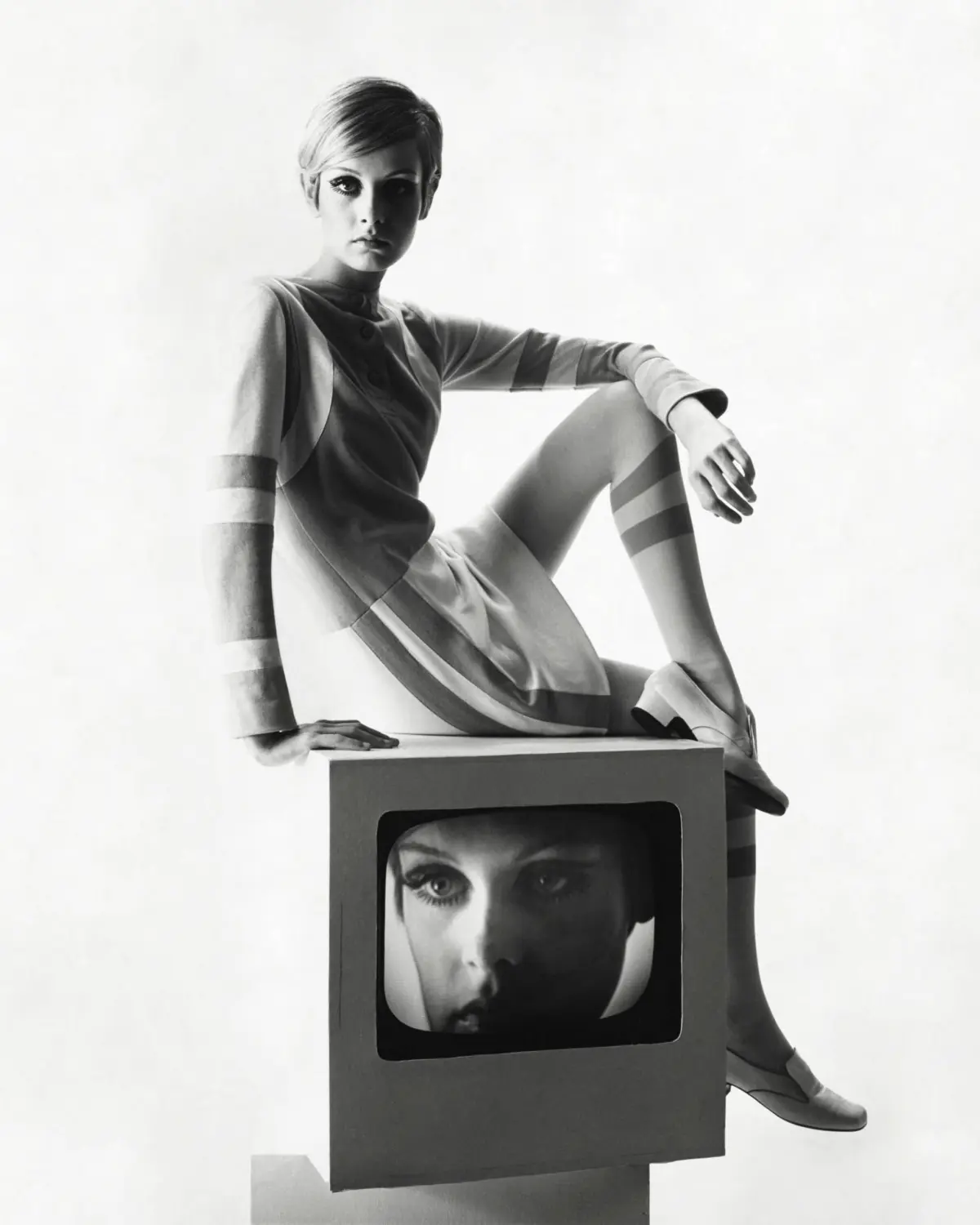
Sitting near the back of a quiet Italian restaurant in Chelsea on a beautiful late-summer day, Lesley Hornby—better known to the world simply as Twiggy—reflects on a life that changed forever when she was just a teenager. Outside on the sunlit terrace, diners enjoy their lunch, blissfully unaware that one of the most transformative figures in fashion history is casually recounting the whirlwind events of her youth. At 77 years old, Twiggy is in the middle of a remarkably busy week. Just the night before, she hosted a glittering screening party at Sloane’s in SoHo for a brand-new documentary chronicling her extraordinary life. A-list guests, including Fran Drescher, Ellen von Unwerth, Iris Law, and Donna Karan, gathered to pay tribute to her enduring legacy. In a matter of days, she would be boarding a flight to Los Angeles to host yet another screening, proving that her global appeal has not faded over the decades.
Before embarking on this recent promotional tour, Twiggy hadn’t visited New York City since before the COVID-19 pandemic. The contrast between her arrival today and her very first trip across the Atlantic is striking. When she first touched down in New York as a 17-year-old in the late 1960s, she was immediately mobbed by enthusiastic crowds of fans.
“I landed and they were teenage girls with banners up with my name,” she remembers, recalling the surreal intensity of her sudden rise to prominence. “I came in after the Beatles, so I became part of the British Invasion… I was one of the invaders.”
Long before she became the biggest model in the world, Twiggy was born Lesley Hornby and brought up in suburban London. She was a typical teenager of her era, beginning to sneak off to mod clubs at the age of 13. Her social life, however, was tightly regulated by the standards of the time.
“I was a school girl, so I was only allowed out on a Saturday night. I had a strict curfew. I had to be home by 10:00,” she says. “We’d go to a club in another suburb of London. The thing about mods is you wore the same things. It was a uniform.”
Twiggy and her friends would emulate the older girls, adopting an established look that consisted of a gray pleated skirt falling just below the knee, classic Hush Puppies shoes, and a navy blue nylon raincoat. During the week, she worked as a Saturday girl at a local hairdresser, carefully saving up her modest tips so she could shop at the storied London boutique Biba, which was then the epicenter of youth culture.
“It was like our church, going to Biba,” Twiggy says with fondness. “Every fourth week, we’d run down to Biba during our lunch hour. You could get a dress for two pounds and it was brilliant.”
It is a striking irony that Twiggy spent her spare time working in a hair salon, because it was ultimately at the hands of a hairstylist that her entire destiny shifted. In 1966, Leonard Lewis, widely known as Leonard of Mayfair, gave Twiggy the iconic, boyish crop that would define a generation of style.

“I didn’t want my hair cut,” she confesses, looking back at the fateful appointment. “I was sitting in this posh salon in Mayfair and I was too shy to say no. Thank God, because if I hadn’t had my hair cut, none of this would have happened.”
Renowned photographer Barry Lategan captured the radical new look, and the resulting portrait was hung prominently in the salon. There, it caught the discerning eye of Deirdre McSharry, a fashion journalist at the Daily Express. The publication quickly heralded Twiggy as “The Face of ’66,” setting off a chain reaction that launched her into the stratosphere of international modeling—though those very first snapshots remain among the most famous and enduring images of her career.
The new documentary exploring this remarkable journey, simply titled Twiggy, came together through an unexpected encounter with director Sadie Frost. Frost, who returned to formal education in 2019 to earn her master’s degree in film production, was busy promoting her own directorial debut—a critically acclaimed documentary about the pioneering fashion designer Mary Quant. During that press circuit, Twiggy invited Frost to appear as a guest on her podcast, Tea With Twiggy. Toward the end of the recording, Twiggy asked Frost what she planned to work on next.
“At that moment, I realized I didn’t have a job,” Frost says. “I’d been working for three years on Quant and I hadn’t thought about the future because I was so consumed with that. And it just spurted out: ‘Oh, I don’t know. Let me do a documentary about you.’”
Twiggy admits she was initially hesitant about the proposition. Over the years, she had been approached numerous times by various filmmakers and producers, but she had always backed away for different reasons.
“It’s a big commitment to agree to have somebody put your life on the big screen,” she notes.
However, she did not immediately turn Frost down. Instead, she suggested that they continue the conversation off the air. Prior to speaking on the podcast, the two women had occasionally crossed paths in similar social circles in London, but they had never properly gotten to know one another. They decided to go out to lunch the following week to see if a professional collaboration made sense.
“We got on really well,” Twiggy recalls of the meeting. “I liked the fact that [Frost] was a woman. She’s been a model, an actress, a designer. She’s been in the public eye since she was about 15.”
Because Frost had navigated a remarkably similar path through the entertainment and fashion industries, Twiggy felt an immediate sense of trust. “I thought, she’ll understand where I’m coming from and what I’ve lived through.”

“By the end of lunch, she said yes,” Frost adds.
The ambitious project took three years to complete from conception to final cut. The documentary features extensive interviews with prominent figures from across the entertainment, fashion, and cultural industries, including Sienna Miller, Stella McCartney, Brooke Shields, Edward Enninful, and Sir Paul McCartney. Frost carefully curated her interview subjects based on the core themes she intended to explore in the film and who could offer the most insightful perspectives on them.
“I knew Sienna Miller—being young, blonde, a model, an actress—could really relate to Twiggy,” Frost reflects. Meanwhile, aside from being a personal friend of Twiggy’s, Sir Paul McCartney offered a shared perspective rooted in a similar working-class British background.
The film also makes extensive use of archival footage capturing teenage Twiggy during the height of the 1960s cultural explosion, a research process that Frost describes as one of the most rewarding aspects of making the movie.
“There’s this authenticity and naivety and innocence,” Frost says, analyzing the enduring appeal of the footage. “You really had these very upper-class, middle-class models who were very put together. And then Twiggy came along and just blew that out of the water.”
Among the archival clips included in the documentary is one that has recently been making the rounds on social media. In the vintage interview, Twiggy is subjected to a condescending line of questioning by Woody Allen, who bluntly asks her to name her favorite philosophers. Visibly uncomfortable with the patronizing tone, Twiggy deftly turns the question back around on him, leaving the filmmaker with no ready answer.
While pop-culture history forever links Twiggy to the swinging sixties, some viewers of the documentary may be surprised to discover just how brief her modeling career actually was. Twiggy retired from full-time modeling in 1970 after a run that lasted a mere five years, quickly pivoting to acting, singing, and other creative pursuits. When asked how she balanced the monumental fame of her modeling years with everything that came afterward, Frost explains that her editorial vision was shaped by a desire to show the full breadth of Twiggy’s life.
“You are remembered for the moment you became famous a lot of the time, then you might have a career for 40 years after,” Frost says. “But then she went on to win Golden Globes. She went on to do albums, she had a TV show.”
Frost’s mission as a director was to ensure contemporary audiences are made fully aware of all the diverse accomplishments Twiggy achieved long after her initial splash in the fashion world.

Reflecting on her unlikely ascent, Twiggy draws a parallel to one of her most famous theatrical roles. “There’s a bit of Eliza Doolittle in me,” she admits.
It is a fitting comparison; Twiggy memorably played the iconic character in a 1981 television adaptation of George Bernard Shaw’s classic play Pygmalion.
“I came from the wrong class. I would never have gone to a modeling agency and they wouldn’t have taken me because I was too small, too thin,” she says, highlighting how radically she broke the established molds of the era. “What happened to me shouldn’t have happened.”
When asked what advice she would offer to that teenage version of herself—the young girl from suburban London who was utterly unaware of the global phenomenon she was about to become—Twiggy’s response is direct and unhesitating.
“Be brave and go for it,” she replies. “लेकिन I think I did.”
Twiggy is available on DVD and VOD from September 22.