
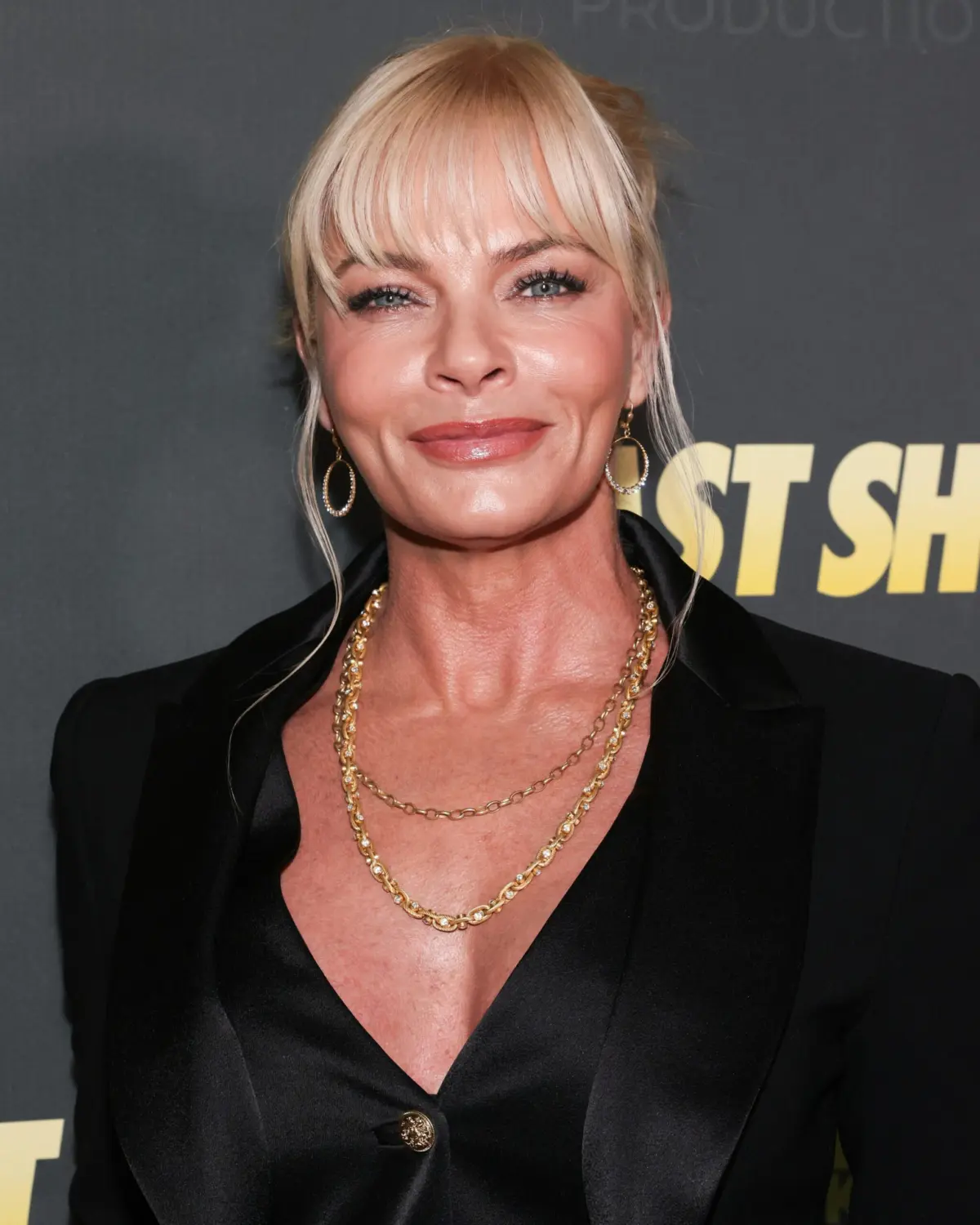
Throughout her celebrated television and film career, Jaime Pressly has become a familiar and comforting presence playing mothers of various stripes. From the chaotic, free-spirited Joy Turner on My Name Is Earl to the complicated and evolving foster parent Jill Kendall on Mom, and a witty single mother navigating life in Jennifer Falls, Pressly has long explored the multifaceted landscape of parenting on screen. However, her latest role in the upcoming indie drama The Last Shot presents an entirely different kind of character—one that challenged her perspective from the moment she first turned the pages of the script.
The Last Shot, which arrives in limited theaters starting October 2, centers on Caden Isaacs, a promising 12-year-old basketball player whose life is upended when his problematic yet deeply doting father unexpectedly passes away. Following the tragedy, Caden moves to Nashville to live with his estranged mother, Lexi. Played by Pressly, Lexi is a driven music executive who successfully kept the family afloat financially for years while remaining almost entirely absent from her son’s day-to-day life.
For Pressly—a devoted mother to 19-year-old son Dezi and 8-year-old twins Leo and Lenon—the deep emotional disconnect between Lexi and her child was initially foreign territory. As a working mother who frequently balances demanding on-location film shoots with the daily realities of raising three boys, Pressly found herself having to dig deep to understand a parent who could remain so detached. Yet, beneath the character’s icy exterior, she discovered a shared baseline: the relentless, often impossible mathematical balancing act of managing a career while trying to raise a family.
Speaking from a remote film set outside Alabama, far away from her own children and acutely feeling their absence, Pressly opened up about the complexities of working motherhood, why contemporary audiences need to see parents break down, and the richer, more grounded roles she is actively seeking out in mid-life.
Lexi is far removed from the warm, fuzzy cinematic mother archetype often portrayed in Hollywood. She is defined by her financial stewardship of the household, yet she is profoundly disconnected from her son’s emotional world. Reflecting on her approach to the character, Pressly admits that empathy—an emotion typically rooted in shared personal experience—was not immediately accessible. Instead, she had to search for sympathy.
"I had to find sympathy. Empathy is something you’ve been through, so you understand the feeling. I didn’t understand the feeling whatsoever. I have three boys, and I could not imagine not raising them or being a part of their lives," Pressly explains.
To bridge that gap, Pressly examined Lexi’s own troubled upbringing. Lexi grew up with an unsupportive, work-obsessed father and a perpetually absent mother, depriving her of the foundational warmth and unconditional love Pressly provides her own sons in real life. Understanding that generational cycle of emotional unavailability allowed the actress to humanize a character who might otherwise have appeared irredeemable.
The true point of convergence between actress and character, however, lay in the universal struggle of the working mother. Pressly relates deeply to the agonizing tug-of-war between professional ambition and parental presence. Being on location in Alabama while missing her boys serves as a constant reminder of how difficult it is to manage a demanding career while striving to be physically and emotionally present for three growing children.
This nuanced exploration of motherhood extends into the film’s rawest emotional confrontations. In one particularly poignant scene, Lexi snaps and delivers a cutting remark to Caden—a moment that resonates with painful familiarity for anyone who has ever parented under pressure. When asked how she navigates the aftermath of such a breakdown, Pressly emphasizes the importance of transparency and humility over artificial perfection.
According to Pressly, repairing the bond after losing one’s temper requires stepping back, taking a breather, calming down, and returning to sit with the child. It involves acknowledging human fallibility and explaining that anger sometimes causes people to utter things they do not truly mean.
"I didn’t mean it. You’re my entire world, and sometimes I snap because I’m tired and frustrated," Pressly says, modeling the kind of dialogue she advocates for in parenting. She believes that parents often make the mistake of attempting to shield their children entirely from imperfection, trauma, or bad days. However, she argues that this protective instinct is ultimately unrealistic, as children will inevitably grow up to face their own hardships, fatigue, and emotional missteps.
When children witness their parents experiencing emotions authentically—breaking down, making mistakes, and then repairing the rupture through honest conversation—they learn that the human condition encompasses a wide spectrum of feelings. Pressly stresses that the key lies not merely in uttering a superficial apology to move past a conflict, but in helping children understand the underlying reasons for the mistake. Seeing a parent cry, struggle, and talk through it normalizes emotional turbulence and prepares children to handle their own future challenges.
This refusal to sanitize the human experience bleeds into the very fabric of The Last Shot. While the film features a happy resolution, it purposefully avoids a neat, perfectly tied-up conclusion. Pressly champions this narrative choice, pointing out that tidy endings belong exclusively to fiction, whereas real life is an ongoing, continuous journey filled with peaks and valleys. By portraying a mother and son who are still actively working on their relationship without reaching instant perfection, the film honors the ongoing, imperfect nature of human growth.
As Pressly reflects on her career at age 49, she views characters like Lexi as proof that acting opportunities generally improve with age and accumulated life experience. Because she has lived through more of life’s complexities, she finds herself drawn to material with deeper emotional weight and richer narrative substance. She points to acclaimed peers like Allison Janney—whom she affectionately calls the "GOAT" of acting—as an inspiration, recalling how their hit sitcom Mom successfully balanced serious, heavy subject matter with authentic humor derived from real-life drama.
Having spent a significant portion of her career mastering comedy, Pressly admits she is now actively craving dramatic material. While she acknowledges that comedy remains notoriously difficult to execute, her desire has shifted toward exploring multidimensional female characters of a certain age rather than recycling familiar tropes.
"I’m 49 now. I don’t want to play Hot Mom. I don’t want to play Arm Candy. I don’t want to do any of that. So it was a breath of fresh air the second I read the script, and I could not wait to get on set," Pressly says.
The transition to this project came together swiftly after director Andy Palmer reached out with the script, featuring a hospital scene that immediately hooked the actress. Having previously collaborated with Palmer, Todd Friedman, and Warner Davis on The Re-Education of Molly Singer, Pressly jumped at the chance to reunite with the creative team on a project that offered a departure from her comedic roots.
Looking back at her expansive filmography, Pressly remains open to revisiting past hits under the right circumstances. As the cult classic comedy Joe Dirt approaches its 25th anniversary alongside plans for an animated series reboot, the actress confirms she would happily return to the franchise if given the call. True to her practical nature, she notes the distinct advantage of voiceover work: the ability to record comfortably in pajamas without the need for extensive hair and makeup.